Logo 3’s Are Entertaining But They Don’t Make You An MVP Candidate

There is no denying that Caitlin Clark is one of the most entertaining players in basketball. The logo threes are spectacular. Her passing can be breathtaking. She can take over a game offensively, and when she gets hot from 30 feet, there aren’t many players in the world who create that kind of electricity.

She deserves credit for all of that.

But MVP isn’t the Most Entertaining Player award.

And once we move beyond highlights, logo threes, social-media clips and television ratings and examine the entire body of work, I don’t believe Clark has a stronger MVP case than A’ja Wilson, Olivia Miles, Kelsey Mitchell or Paige Bueckers.

First, let’s correct one talking point. Clark does not have the most 30-point games in the WNBA this season. A’ja Wilson does. Wilson already had 11 such games as of August 21, while Clark has added another explosive 37-point performance since then. 

What Clark does have is an extraordinary collection of scoring-and-passing accomplishments. Her latest 37-point, 10-assist performance gave her a WNBA-record fifth career game with at least 30 points and 10 assists. That’s incredible and should be celebrated.

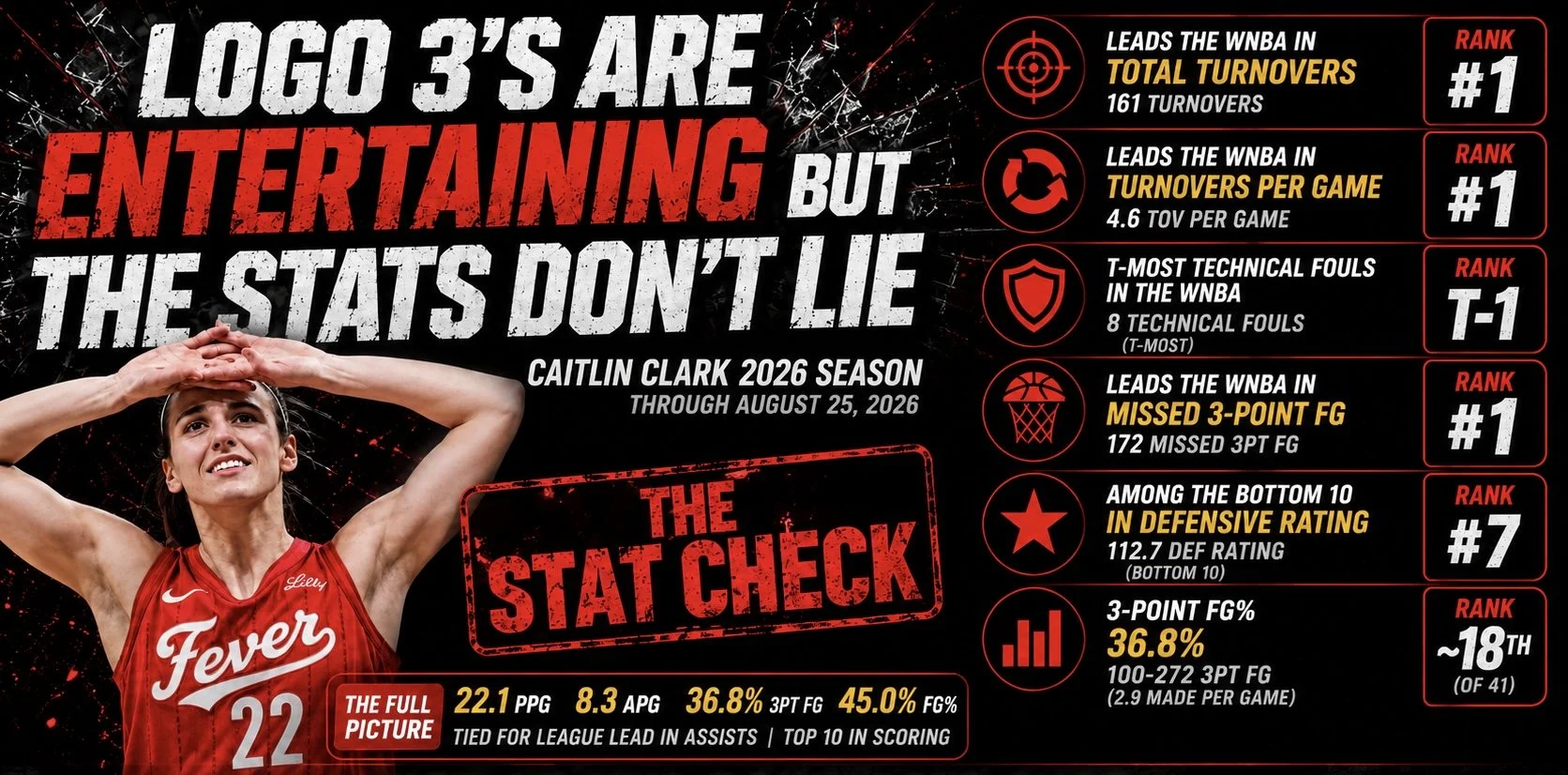
But again: look at the full picture.

Clark is averaging 22.1 points and a league-leading 8.3 assists, which are absolutely elite numbers. She’s third in the league in scoring average. But she also leads the entire WNBA with 161 turnovers. The next-highest player has 126. That’s a 35-turnover gap between Clark and second place.

Then compare her overall impact with the other candidates.

A’ja Wilson is in another universe statistically. She’s leading the WNBA at 26.0 points per game, while ranking among the league’s best rebounders and shot blockers. She also leads the league in Win Shares. CBS noted that Wilson was averaging roughly 26 points, 9.5 rebounds and two blocks while shooting better than 50% from the field and 40% from three. That’s MVP production on both ends of the floor, not simply offensive fireworks.

Kelsey Mitchell has a fascinating argument because she’s doing it on Clark’s own team. Mitchell is averaging 24.8 points, compared with Clark’s 22.1, and leads the entire WNBA with 967 total points. She’s also second in the league in Win Shares, while Clark ranks 19th. Mitchell recently extended her remarkable streak to 23 consecutive 20-point games

Then there’s Olivia Miles, who is doing something remarkable as a rookie. She’s averaging approximately 20 points and 6.2 assists, shooting over 40% from three, and playing a major role for a Minnesota team with the league’s best record. Her efficiency and team success have put her squarely into the MVP conversation. 

And Paige Bueckers is averaging 20.6 points per game while sitting sixth in the league in total scoring. Her team’s record hurts her MVP argument considerably, but if we’re discussing the league’s elite individual performers, her name belongs in the conversation. 

That’s why my argument isn’t that Caitlin Clark isn’t great.

She is.

It isn’t that the logo threes aren’t entertaining.

They absolutely are.

It isn’t even that Clark doesn’t have an MVP-caliber offensive skill set.

She clearly does.

My argument is that an MVP evaluation has to account for efficiency, turnovers, defense, consistency, winning and overall impact — not simply the moments that generate the loudest reaction on social media.

Ironically, the current MVP odds actually have Clark third, behind Wilson and Miles and ahead of Mitchell and Bueckers. So people can reasonably disagree with my ranking. 

But if I’m casting an MVP ballot based on the full picture, I’m putting A’ja Wilson, Olivia Miles, Kelsey Mitchell and Paige Bueckers ahead of Caitlin Clark. 

Because logo threes may win the highlight reel.

But the stats don’t lie.


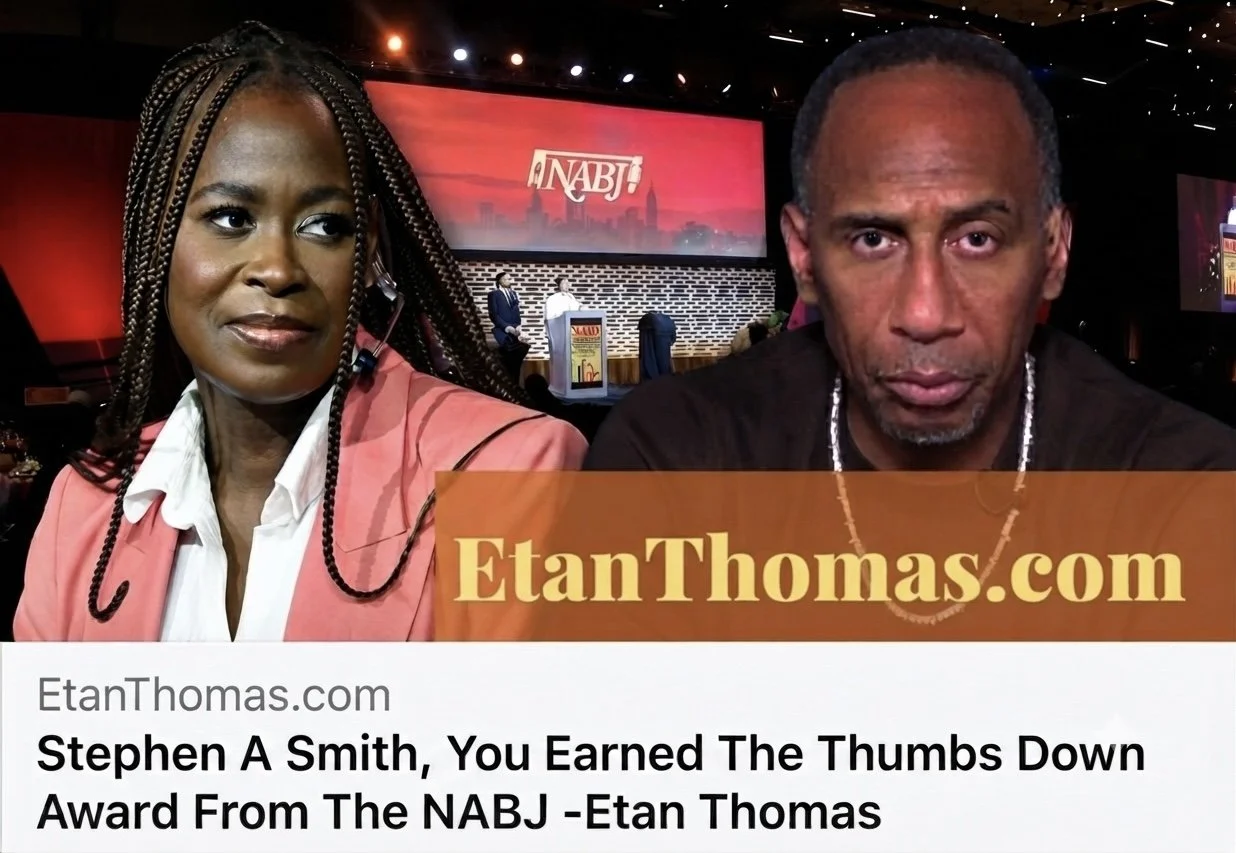
Stephen A. Smith: You Earned The Thumbs Down Award From The NABJ

Dear Stephen A. Smith, 

After receiving the National Association of Black Journalists’ Thumbs Down Award, you responded by defending your record.

You tweeted:

> “The work speaks for itself. I will continue opening doors, creating opportunities, and making space for Black journalists and beyond.”

You also laid out your history with NABJ and talked about the work you have done throughout your career. You spoke about your sisters and your mother and the tremendous love, respect and admiration you have for them. 

And Stephen A., all of that is well and good.

But none of it actually addresses why you received the award.

NABJ describes its Thumbs Down Award as recognition given for “especially insensitive, racist or stereotypical reporting [or] commentary” about the Black community, or conduct contrary to the organization’s goals. The criticism surrounding your award specifically centered on what NABJ described as a recurring pattern of disparaging commentary toward prominent Black Women in politics, sports and media. 

So listing the Black People you’ve helped doesn’t answer the criticism.

Listing your history with NABJ doesn’t answer it.

Talking about how much you love your mother and sisters doesn’t answer it.

Because nobody said you don’t love Black Women. 

Nobody said you’ve never helped Black journalists.

Nobody said you haven’t opened doors.

Those again are straw man’s arguments. This has become a pattern with you I see as you utilized this same tactic when you responded to my article back in May where I explained why Many Black People didn’t like you. Which I addressed on my podcast The Rematch 

https://youtu.be/dD6QHflY-E4

The topic at hand is what you have repeatedly done with the enormous platform you possess.

The Bible repeatedly teaches that correction should not automatically be treated as an attack. Proverbs warns that rejecting discipline and correction leads toward foolishness, shame and destruction, while listening to correction leads toward wisdom and understanding.

And Stephen A., you are falling into that category right before everyone’s eyes.

Because rather than seriously examining whether there could be something to what so many Black journalists, athletes, commentators and viewers are telling you, your instinct is to take offense and defend your resume instead of examining the actual critique. 

And then you went to Sean Hannity.

That part was especially telling.

Why, after receiving criticism from the National Association of Black Journalists, would validation from Hannity’s audience be the place you turn? You have publicly described Hannity as a longtime friend, and your relationship with him goes back many years. But friendship doesn’t erase the larger question: why seek affirmation in a media environment that has so often been hostile toward the very Black Voices  raising concerns about you?

Bishop Talbert Swan put together an extensive list of receipts and the cumulative pattern deserves an answer rather than a dismissal.

https://www.instagram.com/p/DcL4O7dOjTN/?igsi=MWVmdjlxeG8zZXZndw==

The examples raised include your public scolding of CongressWoman Jasmine Crockett. Stephen A, Donald Trump is the most disrespectful President this country has ever seen. The most disrespectful politician this country has ever seen. In a society that has always disrespected Black Women, for you to have the audacity to tell a disrespected Black Woman (who is a U.S. Congresswoman) that she needs to adopt a more professional approach, focus on negotiating to get results for her constituents, tone down her aggressive rhetoric and be more respectful in the face of the most disrespectful person on earth, would've sufficed as the sole example of you winning this award, but there are so many more. 

They include your clashes with Monica McNutt over WNBA coverage, your attacks on Sheryl Swoopes while vigorously defending Caitlin Clark, your criticism of Angel Reese, and your public disputes with Black Women across sports, politics and media.

Then there are the broader criticisms: your defense of Jerry Jones after the resurfacing of the 1957 Little Rock integration photo; your arguments that racism isn’t as prevalent as some claim; your repeated suggestion that Black voters should seriously consider Republicans; your criticism of Kamala Harris; and your repeated appearances alongside Hannity.

Some of those are political disagreements. You have every right to them.

But you can’t simply wave away the entire criticism as politics.

Your disparagement of Black Athketes isn’t political.

Threatening or talking down to athletes because they challenged something you said isn’t political.

The radically different energy you often display depending upon who is sitting on the receiving end of your criticism isn’t merely political.

That’s racial.

That’s cultural.

That’s about power.

And that’s precisely why people are talking about a pattern rather than one isolated opinion.

You have publicly attacked, not critiqued which is your actual job, but publicly disparaged and demeaned Kwame Brown, Terrell Owens, Stephon Marbury, Kevin Durant, Kyrie Irving and Jaylen Brown, among others, with a level of aggression that has become part of your television persona.

But when Donald Trump publicly disrespected you, something interesting happened.

Trump called you:

● “an arrogant fool”

● “a low IQ individual”

● “dumb as a rock”

● “totally unqualified” to run for political office

● “a loudmouth huckster”

Those aren’t paraphrases. Trump actually used those words publicly. 

And suddenly the temperature seemed different.

You told CNN you weren’t offended and explained that attacking the intelligence of people who challenge him is Trump’s “default position.”  You later said publicly that Trump had every right to fire back at you. 

And that’s where people notice the contrast.

Where was the Stephen A. who has consistently eviscerated Black Athletes on national television?

Where was that same venom?

That same indignation?

That same theatrical fury?

That same willingness to question somebody’s character, intelligence, professionalism or worth?

Because we’ve certainly seen that Stephen A. before.

Jemele Hill has made a broader version of this point about the noticeable difference in how you discuss Black women such as Jasmine Crockett, Kamala Harris and Michelle Obama compared with the grace you sometimes extend elsewhere.

https://youtu.be/sY8eU3A2M-Y?is=Vt3BSEC-vdQKZO9Y 

And when you speak about certain Black women, there are moments when — whether you realize it or not — you begin sounding remarkably similar to the people whose shows you repeatedly visit at Fox.

And yes, Stephen A., I know you aren’t going to like this analogy.

But remember Samuel L. Jackson’s character Stephen in Django Unchained?

Remember the difference between the way he addressed the enslaved Black People on that plantation versus the way he addressed the white people who held power?

Remember the image of Stephen hugging and crying when Leonado Di Caprio’s character was dying ? Not insert your face for Stephen and Trump’s face for Di Caprio. 

That’s the uncomfortable analogy people are seeing every time you speak about Black Athletes with so much venom but have a much softer and respectful tone with athletes of a lighter hue. That’s the nauseating image that comes to mind every time you passionately and emotionally defend Trump. 

Let me be clear; I’m not saying you’re that character. I’m talking about the difference in posture — aggression toward people who look like you, followed by a noticeably different posture around people who don’t look like you. 

That’s what many people see.

And you can’t answer that by telling us how many HBCUs you’ve helped.

It isn’t about that.

You can financially support HBCUs and still deserve criticism.

You can mentor young Black Journalists and still deserve criticism.

You can create jobs for Black People and still deserve criticism.

You can adore your mother and sisters and daughter (who is a star by the way) and still deserve criticism for the way you publicly discuss other Black Women. 

Two things can be true simultaneously.

Nobody has to erase the good you’ve done to examine the harm people believe you’ve caused.

In fact, the more powerful your platform becomes, the more important that examination becomes.

You have spent decades telling athletes that accountability comes with the territory. You’ve told coaches that. You’ve told executives that. You’ve told politicians that.

Well, Stephen A., it comes with your territory too.

When Monica McNutt challenged your WNBA coverage, that was an opportunity for reflection.

When Sheryl Swoopes pushed back against narratives surrounding Caitlin Clark, disagreement didn’t require public ridicule.

When Black Journalists criticized your treatment of CongressWoman Jasmine Crockett, that didn’t automatically make them political operatives.

When Black Viewers notice that the volume seems to go up when you’re chastising Black People — particularly Black Women — but somehow gets adjusted depending upon who’s sitting across from you, dismissing everybody as haters doesn’t make the observation disappear.

And when the National Association of Black Journalists gives one of the most successful Black broadcasters in American history its Thumbs Down Award, maybe the first response shouldn’t be:

Look at everything I’ve accomplished.

Maybe it should be:

Why are they saying this about me?

Because you’re absolutely right about one thing, Stephen A.

The work does speak for itself.

But so do the receipts.

So does the criticism.

So does the pattern.

And so do the people you’ve publicly attacked.

And let’s be honest Stephen A, there are a lot of reasons the NABJ could’ve named you as one of their recipients of the Thumbs Down Award. 

They could’ve cited the numerous times you vehemently defended Donald Trump who has proven himself time and time again to be exactly what Jemele Hill called him in 2017 on then twitter which is a white supremacist. 

They could’ve cited the way you defended Charlie Kirk and praised the Yankees for honoring him. The same Charlie Kirk who in 2023 said that Michelle Obama, Joy Reid, Rep. Sheila Jackson Lee, and Justice Ketanji Brown Jackson, “You do not have the brain processing power to otherwise be taken really seriously” and that they had to, “steal a white person’s slot” to be taken seriously. If we listed all of the times Charlie Kirk made hateful, racist remarks about Black People, we would be here all day. 

They could’ve pointed to your decision to give your massive platform to people pushing inflammatory narratives about Nolan Wells and his family—including allowing the accusation that Nolan’s own parents ‘don’t care about him drowning’ to be said on your show. Think about the weight of that statement, Stephen A. These are parents who buried their 18-year-old son and have publicly fought for answers about what happened to him. You yourself previously said your heart went out to Nolan’s family and that ‘we need to find out what happened to that young man.’ Yet you then provided a national platform where Nolan’s grieving parents could have their motives and their love for their own son questioned in such an ugly and personal way. There is a difference between allowing opposing viewpoints and allowing grieving parents to be personally disparaged while they are still searching for answers about their child.”

They could’ve pointed to your willingness to share your platform with people like Steve Bannon in 2025. The same Steve Bannon who  formerly ran Breitbart, which he famously described as a “platform for the alt-right.” Even Ben Shapiro, who worked at Breitbart, acknowledged that the alt-right included actual white supremacists and white nationalists and criticized Breitbart’s later promotion of that movement. 

Or you platforming known white supremacist Ben Shapiro for a lengthy face-to-face interview in March 2025, including a debate about George Floyd and Derek Chauvin.  Shapiro has a long history of white supremacist commentary but here he is on your show, not challenged as if he is  on the hot seat, but welcomed as if you are an ally to them. 

They could’ve pointed to your repeated criticism and dismissal of Black Lives Matter, or the stunning irony of you—someone who has built an enormously successful career by speaking loudly and unapologetically about issues far beyond the boundaries of sports—telling Black sports journalists who criticized Donald Trump that “we are stepping out of our lane.” Stephen A., how exactly do you tell other Black journalists to stay in their lane when you have made an entire second career out of leaving yours? You discuss presidential politics, race, crime, immigration, culture and virtually every major political issue in America. 

They could’ve also revisited your criticism of Black Men wearing hoodies and the troubling respectability-politics message behind suggesting that what Black Men wear somehow contributes to how society perceives or treats us. Any one of these controversies could have warranted serious criticism from an organization whose mission includes advocating for Black journalists and challenging the very stereotypes and double standards that Black People continue to confront in American media.

But Stephen A., none of that was listed as reasons why you received the award, although it could’ve and actually should’ve been. But the NABJ, focused solely on 

your treatment of and public commentary about Black Women in particular, and yet that is the criticism you seem least willing to actually confront. Instead of addressing what was said, examining why so many Black Women found it harmful, or even considering whether there might be something worth reflecting on, you responded by presenting your résumé. You pointed to the doors you’ve opened, the opportunities you’ve created, your history with the NABJ, your love for your mother and sisters, and your record of supporting Black Journalists. 

And Stephen A., all of those things can be true. You can love and respect the Black women in your life. You can have helped Black Journalists advance their careers. You can have opened doors that were previously closed. But none of that automatically absolves you from criticism about how you have publicly spoken about other Black Women. Your accomplishments are not a rebuttal to the criticism; your résumé is not an answer to accountability. The question isn’t what you’ve done throughout your entire career. The question is whether you are willing to honestly confront the specific behavior that earned you the Thumbs Down Award in the first place.

I was at the NABJ conference in Atlanta last weekend sitting on a panel that examined the strained relationship between athletes and the media. It was a powerful discussion. 

And of course your name came up as exhibit A, and the word accountability kept coming up. The media needs to be held accountable for their words. The power of the pen. The reckless nature some members of the media, not all, but far too many utilize in covering athletes because it receives clicks and attention. The fact that members of the media who utilize those tactics can’t be shocked and surprised when athletes have a negative feeling toward them. 

Stephen A, Self-examination doesn’t erase your accomplishments. It doesn’t diminish the doors you’ve opened or the young journalists you’ve helped. If anything, having the humility to examine criticism would strengthen that legacy.

Because if one person tells you something, perhaps they’re wrong.

If two people tell you, maybe they’re biased.

But when journalists, athletes, commentators, social media, Black Women, Black Men and finally an organization dedicated to Black Journalists are all pointing toward variations of the same pattern, at some point you have to stop asking why everybody is attacking you and start asking whether there is anything they’re seeing that you refuse to see.

You’ve built a career demanding accountability from everybody else.

Now accountability has knocked on your door.

The question isn’t whether you’ll yell louder than the people knocking.

The question is whether you’ll finally open the door of accountability. 

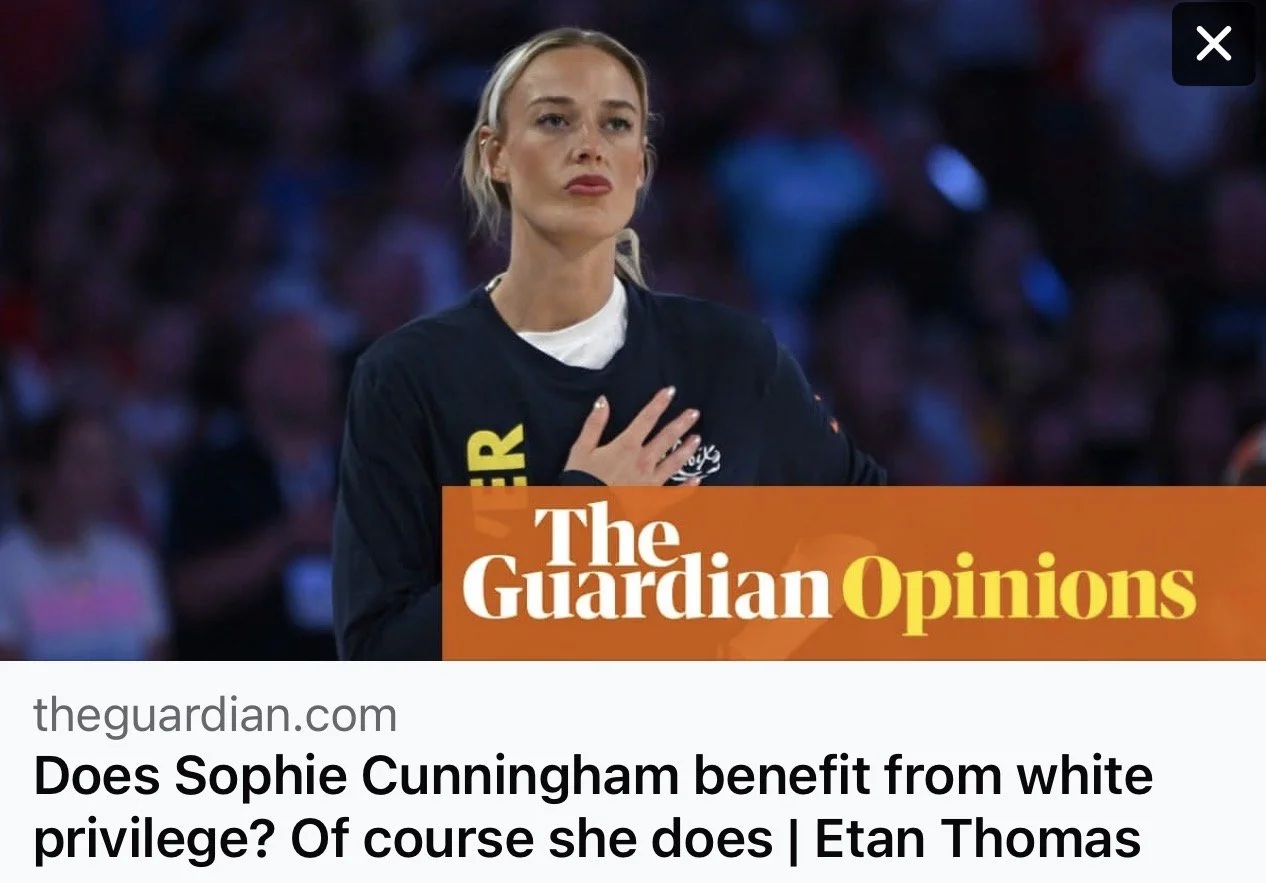
Does Sophie Cunningham Benefit From White Privilege ? Of Course She Does

White privilege. An accusation that triggers multitudes of white people in America as if you had insulted their mother. Mention racism, and people may debate you. Mention discrimination, and people may even listen. But say the words “white privilege”, and suddenly defenses go up, outrage erupts, and people start explaining why privilege couldn’t possibly have anything to do with what everyone just witnessed with their own eyes.

Which brings us to DiJonai Carrington and Carrington acknowledged she should have been penalized for the foul. But after her ejection, she 

went on social media and posted those two words many white people seem to fear so much: “WHITE PRIVILEGE”.

Predictably, Carrington’s words became as controversial as the foul itself. But instead of dismissing Carrington’s accusation, we should ask why she posted the words that she did – she has said they had nothing to do with the officiating decision itself. What happens when Cunningham, a white woman, is the aggressor, and what happens when she is the “victim”? 

We’ve already seen the first scenario. In June 2025, Cunningham committed a Flagrant 2 foul against Connecticut Sun guard Jacy Sheldon. Cunningham wrapped Sheldon up as she drove toward the basket, sent her to the floor, and ignited an altercation. Cunningham was correctly ejected and fined by the WNBA.

If we are going to discuss racial double standards, we shouldn’t manipulate facts. Cunningham was ejected in 2025, just as Carrington was ejected in 2026. The referees treated both players the same – as Carrington herself appeared to suggest. Instead, the white privilege is found in what happened next.

As my co-host on The Collision podcast, Chuck Modi, pointed out after Cunningham’s 2025 foul, a significant portion of the public didn’t transform her into a dangerous menace threatening the integrity of women’s basketball. Instead, she was lauded as an enforcer. She was the teammate willing to protect Caitlin Clark, a player whom many on the right see as a delicate white flower who needs protecting at all costs. Cunningham also became immensely marketable. Her TikTok following exploded from 300,000 to over one million, and she was flooded with lucrative marketing opportunities.

When Cunningham fouls an opponent, she’s an enforcer. When Carrington does the same, she’s a danger

Think about that. A white player is ejected, and emerges with exponentially more followers, an “enforcer” identity, and lucrative endorsements.

Now imagine if Carrington had been flooded with endorsement deals built around being an “enforcer” after her foul on Cunningham. Would America think that was cute? Would television personalities laugh and celebrate her toughness? Or would she be described with words like “dangerous”, “dirty” and “thug”?

That question isn’t hypothetical, either. Look at what happened when Carrington fouled Cunningham.

Carrington’s foul was immediately framed by commentators as something larger than basketball. Cunningham was portrayed not simply as the recipient of a Flagrant 2, but as another white WNBA player being victimized by an increasingly dangerous culture within the league. We’ve heard similar rhetoric surrounding Clark for years: opponents aren’t merely fouling her; they are targeting her, jealous of her, and trying to hurt her. The racial subtext matters because the villains in this narrative are disproportionately Black women, while the white players like Clark and Cunningham are portrayed as in need of protection.

Then the Carrington-Cunningham incident went somewhere very strange: Florida’s attorney general, James Uthmeier, got involved. Uthmeier said he would be willing to charge players with assault and battery if they committed hard fouls in Florida.

This is, of course, ridiculous, and Uthmeier – no doubt grandstanding for a certain demographic of conservative voters – knows it. Quite apart from the fact that Florida doesn’t have an WNBA team, we are talking about professional basketball. Hard fouls have existed since Dr James Naismith hung a peach basket on a wall. Players have been clotheslined, elbowed, shoved, and involved in fights. Flagrant fouls exist precisely because sports already have mechanisms to distinguish basketball contact from excessive contact. Yet suddenly, we are discussing criminal prosecution.

Would we be having that conversation if Cunningham had fouled Carrington? We don’t have to guess. When Cunningham committed her retaliatory Flagrant 2 against Jacy Sheldon, where was Uthmeier? Where were the threats of assault charges, the politicians warning the WNBA, or the television segments asking if Black women were safe from prowling white women?

Fouls an opponent, she’s an enforcer. When Carrington does the same, she’s a danger.

This isn’t the first time Cunningham has become a cultural phenomenon. In June, she pointed at Phoenix Mercury’s DeWanna Bonner during an on-court confrontation. The image exploded across social media, accumulating tens of millions of views as Cunningham’s point became a meme. People described it as hilarious, petty, and iconic – and there’s no denying it was entertaining.

But in considering white privilege, I posted an image on social media of Cunningham as a Black WNBA player and asked: How would it be viewed if the roles were reversed? If a Black player followed a white opponent around the court, staring her down and pointing in her face for 20 seconds. Would she still be called adorable? Or would she be described as threatening, aggressive, classless, and hostile?

That’s why conversations about white privilege cannot stop at whether two players received the same foul classification on the scorecard.

We could test this. Take every comparable WNBA flagrant foul over the last several seasons involving contact to the head or neck. Separate the incidents by the race of the offending player and the race of the recipient. Examine the headlines and social media posts. How frequently do the words “hard foul” come up versus “cheap shot”, “brutal”, “assault”, “targeted”, or “clobbered”?

That would be a far more meaningful investigation of white privilege than screaming about playing “the race card.”

Privilege isn’t always receiving something someone else didn’t. Sometimes privilege is being granted innocence of interpretation. It’s having your aggression interpreted as toughness, your confrontation as personality, your retaliation as loyalty, your defiance as humor, and your anger as passion. Meanwhile, someone else’s aggression becomes violence, confrontation becomes hostility, retaliation becomes assault, and anger becomes evidence that she is dangerous.

White privilege doesn’t require Cunningham to ask for it or be racist. It doesn’t require every referee, journalist, or politician to consciously think: “She’s white, so I’m going to treat her differently”.Privilege operates through assumptions, sympathy, and framing – through whose aggression gets contextualized and whose gets criminalized.

So when Carrington talks about white privilege, instead of becoming enraged, America should examine why those two words make people angrier than the double standard she’s asking them to examine. The question isn’t simply whether white privilege exists in the WNBA. The real question is: How much more evidence do people need before they’re willing to admit that it does?

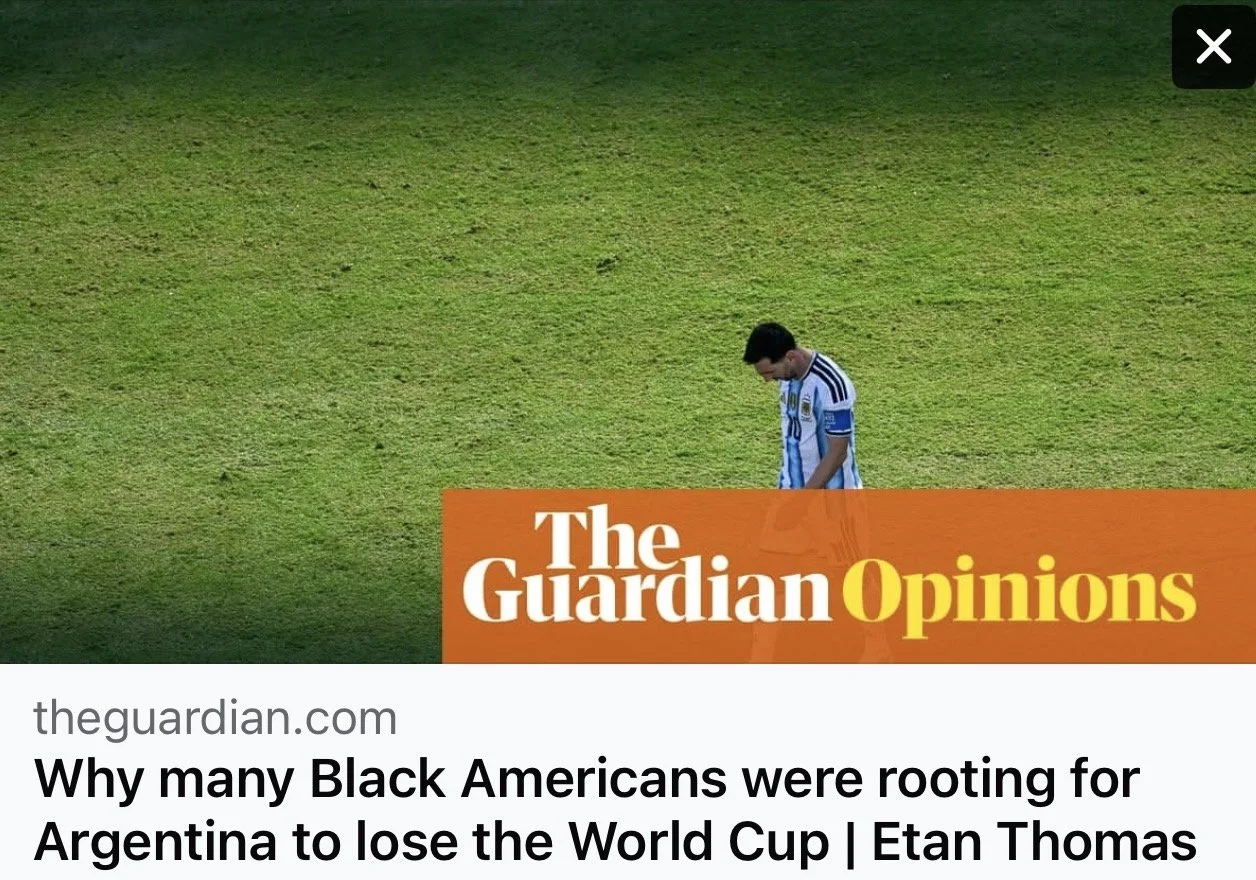
Why Many Black Americans Were Rooting For Argentina To Lose The World Cup

There are moments in sports when you realize people aren’t just watching the score any more. They’re watching values. They’re watching who speaks. They’re watching who stays silent. And they’re watching what those silences say.

I found myself thinking about that throughout this World Cup. On paper, Sunday’s final looked simple. Spain v Argentina. Two footballing giants and countries with glorious soccer histories. Two nations whose pasts are also stained by colonization, oppression and chapters of history that shouldn’t be whitewashed simply because someone can score a goal.

So no, this wasn’t some fairytale of good versus evil. Spain’s colonial legacy is well documented. Nobody who knows history should pretend otherwise.

Yet for many Black Americans, this final wasn’t really about rooting for Spain. It was about rooting against Argentina.

When your fanbase repeatedly becomes associated with racist incidents … when videos circulate of Argentinian fans decked out in Argentina team gear hurling racial epithets toward Black people … when the world watched members of Argentina’s national team sing a racist chant targeting France’s Black players after winning Copa América … when American streamer IShowSpeed was verbally assaulted by fans fully dressed in Argentina team gear … when word spreads across social media that in Argentina, there is a real hamburger business in Llavallol whose official name uses the “-a” version of the N-word: “Big N– Burgers” … when Argentina president Javier Milei openly embraces positions that align very closely with Donald Trump and offers support for Israel in the midst of a genocide, ethnic cleansing and slaughter of Palestinians … when Benjamin Netanyahu is asked on a recent podcast if he was rooting for Messi and says, “No, before Messi, Milei. He’s a superstar” … eventually, the tide of supports shifts. After a while, any accomplishments on the field become overshadowed.

It’s like a college basketball coach who has all the appearances of a great program. He has a great winning percentage and a high graduation rate, and all of his players are disciplined, articulate and present themselves as professionals. But you keep hearing stories of verbal abuse and berating, whispers of a tyrant coach who is actively damaging his players’ mental health. At some point, the results become secondary and people start asking, “What’s going on with the Indiana Hoosiers?”

Argentina kept giving people reasons to ask that question. Which brings us to Lionel Messi.

This is where people get uncomfortable because everybody loves Messi, and for good reason. His brilliance doesn’t require exaggeration. His résumé speaks louder than any sports debate ever could. Whether you think he’s the greatest player ever or merely one of them – shoutout to Pelé – you’re arguing over different shades of greatness.

But greatness on the field has never automatically translated into courage off it.

Muhammad Ali taught us that. Bill Russell taught us that. Mahmoud Abdul-Rauf taught us that. Craig Hodges taught us that. John Carlos and Tommie Smith taught us that. Being extraordinary with a ball, a bat or track shoes isn’t the same thing as being willing to risk comfort for conviction.

To my knowledge, throughout this entire World Cup, Messi never publicly condemned the racist incidents involving sections of Argentina’s fanbase. He did not publicly address the racist chant that drew worldwide criticism after Copa América. Nor has he publicly spoken out after videos of Argentina supporters racially abusing Black people circulated online.

He didn’t even offer the kind of broad, indirect condemnation that many critics argued was insufficient when Caitlin Clark addressed racist abuse coming from some of her supporters. As my co-host Chuck Modi argued on our show The Collision: Where Sports and Politics Collide:

“She has to be more specific. When Alyssa Thomas was getting death threats, she has to say Alyssa Thomas by name, and say directly to her fans that you cannot have death threats going to Alyssa Thomas in my name the same way we as Jewish people say not in my name for Palestinian rights. She needs to use all of her clout and tell her fans this is unacceptable.”

Messi did not even clear that lower bar. He offered no public statement at all addressing the racism carried out by some of his supporters.

As Dr Martin Luther King Jr said in his Beyond Vietnam speech: “A time comes when silence is betrayal.”

Sometimes silence becomes its own statement simply because the loudest voice in the room chose not to use it. Contrast that with the generation coming after Messi.

Lamine Yamal has spoken openly about his family’s sacrifices. He has recalled how his father searched through discarded items that could be repaired or sold so there would be enough money for food. He has said he grew up in a tiny apartment where the kitchen and bedroom were one and the same. Today, he says what makes him happiest is seeing his mother smile and knowing his younger brother can enjoy the childhood he never had.

Nico Williams carries a similarly powerful story. His mother, María, walked nearly 2,000 miles while pregnant, from Ghana toward Spain, in search of a better life. Decades later, her son set up the goal that won Spain the World Cup and then placed his winner’s medal around her neck.

Spain’s triumph was never just about tactics, possession or technical excellence. It was about possibility. It was a team that reflected the modern Spain – diverse, confident and shaped by the journeys of families who crossed borders in pursuit of a better life. That, more than any passing sequence or tactical innovation, was their most powerful statement.

After Spain defeated Argentina on Sunday, one image stood out to me: Lamine Yamal embracing Messi. No taunting or chest-pounding or disrespect, just respect from one generation to another. Like the old African Proverb says: “The lion doesn’t need to roar after every meal.”

Another image that resonated was seeing Lamine Yamal kneel in prayer amid the chaos around him while emotions boiled over after the match. While others argued, he prayed. That image reminded me that composure can be louder than confrontation.

Lamine Yamal has also shown a willingness to let people know where he stands on issues beyond football, including expressing solidarity with Palestine. Whether people agree with every public stance an athlete takes is almost beside the point. The point is that he is willing to recognize that his platform extends beyond 90 (or 120) minutes on the field.

Jackie Robinson wasn’t remembered simply because he stole bases. Kareem Abdul-Jabbar isn’t remembered simply because he had the most unstoppable move the NBA has ever seen. Colin Kaepernick isn’t remembered simply because of his dual-threat quarterbacking skills. Eventually the statistics become paragraphs, but character becomes chapters.

That’s why comparisons between Messi and Ali don’t really work for me. One changed football forever, but the other changed the world.

Some people have asked why so many Black Americans seemed emotionally invested in seeing Argentina lose. I don’t think it’s complicated. When you’ve spent your entire life hearing people tell you sports and politics should stay separate – but somehow they only say that after racism enters the conversation – you start recognizing the pattern.

People told Ali to “just box”. People told Kaepernick to “just play football”. People told LeBron James to “shut up and dribble”. People effectively accused Jaylen Brown of being “uppity”. Apparently athletes are free to use their platforms – unless they’re using them for something that makes people uncomfortable.

That’s always been the rule, until it isn’t.

This World Cup became about more than goals because people made it about more than goals. Racism made it bigger. Politics made it bigger. Silence made it bigger. For many viewers, supporting Spain wasn’t an endorsement of Spain’s history; it was simply rejecting what Argentina had come to represent in this particular moment. Sometimes cheering isn’t about choosing perfection, but about choosing the option that feels less harmful.

Maybe that’s why so many people found themselves drawn to this young generation. Not simply because they won, but because they represent the possibility that excellence and conviction don’t have to play on different teams. To quote Abdul-Rauf from our interview for my book Police Brutality and White Supremacy: The Fight Against American Traditions: “What you do speaks so loudly in my ears that I can’t hear a word you’re saying.”

I couldn’t agree more.

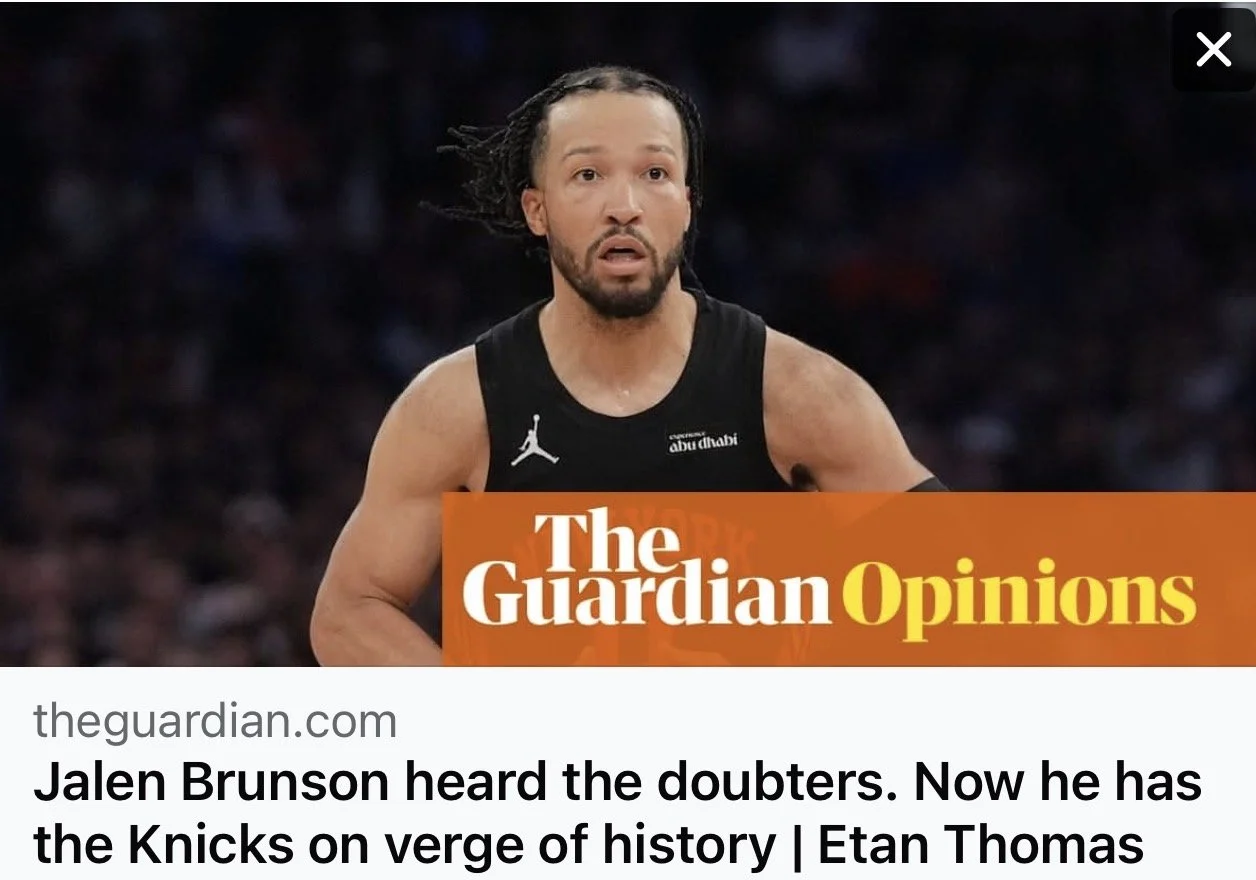
Jalen Brunson Heard The Doubters, Now He’s On The Verge Of History

The entire basketball world is singing the praises of Jalen Brunson and rightfully so. He has led the New York Knicks to the NBA finals for the first time since 1999 and has united the entire city of New York in a unique way.

On every New York street you can see people of every race, color, creed, nationality, religion, economic status and political affiliation unified in excitement as the team seek their first NBA title since 1973. While older Knicks fans break out their Patrick Ewing, Charles Oakley and John Starks jerseys, younger fans have the names of Brunson, Josh Hart and Karl-Anthony Towns on their backs. Chants of “MVP!” fill the air in every New York borough every time Jalen Brunson steps up to the free-throw line. Knicks fans have staged watch parties on the sidewalks, in the parks, and on the corners. All of New York is, in the words of JadaKiss, “outside”.

Related: 

‘The whole of New York is stressed right now’: how Knicks finals fever reached Rikers Island

https://www.theguardian.com/sport/2026/jun/05/rikers-island-nba-finals-new-york-knicks-photos

https://www.theguardian.com/sport/2026/jun/05/rikers-island-nba-finals-new-york-knicks-photos

The scenes will be even more intense – and joyous – if the Knicks win two more games against the San Antonio Spurs to clinch the NBA title, something which could happen as soon as Wednesday on the team’s home court, Madison Square Garden. Brunson has been the spark for the Knicks’ brilliant run and he has been praised by analysts, writers and broadcasters. But the universal praise for the point guard wasn’t there in 2022 when he joined the Knicks. And it wasn’t just from a handful of media members, it was the majority of them.

Stephen A Smith went on a tirade berating the Knicks organization for putting their faith in Brunson, hiring his father, Rick. He appeared to have given up on Brunson before he had even played a game for the Knicks. “He’s not a one, I’m not even sure he’s a real two,” Smith said.

It wasn’t just Smith though. Frank Isola on Sirius XM questioned whether the Knicks were overpaying for a player who, in his opinion, had a standout postseason with the Mavericks only due to Luka Dončić missing time with an injury. Fox Sports’ Nick Wright and Colin Cowherd and ESPN’s Brian Windhorst had similar views: that Brunson was a good player, but not one who could put a team on his back and carry them to the title. Wright wondered if Brunson was “even one of the top 10 point guards in the NBA?”.

While Kendrick Perkins was one of the few dissenting voices to back Brunson from the start, he was in a firm minority.

Becky Hammon, a six-time WNBA All-Star who has won three titles with the Las Vegas Aces as a coach, had perhaps the most interesting take. Her view was not that Brunson lacked talent: in fact, she repeatedly praised his skill, toughness, and leadership. Her criticism was that Brunson, who is listed at 6ft 2in, he was too small to be the best player on a championship team. She referenced Hall of Fame guards Allen Iverson (6ft), Steve Nash (6ft 3in) and John Stockton (6ft 1in) as elite players who never won a championship as the unquestioned best player on their team. She pointed out that most NBA champions have been led by taller stars such as wings, forwards, or centers; that smaller guards tend to be easier to target defensively in playoff series; and teams can scheme against undersized stars over a seven-game series. She acknowledged that Stephen Curry (6ft 2in) was able to overcome his lack of height and lead the Golden State Warriors to four NBA titles but Hammon saw him as an exception to the rule.

“If your best player is small, you’re not winning,” she said during an appearance on ESPN in December 2023.

Hammon has never really backed away from her opinion. Even after Brunson led the Knicks to the 2026 NBA Finals, she said she still believed the historical trend favored her argument, while acknowledging that Brunson could prove her wrong. “I said what I said. If he proves me wrong, he proves me wrong,” she said in May.

The point of this isn’t to castigate those in the media for lambasting the Brunson signing but to send a message to young athletes who give too much credence to what “they” say. Athletes have always had to live with criticism. It started with newspaper columnists in the early 20th century to talkshow hosts on radio to hot-take artists in the cable TV era. But now young athletes are often glued to their phones, subject to negative attention on social media 24 hours a day. We have seen case after case of athletes going into depression and losing their love of a sport they excel at.

Of course, not every young athlete can be as brilliant and exceptional as Brunson. But he has shown that opinions on social media and cable are just that – opinions. This season, after years of criticism. Brunson has:

-- Made the all-NBA second team (with a strong case that he should’ve been on the first team)

-- Won the Larry Bird Trophy as Eastern Conference finals MVP after averaging 25.5 points and 7.8 assists per game against Cleveland.

-- Led the Knicks to within two games of the championship after a 13-game (and counting) winning streak.

-- Produced several clutch moments in these NBA finals such as his 30 points in Game 1 as New York stole home-court advantage, and a game-sealing steal and free throw in Game 2, helping the Knicks take a 2–0 series lead.

For Knicks fans, this playoff run has cemented Brunson’s reputation as one of the franchise’s greatest postseason performers and one of the league’s premier clutch players. I hope the message resonates loud and clear with all young players. Don’t ever let haters discourage you. Always believe in yourself and let the hate motivate you to greatness.

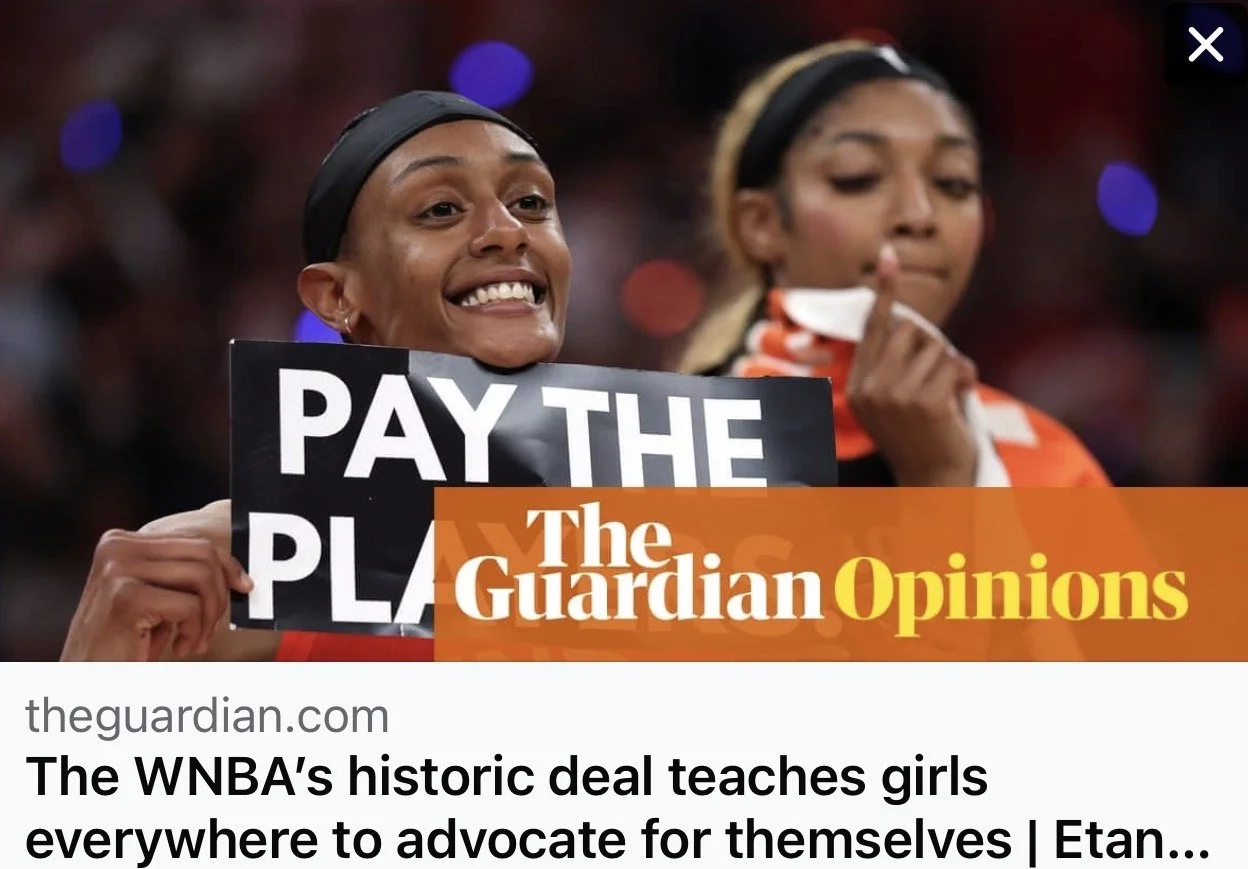
The Historic WNBA Deal Teaches Girls Everywhere To Advocate For Themselves

I interviewed Jemele Hill for my podcast The Rematch and asked for her reaction to the WNBA’s landmark new collective bargaining agreement, a seven-year deal that includes a salary cap increase to $7m (up from $1.5m in 2025), maximum salaries approaching $1.4m, 20% revenue sharing, expanded rosters, charter flights and more.

Hill didn’t mince words.

“Unfortunately, there’s still a very prevalent attitude when it comes to women’s sports that, ‘Hey sweetie, you should just be happy that somebody is letting you put on a uniform and bounce a ball,’” she said.

I’m a Girl Dad. My daughters, Imani and Sierra, both play volleyball at Bishop McNamara High School in Prince George’s County, Maryland, and for Maryland Juniors. They followed these negotiations closely – for reasons that extend well beyond the game.

One morning on the school run a few months ago, we had SiriusXM on, as we often do. The topic was Minnesota Lynx star and WNBPA vice-president Napheesa Collier, who had publicly criticized what she called a “dangerous and dismissive culture at the top of the WNBA”.

She accused the league of negligence – ignoring injuries, brushing off officiating concerns and failing to treat players with basic respect. She also described a meeting with commissioner Cathy Engelbert in which she raised issues including poor officiating and rookie salaries for players like Caitlin Clark, Angel Reese and Paige Bueckers, who are generating enormous revenue for the league.

Collier said Engelbert told players they should be “on their knees thanking their lucky stars” for the media rights deal and that Clark should be “grateful” for the WNBA platform when it comes to off-court earnings. (Engelbert later disputed that account.)

Collier then said that the WNBA has the worst leadership in the world. Needless to say, those statements got the entire carpool’s attention.

Then came the reaction. A clip of right-wing sports pundit Dan Dakich ripping Collier to shreds for having the “audacity” to say what she said. Frank Isola agreeing with everything Dakich said. The tone was familiar: Who does she think she is? That was a private conversation. WNBA players should be grateful.

That’s when the carpool came alive.

Addy, our starting defensive specialist, said: “Does he not know Napheesa Collier is probably second only to A’ja Wilson? He’s talking about her like she’s a little girl.”

Imani: “He thinks all WNBA players should be crawling on their knees thankful? Who is this guy? What decade are they in? This is 2026, not the 1950s.”

Sierra: “They act like women don’t deserve anything. Basically: shut up and dribble and be thankful? I’m glad she called them out. So that doesn’t change once we grow up, huh?”

I turned the volume down and asked if they encounter that kind of thinking as female athletes.

All three said: Yes! All the time!

They told stories: teams forced to practice outside so the boys can have the gym; weight-room slots at 5am or late at night because football comes first; decade-old uniforms for girls while boys get new ones every year. And it’s all treated as normal.

Sierra then brought up Swagger, the Apple TV show we watch together. In one scene, a McDonald’s All-American basketball player named Crystal (played by Quvenzhané Wallis) is pushed off the court during a workout by a group of boys. Instead of leaving, she goes live on her phone and calls them out. They back off.

“That’s why we have to stand up for ourselves,” Sierra said. “Like the WNBA players are.”

So when people ask why I speak out – why I call out commentators like Dakich, Stephen A Smith or Isola – that’s why.

Throughout these negotiations, a familiar argument kept coming up: the WNBA doesn’t generate what the NBA does in revenue, so it shouldn’t expect the same treatment. But does that mean players should be treated as second-class citizens?

Before this deal, WNBA players received roughly 9% of league revenue. For context: NBA players receive 49-51% of basketball-related income; NFL players around 62%; NHL players 50%; MLB players about 48%.

Nine per cent. That wasn’t just inequitable. It was disrespectful.

As Hill told me: “Women in sports have had to have this fight for dignity and respect from the day women began playing sports.”

And every female athlete will tell you the same thing: the resources, the respect, the opportunities are not equal. That reflects a broader reality. According to the 2025 gender pay gap report, women in the US working full-time earn roughly 82 to 85 cents for every dollar earned by men. That gap persists across most industries.

Let me be clear: no WNBA player is asking to be paid like NBA players. But it is outrageous that any professional athlete has had to take a second job to make ends meet.

For years, WNBA players have gone overseas in the offseason just to supplement their income. Again, no one is expecting them to make LeBron James’ salary, but they should be able to support themselves and their families. This isn’t the 1950s. It’s 2026. That shouldn’t be the reality for any professional athlete.

The causes of the gender pay gap are structural. They are rooted in unequal opportunities, expectations and norms that shape women’s careers long before they ever bargain with an employer over wages.

Which is why this moment matters. The women of the WNBA understood their value. They organized. They advocated. And they secured a deal that will change the lives of the players in their league forever. That act of solidarity sent a message – not just to my daughters’ carpool, but to young girls everywhere.

My oldest daughter put it best: “As a Black woman in sports, seeing players in the WNBA demand fair pay reminds me that I have to stand up for my worth. Because if I don’t, society will keep undervaluing me no matter how hard I work.”

Imani, I couldn’t agree more.

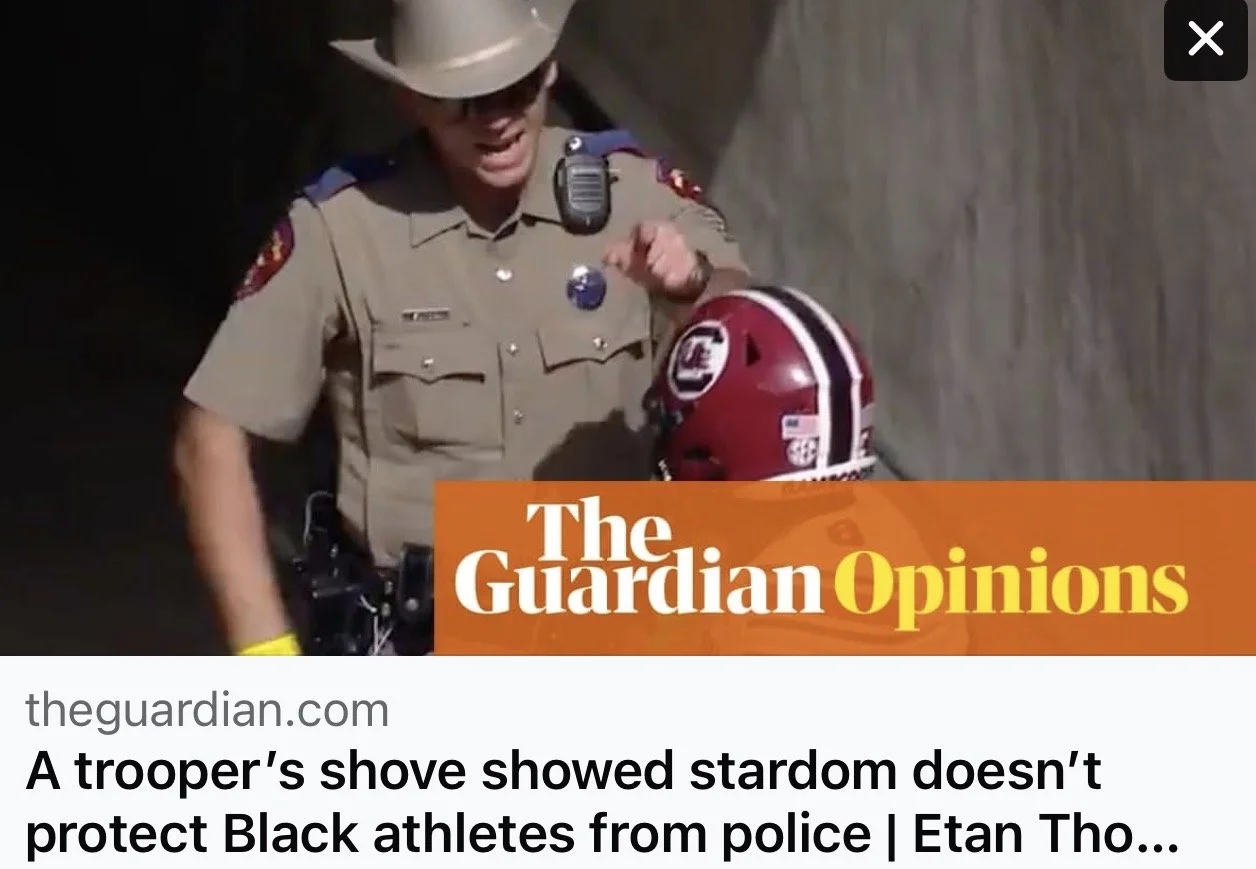
A Trooper’s Shove Shows Stardom Doesn’t Protect Black Men From The Police

It was 1996, my first day stepping foot on Syracuse University’s campus. I saw a big student protest was taking place so, with my freshman’s inquisitive mind, I ventured over to see what was going on.

I listened to a passionate sista named Kathy Ade, who was the president of Syracuse’s student African-American Society. She stood there with her Bantu knots and a megaphone addressing the crowd, while discussing the fact that campus security was now going to be able to carry pepper spray. In the 90s – which my daughter Baby Sierra calls “the 1900s,” just to keep me humble – campus security carrying pepper spray was a big deal. Now, they all carry guns.

The fear was that they’d use it on Black and Brown students without hesitation, at the slightest perceived sign of trouble.

Syracuse’s campus newspaper, the Daily Orange, printed a photo of myself and Roland Williams, who would go on to play in the NFL, standing at the rally alongside the sista with the megaphone. A few days after the protest, Kathy found me on the quad to thank me for lending my visibility and privilege as a basketball player to their cause. She said she seriously doubted the police would ever pepper-spray one of us.

She talked about how the university treated athletes like we were different – valued and welcomed – while other Black and Brown students were made to feel like trespassers, constantly asked to show ID just to prove they belonged. (This was Rudolph Giuliani and Eric Adams’s stop and frisk before it was called that, but I digress).

Those memories came back to me on Saturday when a Texas state trooper was “sent home” after a run-in with South Carolina player Nyck Harbor during a game. Harbor, as a star athlete, was among the group of people that Kathy lumped into a protected class of Black people when we spoke all those years ago in Syracuse.

A quick recap of what happened on Saturday. ESPN’s broadcast showed the trooper appear to intentionally barge Harbor and his teammates after the receiver had scored a touchdown against Texas A&M in their home stadium. In doing so, the trooper came off like a low-self-esteem school bully – the kind of senior who gets his kicks plowing through a sea of freshmen, daring them to speak up so he can enjoy pummeling them in front of everyone. The Texas Department of Public Safety (DPS), which employs the trooper, later said he had been sent home. 

There’s a lot to unpack here. Why didn’t the DPS call an immediate press conference and condemn the trooper’s actions? Why didn’t they say his behavior was appalling, disgusting, and unacceptable and not what they teach their state troopers to do.

If this trooper behaved like this in the middle of a football stadium, during a nationally televised game, how does he behave whenever he stops a Black person on the side of the highway?

Harbor did not retaliate, despite the trooper’s provocation – he turned around and made his way back to the field. But if he had responded, what would have happened? It happens all the time: the person being mistreated by police is expected to respond perfectly, or risk making things worse. Yet there’s no such expectation for the officer – no demand for restraint, professionalism, or even basic decency.

Before they try to “no angel” Harbor, it’s important to note that he won the 2023 Franklin D Watkins Memorial Award, a prize which honors African American high schoolers who excel in athletics, academics and charity work. Aside from his football career, Harbor has won national titles in track, volunteered at a soup kitchen and worked with Generosity Global, which campaigns to improve women’s health in Africa. Harbor is majoring in public health and has been on the SEC Academic Honor Roll two years in succession. 

I asked retired police captain Sonia Pruitt what she thought of the trooper’s behavior.

“People say maybe he was having a bad day. But no, as an officer of the law, you do not get to abuse the public because you are having a bad day … People want to be treated with dignity and respect from their police officer,” she said. “However, far too often, in police training that simply isn’t the focus or conversation. And when it’s not a focus, you see acting out like what we observed with this Texas state trooper. That’s not a ‘bad apple’ issue, that is a bad system issue”

Captain Pruitt, I couldn’t agree more.

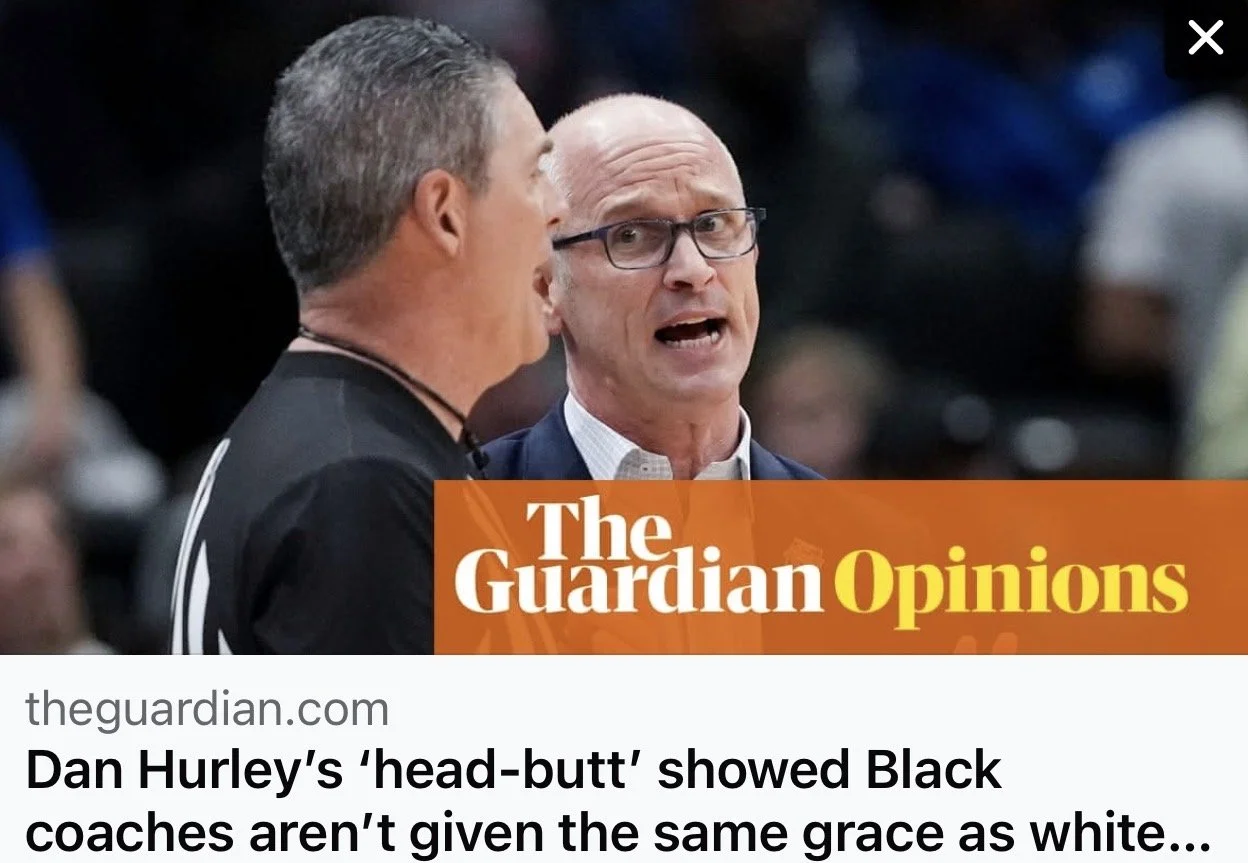
Dan Hurley’s Head Butt Shows Black Coaches Aren’t Given The Same Grace As White Coaches

The UConn-Duke game on Sunday night was one for the ages. A last-second game winner from freshman Braylon Mullins took down the top-seeded Blue Devils, who at one point had led by 19 points. It is a moment that will be replayed over and over for years to come.

However, something strange happened after Mullins’s shot. UConn’s head coach Dan Hurley approached referee Roger Ayers and touched foreheads with the official while glaring into his eyes. It wasn’t quite the “head-butt” some called it on social media but it was an eye-catching scene. For his part, Ayers told ESPN the incident was “absolutely nothing” but it wouldn’t have been unusual for Hurley to be given a technical foul, which would have given Duke free throws and a chance to win the game with 0.4 seconds left. Hurley mystifyingly has said he thought Ayers was trying to “chest bump me to celebrate.”

This wasn’t Hurley’s first brush with controversy. Earlier this month, he was fined for “unsportsmanlike conduct” after confronting an official at a game against Marquette. In 2025, he taunted Creighton fans after a UConn victory. Later that season, after UConn were beaten by Florida in the NCAA Tournament, he approached Baylor players as they prepared for their game and told them: “I hope [the referees] don’t [expletive] you like they effed us”.

Hurley is largely forgiven for all this. He is called “passionate”, “eccentric” or “fiery”.

Which leaves some coaches wondering if things would have been different if they behaved in a similar manner to Hurley. I posted video of the Hurley-Ayers incident on my Instagram account and Tennessee State head coach Nolan Smith, who is Black, replied in the comments: “I’ll never try this. I’ll be coaching in Pelican Bay.” 

Smith was joking, but he is 100% correct. Make no mistake, a Black coach wouldn’t be able to get away with any of that. They’d be accused of being unable to control their emotions or of being a corrupting influence on their players. Maybe they’d just be handcuffed and led off court. That’s exactly what happened to Tuskegee coach Benjy Taylor – and he was trying to calm a situation down.

There are other examples out there. Rick Pitino is a brilliant coach but his career would have been sunk long ago if he was Black. The most prominent of his missteps came from his time at Louisville where his former assistant coach, Andre McGee, was accused of paying for escorts to strip and have sex with players and recruits. McGee was put on probation by the NCAA and his appeal failed. Pitino was never accused of being involved in the scheme but the NCAA admonished him for “failing in his responsibility to monitor the activities of [McGee]”. Louisville subsequently fired him but rather than ending his career he is now coaching another prominent program, St John’s. A Black coach in that situation? He never would have coached a major team again.

The reason is that the rules are different for Black people in every aspect of society. And that goes all the way to the top.

Barack Obama had to be perfect to become president of the United States: an Ivy League eduction at Columbia and Harvard, where he became the first Black president of the Harvard Law Review. One wife, two daughters with that same wife, and zero scandals.

Donald Trump, on the other hand, was found guilty of all 34 counts of falsifying business records in a criminal hush-money scheme to influence the outcome of the 2016 election. But wait, there’s more. In 2023, a jury found Trump liable for sexually abusing E Jean Carroll in a New York department store dressing room in the 1990s. In fact, more than 20 women have accused Trump of sexual misconduct, all of which he has denied.

That’s a list that would have kept a Black person from even being considered as president of McDonald’s, let alone president of the United States – and that’s before we even get to the stain of Trump’s one-time friendship with Jeffrey Epstein. The fallout for Trump? He’s been elected president twice.

Black people know this because we learn how America works from a very young age. The rules are just different for us.

Dylann Roof killed nine people during his shooting spree at a Black church in 2015, and the police bought him a Burger King. Meanwhile, they choked Eric Garner to death for suspicion of selling loose cigarettes, and kneeled on the neck of George Floyduntil he died for allegedly using a counterfeit bill.

Of course it’s not fair, and of course it’s not how it should be, but it is just the way it is. White privilege exists in every aspect of American society, and that includes college basketball.

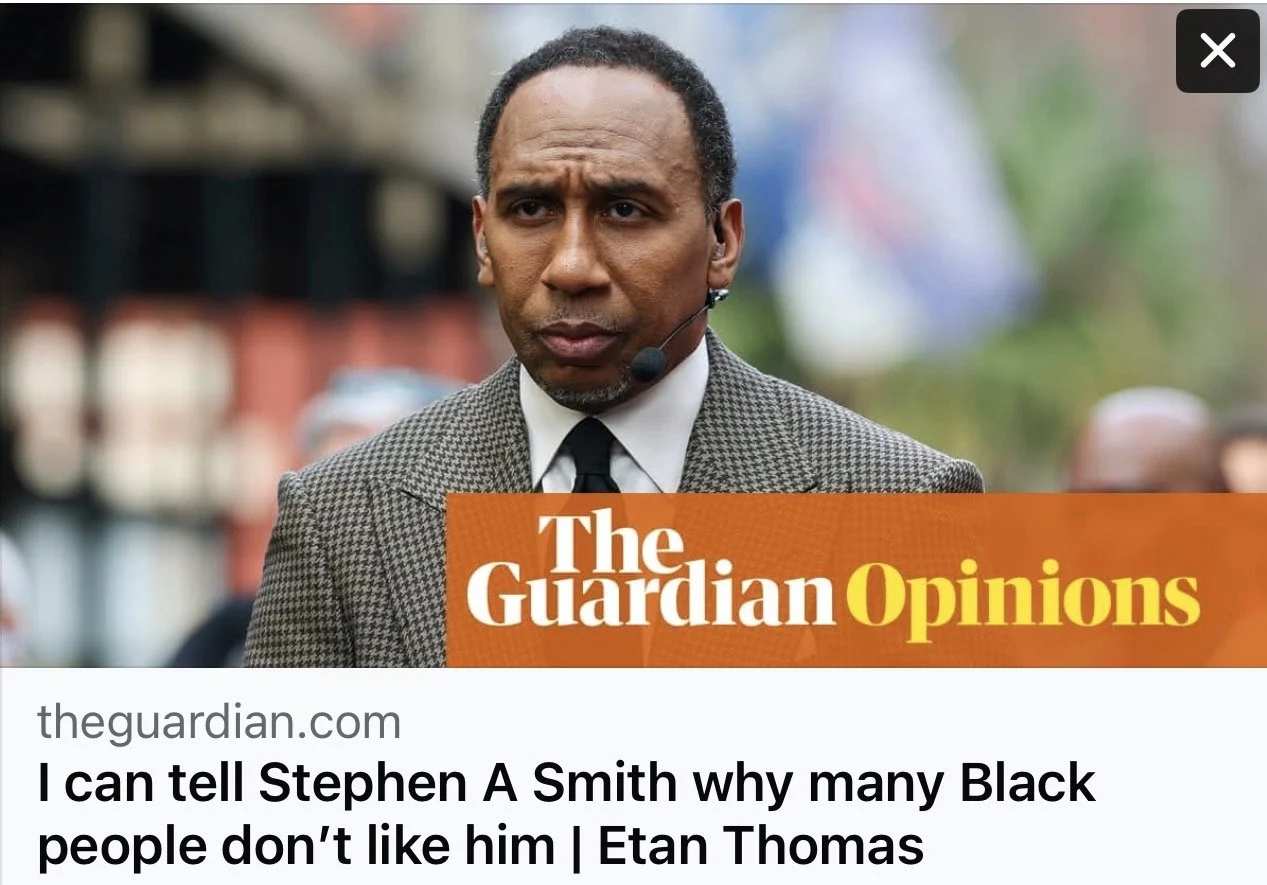
I Can Tell Stephen A. Smith Why Many Black People Don’t Like Him

Dear Stephen A Smith,

Let me first say that I tremendously respect all you do for historically Black colleges and universities. You have helped generate millions in scholarships, promoted student enrollment and brought national media attention to HBCUs across the United States. Specifically, as ambassador, you have promoted the annual HBCU College Fair, which has garnered over $12m in scholarships. You encourage students to consider HBCUs for their higher education, highlighting the community and nurturing environment they provide.

And yet, you wonder why many Black people in America feel that you “betrayed your race”.

It’s not a mystery why they may feel this way. Chuck Modiano, my co-host on The Collision, put it well: “Stephen A Smith loves to criticize Black athletes, but he won’t go after Roger Goodell like that. He won’t go after owners that way.”

Far too often, you attack Black male athletes in particular – Kyrie IrvingKwame BrownLeBron JamesTerrell Owens and Kevin Durant are just a few of your targets – with a passion and vitriol you just don’t reserve for white athletes and executives.

It doesn’t stop there though. You parrot rightwing talking points, as you did earlier this year, when you said that racism isn’t as prevalent in the US as some on the “left” claim. You went on to argue that most Americans judge people based on their character rather than skin color, which is not the experience of most Black people in the US.

In the midst of ICE’s brutalization of large parts of the country, you blamed Renee Good for her own death at the hands of federal agents. You then claimed that people celebrated ICE under Obama but are condemning Trump. That’s not the only time you were sympathetic to the president either: you called Democrats’ efforts to hold Trump accountable in the courts as “lawfare”. It’s particularly galling for Black people when you chastize Black athletes at the same time as minimizing a president who was convicted of 34 felonies. You’re not much better with Black politicians. You attacked congresswoman Jasmine Crockett for not being respectful enough to Trump.

Recently you called out Trump for the delay in releasing the Epstein files, but many of us remember you once questioned why people were outraged by the files when there are other issues to focus on. Then there are your frequent appearances with Sean Hannity, whose denigration of Black people is well known – from his comparison of Black Lives Matter to the Ku Klux Klan to his denial of systemic racism in policing. The inconsistency is hard to ignore.

Recently on Cam Newton’s show you made a case that every Black person should vote Republican because the Democratic Party takes our vote for granted, adding that we have been giving our vote to them since 1964. You failed to mention that the Civil Rights Act of 1964, the Voting Act of 1965 and the Fair Housing Act of 1968 were all passed under Lyndon B Johnson, a Democrat. Your specific choice of words - “give” – implies the Black community are sheep, gifting our votes away. As if they weren’t earned by those key pieces of legislation on civil rights and desegregation, things Republicans stood vehemently against. This comes at a time when the Trump administration celebrated the supreme court gutting the Voting Rights Act, the 1965 civil rights law that prevents racial discrimination in voting.

I actually agree with your position that both parties should have to work for Black people’s votes. But here’s the important part you leave out: Democrats don’t do enough for Black people but Republicans actively work against us. Your arguments present the Black community as naive and blindly loyal to Democrats. That’s not only wrong – for many of us, Democrats are simply the lesser of two evils – it’s insulting, and another reason there’s antipathy towards you from Black people.

If you’re looking for misplaced loyalty, you might start elsewhere. Perhaps you could win some favor from Black people if you instead lectured those white people who follow Trump, a man actively working against their interests.

I see Maga Christians supporting someone who doesn’t follow any of the principles of Jesus Christ. Someone who has decades of accusations of sexual misconduct. Someone who, on Resurrection Sunday, went on social media and threatened to destroy an entire civilization, but still has the support of the religious right. He’s also hurt white working people: after his campaign promises to lower the price of eggs and gas prices, put an end to wars, boost the economy and make life better all around, he’s actually done the opposite.

Under the One Big Beautiful Bill Act, the tax burden has shifted toward low- and middle-income earners while windfalls are concentrated at the top 1%. Not to mention broad tariffs, the expiration of pandemic-era social supports and rising health-insurance premiums. Maybe you should lecture the white Maga community about the absurdity of their support for Trump, rather than telling Black people how we should conduct ourselves.

And the consequences are tangible. Anyone voting Republican who isn’t in the top 1% is voting against their own interest. But for Black people, this administration has been even more detrimental. He refused to apologize for a racist video posted on his social media depicting the Obamas as apes. It’s just as obvious in his harmful policy. From day one, Trump set his target on dismantling diversity, equity and inclusion. He received a standing ovation from the GOP when he declared at the State of the Union, “We Ended DEI in America”.

Since Trump took office again, the Black unemployment rate has risen – at one point to 8.2%, the highest since its pandemic peak – because of his policy changes, trade tariffs and the reduction in public-sector opportunities. His administration has targeted the federal workplace, a major employer of Black Americans, and enabled the loss of jobs and opportunities for many people, particularly Black women. The administration has slashed programs like Medicaid and made it more difficult to fight systemic discrimination in housinglending and education.

So, Stephen A Smith, that’s the party that you suggest Black people all vote for? So we teach the Democrats to appreciate us more? You’re intelligent, well read, and exceptionally good at your job. You can create a buzz about any topic any time you speak, which is why you are the highest-paid commentator at ESPN. But the reason why many Black people don’t like you is because you are pushing an agenda that is detrimental to the Black community as a whole.

Why Hasn’t Middle America Given Paige Bueckers The Caitlin Clark Treatment

UConn’s Paige Bueckers, the probable No 1 pick in this year’s WNBA draft, is a brilliant talent, although she may not want you to point that out.

“Everybody was focused on me and what I did at UConn my freshman year,” she said during last year’s NCAA Tournament. “But I think it’s more important for the game to share the spotlight to grow the game and show all the stars of college basketball and not just focus on one particular player, whether it be me, Caitlin [Clark], JuJu [Watkins], Angel [Reese]. There’s so many names in college basketball now that are huge, that are stars that deserve credit.”

That’s very admirable of her, but sometimes praise is due. In 2021, Bueckers was the first freshman to earn the Wooden Award, Naismith Trophy, AP Player of the Year and USBWA Player of the Year. She also led the Huskies in points, assists, steals and three-point percentage for a team that played in the Final Four and finished 28-2 overall.

Then, in July 2022, she tore her ACL and missed the entire 2022-23 season. She had also been sidelined by injury for 19 games the previous season.

But this season she is healthy and wreaking havoc on every team she faces. She is the model of efficiency. Right now, Bueckers is the only player across the NBA, WNBA and college basketball with a 50/40/90 line and top assist to turnover ratio. She’s averaging nearly 20 points per game and a conference-best 4.8 assists per game. It’s little wonder her team are one of the favorites to win the championship.

To bounce back from a series of serious injuries is amazing in itself, but to come back arguably better than she was before deserves a standing ovation. And, yet, Bueckers doesn’t receive the same fawning attention from large parts of white America as Clark, a player of similar skills. Why?

Perhaps it’s because, unlike Clark, Bueckers has always been outspoken about issues off the court. At the 2021 ESPYs, Bueckers was named the college athlete of the year. She used her acceptance speech to celebrate and honor Black women in particular.

“With the light that I have now as a white woman who leads a Black-led sport and celebrated here, I want to shed a light on Black women,” said Bueckers. “They don’t get the media coverage that they deserve. They’ve given so much to the sport, the community and society as a whole and their value is undeniable.”

Only 19 at the time, she told the audience that in the previous WNBA season, 80% of the postseason awards were won by Black players, but they received a fraction of the coverage given to their white peers.

“I think it’s time for change. Sports media holds the key to storylines,” she said. “Sports media and sponsors tell us who is valuable, and you have told the world that I mattered today, and everyone who voted, thank you. But I think we should use this power together to also celebrate Black women.”

She went on to acknowledge Black female trailblazers. “To Maria Taylor, Robin Roberts, Maya Moore, Odicci Alexander. To all the incredible Black women in my life and on my teams,” she said. “To Breonna Taylor and all the lives lost, and to those names who are not yet learned, but I hope to share, I stand behind you and I continue to follow you, follow your lead and fight for you guys so I just want to say thank you for everything,”

While Black America cheered Bueckers, it seemed like mainstream, white America – a demographic that once viewed her as, in her words, a “media darling” – weren’t singing her praises quite as much. And still don’t. Is this coincidence? Or maybe because her injuries have made people forget her greatness as an athlete? Possibly. But she’s back from injury now, so why aren’t people as focused on Bueckers as they were on Clark last season, when she was tearing up college basketball? Maybe if Bueckers had delivered a more vanilla ESPYs speech things would have been different.

Another factor is the Angel Reese effect. Women’s college basketball ratings surged in the last two NCAA Tournaments, some of that was to do with the excellence of the players on show. But some of it was for less edifying reasons. Much of the media made Reese the villain to Clark’s heroine after the Black Princess upstaged the Great White Hope in the 2023 NCAA Tournament championship game. The viral image of Reese defiantly waving her hand in front of her face – the same taunt Clark had used in a previous game – transformed Clark and Reese from great players to lightning rods for racial animus. People who had no interest in women’s basketball suddenly became fanatics – in every sense of the word – for all the worst reasons. They were there to cheer Clark’s whiteness, and attack Reese’s Blackness, not their talent. When she was drafted into the WNBA last year Clark repeatedly asked fans not to weaponize her, but it didn’t stop her becoming a dubious hero for bigots, who often spewed racist abuse at her Black opponents. Clark had become a huge star, because of her sheer talent – she was an WNBA All-Star and rookie of the year in 2024 – but also because of her supposed rivalry with Reese, a rivalry both players have played down (and, it has to be said, profited financially from).

Meanwhile, there has been no Black villain for Bueckers to compete against. The fact that that has meant she has gained less attention and adoration from middle America says a lot about the state of the country.

Meanwhile, during Ramadan Bueckers cooks breakfast for her muslim teammate, Jana El-Alfy, sings gospel songs (the Black versions) before games, has a level of connection with her Black teammates that truly resembles a sisterhood, was raised by her Black stepmother, has Black stepbrothers and sisters, has had Black boyfriends has designated herself an ally to her Black teammates on multiple occasions, not just in her ESPYs speech. All of this simply does not sit well with “that certain demographic” who embraced Clark and championed her for the wrong reasons. That’s not to say all of Clark’s fans fall into this category nor is this the fault of Clark, who just wants to play basketball.

Bueckers is a special player and deserves every ounce of praise and respect both on and off the court. But if she does end up winning a championship, and still doesn’t receive the praise given to Clark, you’ll know why.


In This Trump Era, Michael Jordan’s Free Health Clinics Are Very Much Needed

In This Trump Era, Michael Jordan’s Free Health Clinics Are Very Much Needed 

In the first few days of his second presidential term, Donald Trump signed a number of executive orders that will have an impact on the health care industry, some issuing new policies and some rescinding policies set forth by prior administrations. This has had a devastating impact on the American people.

While the country is on pins and needles awaiting the next bomb (both literally and figuratively) to drop from the Trump administration, Michael Jordan has figured out a way to actively combat one of the casualties (U.S. Health Care) of Trump’s plan for mass deportations of undocumented immigrants and extended tax cuts for the upper echelon of the American population. 

From an article in The Guardian titled: 

“Medicaid recipients fear ‘buzzsaw cuts’ for Trump’s agenda”, it reads 

“Republicans are considering a rollback of the federal social safety net, particularly Medicaid, which has nearly 80 million enrollees in all 50 states. The budget plan proposes an $880bn reduction in funding for the insurance over the next 10 years, an amount that experts warn would hollow out the program and have ripple effects across the entire American healthcare system.”

https://www.theguardian.com/us-news/2025/mar/01/republicans-medicaid-cuts

From an article in the MaynardNexsen titled “President Trump’s Latest Executive Orders Impacting Healthcare” it reads…..

“President Trump rescinded former President Joe Biden’s order that extended the enrollment periods for Affordable Care Act (Obama Care) plans in most states, and granted additional funding for third parties aiding enrollment in ACA insurance. While ACA enrollment nearly doubled under the Biden administration to about 24 million people, those gains are attributed primarily to government subsidies that lowered the cost of ACA premiums. The effect this rescission will have on enrollment trends is one thing to watch in the coming years”

https://www.maynardnexsen.com/publication-president-trumps-latest-executive-orders-impacting-health-care

While all this is happening in real time, Michael Jordan has opened his fourth health clinic in North Carolina on February 19 in Wilmington. This new clinic, established in collaboration with Novant Health, focuses on providing care to uninsured and underinsured patients.

MJ has spoken publicly exhibiting a tremendous amount of sincerity and passion about how important these clinics are and how many people they will help. He has addressed the growing issue of healthcare disparities and affirmed his dedication to providing healthcare to all people regardless of their income or economic status in particular in his hometown of North Carolina. 

Many people are pleasantly surprised to see this side of MJ, but it goes along with what I witnessed as his teammate for the Washington Wizards. 


I recall one time in particular, I was sitting in the training room getting treatment and he was getting his knee drained, which fans didn’t know at the time he had to often do in order to continue playing. MJ asked me about a book (Soul On Ice by Eldridge Cleaver) he saw me reading on the plane and we engaged in a deep conversation about race, politics, the community and much more. 

Sitting in ear shot was his bodyguard, George, who chimed in and said jokingly, “Yea Michael doesn’t like to tell anybody the things he does, so people don’t think he does anything” 

He then proceeded to tell me a story of when MJ was all set to have this big event at an exclusive golf resort in Georgia back in the day, and he found out that they were still keeping an old tradition of not allowing Black People to join the club, but of course they would let MJ participate. Well, long story short, right before the event, MJ informed the organizers that he was going to cancel everything if they didn’t change their policy and of course they capitulated to his demands. 

I remember responding saying, “That’s a great story that people need to hear. Why wouldn’t you tell people that ?” And MJ looked at me and said, “No, I don’t do it for that.” and I remember looking at George and him saying, “See, he doesn’t want to tell anybody anything” 

I tell this story for this reason. Playing with MJ for two years with the Wizards, I saw him do a lot of things quietly that nobody knew about. And from time to time I would whisper to him, “You’re not gonna tell anyone about this either huh ?” And he would just smile and shake his head. In fact, he didn’t even tell anyone that he donated his entire salary to the victims of 9-11. I remember being in the locker room when he was watching the coverage on TV and made the decision. Nobody found out until later that he did that. 

Now, for years I have been on panels and programs talking about activism and athletes and they would always bring up MJ as the antithesis to the activist athlete and his infamous statement “Republicans Buy Shoes Too”. They would always paint MJ as the athlete who doesn’t care about the community or really anything outside of himself and I would always push back on that because that’s just not what I saw when I was his teammate. Now, did he lend his voice to causes or speak out on political issues that directly impact the Black Community ? No he didn’t. But did he do nothing behind the scenes and have no interest or care for the community ? I can’t say that because that’s not what I saw. 

People don’t know about MJ’s community impact platform, known as the Black Community Commitment (BCC), which is a 10-year, $100 million initiative focused on creating equitable futures for Black Americans through education, economic justice, narrative change, and social justice.

They also don’t know about him funding nonprofit institutional grantees and grassroots organizations across the country through his Open Call Community Grants program. 

They don’t know about his Jordan Brand Wings Scholars Program that has sent hundreds of kids to college on full scholarships 

But like George told me in the training room, he doesn’t tell anyone so people assume he does nothing in the community. 

Now, going back to MJ’s 4th healthcare clinic. 

There is indeed currently a national healthcare crises in the United States. 

In 2025, an estimated 27.1 million Americans of all ages are projected to be uninsured, representing an uninsured rate of 8.2%, according to data from the National Health Interview Survey. MJ’s efforts have helped thousands of uninsured Americans actually receive care. Furthermore, as many Americans have found out the hard way, being insured does not guarantee full coverage. There is a large percentage of Working Class Americans who are currently drowning in medical expenses, faced with increased costs of medications (thanks to the Trump administration), and higher co-pays all while having limited access to essential treatments. 


An article by Vishwesha Kumar of Fadeaway World, described Jordan’s Health Clinic as, 


“After witnessing the positive impact of these centers, Jordan donated $10 million to Novant Health to expand the project, leading to additional clinics being built in Wilmington. His efforts have helped thousands of patients receive their first-ever primary care visits, reinforcing his dedication to improving healthcare access.

The new Wilmington facility spans 7,300 square feet and includes 12 patient rooms, offering comprehensive medical services to uninsured and underinsured individuals. In addition to primary care physicians, the clinic will have a community health worker to connect patients with essential local resources. The facility will be open on weekdays, aiming to serve as a lifeline for many who struggle to access consistent coverage.” 

Micheal Jordan doesn’t have to do any of this. He could ride off into the sunset and not care about what anyone thinks about him. He doesn’t need any additional notoriety. He already has all the fame a man could possibly have. He doesn’t need pats on the back or nods of approval from anyone. He does this because he genuinely cares. 

“Michael Jordan gives back but you didn't know it. Like LeBron does, but it's just seldom they show it”~Nas 

Charles Barkley calls athletes who won’t visit Trump’s White House “Stupid” I Disagree

Since Donald Trump took office for his second term, he has taken a blowtorch to America. He has pardoned January 6 rioters, started the gutting of the federal government, eliminated diversity, equity and inclusion programs, insulted who we thought were the country’s allies, and vilified immigrants.

While there have been voices of dissent in the sports world – such as former NFL punter Chris Kluwe and soccer coach Jesse Marsch – athletes have largely stayed silent on Trump’s policies, a stark contrast to his first term in power. In recent months, Patrick Mahomes and Travis Kelce spoke of their pride in playing in front of Trump at the Super Bowl, while the Philadelphia Eagles are reportedly keen to visit the White House to celebrate their NFL title, a decision supported by Charles Barkley.

So I wanted to sit down with the epitome of the athlete activist, someone who didn’t hesitate to express his beliefs, even in the face of enormous backlash. And that is the great Mahmoud Abdul-Rauf, whose protest during the national anthem in 1996 cost him his NBA career. Below is our conversation, which was has been lightly edited for length and clarity, about the importance of protest under the Trump administration.

Etan Thomas: Do you think athletes have gone a little quiet since Trump has taken office? How important is it for athletes to not stay silent?

Mahmoud Abdul-Rauf: It’s definitely not just athletes, but for the context of this discussion, we can focus on athletes. And, yes, it’s super important [for athletes to speak up]. I can’t help but think of years ago, J Edgar Hoover was discussing the power of the athlete. And how [the] goal was to shift [focus] from the Muhammad Ali types to the more quiet type of athlete because those in power recognize the power that athletes had to influence people. Especially an athlete that’s articulate and knows how to communicate and is current with all of the issues. So, there is an enormous amount of power that a lot of athletes … don’t realize that they have.

ET: A lot of the reasoning given as to why athletes may be more reluctant to speak out now is because they are making so much more money and have much more to lose.

MAR: Well, to whom much is given much is expected. Sometimes, people are quiet when they’re trying to get ahead in fear of messing up their chances to succeed, and I understand that. But when you get to a point where you are making millions and your finances are all taken care of, you would think that it would embolden you even more. But for so many of us, it makes it even worse … Sometimes, people listen to athletes more than they will academics who have studied the issues continuously.

ET: Has the time of athlete activism passed? Kareem Abdul-Jabbar once told me “if you have someone with that type of power and influence, pushing for something you don’t agree with, of course they are going to try to do whatever they can to silence them, because they are a threat to them.”

MAR: Mr Abdul Jabbar was absolutely correct. So athletes having that power, have to prepare themselves for that responsibility. And if you want to improve on anything, you have to practice. We have to prepare ourselves just like we do on the basketball court. Just as we train, plan, and strategize to overcome the opponent, exploit their weaknesses, capitalize on your strengths to win the game, that same strategic analysis has to be applied in real life. You can’t lose those lessons. It has to carry over. And let me add to that, the more athletes surround themselves with people who can influence them in a positive way, the better.

ET: Like Muhammad Ali being mentored by Malcolm X.

MAR: Exactly. Without the influence of Malcolm X, we may have only known Muhammad Ali as the greatest boxer of all time. And that would’ve been tragic. An athlete can be utilized as a mouthpiece to wake up the masses … because if an athlete says it, they pay more attention. It shouldn’t be that way of course, but a lot of times, that’s the reality. But honestly, the masses shouldn’t need anyone to point out what is clear and evident. It is amazing that a small cabal of people have convinced the masses to accept their oppression while they know they are being oppressed.

ET: Like Trump getting people to vote against their own interests for a second time.

MAR: Exactly, yes. So to answer your original question, it’s mandatory [for athletes to speak out against Trump]. Too much is at stake. I have conversations with different athletes all the time, just as I’m sure you do. Different races, ages, colors, coaches, administrators, everyone. But I also have conversations with different people of everyday life all the time not just athletes, people from all races, backgrounds, owners of companies, people in the workforce. But so many people are afraid to make it public. They got us so fearful right now.

ET: Almost like everyone is afraid to stand up to the school bully. The whole reason I wrote my book We Matter: Athletes And Activism is because I wanted to praise athletes like LeBron James, Steph Curry and Kevin Durant who were using their voices in Trump’s first term, despite the criticism and backlash, and showing younger athletes that they can follow suit.

MAR: And they should look at those criticisms as a compliment. If the powers that be are speaking highly of you, in a system that doesn’t mean you or your people well, you should ask: “Why are they praising me?” Because they always have an angle. They are always trying to manipulate and conform to fit their agenda. But on the flip side, if they are going out of their way to tear you down, that means you are doing something right. The civil rights leader John Lewis talked about “good trouble”. Well, this is “good backlash”.

ET: I like that. In your day, there was no social media. Nowadays, athletes don’t have to wait for a reporter or media outlet to interpret what their message is. They have the power to construct their own message, however they want to. But power unrecognized is just a waste.

MAR: I wish we had social media back in the day. Being able to control your own narrative and get your own message out the way you want to is invaluable. And to add to that, now athletes have the ability to feel the support of the community through social media. So just as you can feel the backlash, you can also feel support. We didn’t have that when we were coming up. We kind of felt like we were on an island by ourselves because we only heard the media backlash. So, yes, social media plays a big difference in many ways.

ET: Any final thoughts?

MAR: OK, let me end it with this. If you’re really about human freedom and justice you have no choice but to speak up. With everything going on right now, it’s crucial for everyone to use whatever platform they have – not just athletes but everyone. I want to make that point clear. We can’t put this all on athletes even though we know and understand the level of influence athletes have. Silence is acceptance, compliance and ultimately agreement with the status quo. It was Huey P Newton who said: “I do not think life will change for the better without an assault on the establishment”. With the magnitude of where we are right now, remaining silent isn’t an option. Either you’re part of the solution, or you’re part of the problem. And that goes for everyone, not just athletes.

Eric Garner’s son Emery passes away at 25 years old

From the family:

Good evening, family and friends. We are in need of your help Emery was a kind soul who battled a heart disease that took us all by surprise. As many of you know, he underwent a heart transplant last year after a long, difficult journey to understand why his heart was failing. For months, he lived on a machine, and through our prayers, God blessed him with a heart large enough to fit his 6’7” frame. He made it through the surgery and returned home to us.

Sadly, just a few months ago, his body began to reject the heart, and we lost him last week at the young age of 25. We are asking for your support in raising the remaining funds needed to give him the proper homegoing service he deserves. Our family has endured so much loss, and I pray that no one else has to experience what we have. Emery’s story is one of tragedy and uncertainty, but God ultimately had the final say.

During this difficult time, we appreciate any help you can offer. Please continue to love on your people, tell them you love them, and cherish every moment—none of us knows when God will call us home. Thank you all for your support and prayers. 🙏🏾 please share!

https://gofund.me/d1608748

Should Caitlin Clark continue condemning any of her fans who project racism and hate?

After the Connecticut Sun defeated Caitlin Clark and the Indiana Feveron Wednesday night, knocking the rookie and her teammates out of the WNBA playoffs, Alyssa Thomas wanted to speak. The All-Star forward called out the hate that Sun players have faced from sections of the Fever fanbase, saying the racist abuse she has witnessed was unprecedented in her 11-year career.

“Basketball is headed in a great direction, but we don’t want fans that are going to degrade us and call us racial names,” she said. “Something needs to be done, whether it’s them checking their fans or this league checking, there’s no time for it any more.”

Thomas is far from alone. Angel Reese, who many of Clark’s fans paint as a villain due to the pair’s on-court rivalry, has spoken about similar issues.

“Caitlin is an amazing player and I’ve always thought she’s an amazing player,” Reese said on her podcast. “We’ve been playing each other since high school, there’s never been beef. We’ve talked trash to each other in AAU. [Her fans] ride for her and I respect that, but sometimes it’s very disrespectful. I think there’s a lot of racism when it comes to it – and I don’t believe she stands on any of that.”

It’s no secret that many of Clark’s fans – or people who say they are her fans – claim they are defending her before spewing racist abuse against players in a league where the majority of players are Black. Clark herself has rejected such behavior, telling reporters: “People should not be using my name to push those agendas. It’s disappointing. It’s not acceptable,” Clark said. “Treating every single woman in this league with the same amount of respect, I think, it’s just a basic human thing that everybody should do.”

Clark made those comments in June, but the racism among elements of her fanbase go back to her time in college. Which is to say, this is nothing new. And yet important figures around the league have not done enough to quell it.

First up is the league itself. The WNBA has been fully aware of the racism and vitriol that has been running rampant among fans well before Thomas’s comments, and the league issued a statement decrying such abuse on Wednesday.

And yet, saying the league has handled the situation well would be a little too kind. A few weeks ago WNBA commissioner, Cathy Engelbert, was asked about the “darker” tone taken by some of the league’s fanbase, particularly when it came to racist and homophobic abuse, and her comment raised a quite a few eyebrows.


Engelbert seemed more interested in how that tone affected business and the league’s bottom line than the pain inflicted on players.

“[The Clark-Reese] is a little of that Bird-Magic moment if you recall from 1979, when those two rookies came in from a big college rivalry, one white, one Black. And so we have that moment with these two,” she said. “But the one thing I know about sports, you need rivalry. That’s what makes people watch. They want to watch games of consequence between rivals. They don’t want everybody being nice to one another.”

Engelbert later admitted she had “missed the mark” with her comments and wrote a letter of apology to the league’s players. But it was disturbing that someone who should be helping to protect players didn’t get it right the first time and had to make that apology in the first place.

As for the Fever, have they done everything they could do stop such behavior? Their coach, Christie Sides, condemned online abuse after Wednesday’s game, but there was no official statement from the team. Sure, many of those spewing abuse online do not claim to be Fever fans – and probably aren’t – but that shouldn’t stop the team from being clear where it stands. They Fever are certainly happy to welcome the hike in attendance and income that Clark brings. So why not fight the negative elements that their star player attracts?

Unfortunately, it’s not only fans who are weaponizing Clark. It appears as though every time Clark gets fouled, certain members of the media begin to push the narrative that she is a white damsel in distress being beaten up by Black opponents. Whether they truly believe this or not, it sure helps push up clicks. (Who can forget the Chicago Sun-Times writer distancing herself from that infamous back page headline last month?)

But it also dredges up a very dark and ugly trope from American history and leads to more abuse for Black players.

Jason Whitlock, a writer with a history of stirring up tension and who has rarely wasted an opportunity to weaponize Clark, is a case in point. Earlier in the Sun-Fever series, Connecticut’s DiJonai Carrington inadvertently poked Clark in the face, leaving her with a black eye. “Caitlin Clark ASSAULTED, the WNBA Should SUSPEND DiJonai Carrington,” tweeted Whitlock. He followed it up by writing: “Dijonai Carrington stabbed Caitlin Clark in the eye with a fingernail. It could’ve damaged the career of the WNBA’s meal ticket and the biggest American women’s sports star of all time. ESPN and the WNBA have yet to address this story. Carrington should be suspended.”

Whitlock, who is Black, knows the danger of evoking the image of the delicate white flower in America. Lynchings of Black men were common when mobs somehow believed a white women was in danger. It’s dangerous and journalistically irresponsible for any member of the media to push the false notion that Clark is being threatened by Black players. And the results were as dismal as they were predictable. Those in need of a history lesson need look no further than RosewoodEmmett Till and Tulsa race massacre that destroyed Black Wall Street.

Social media was filled with hatred towards Carrington. Calls for her to be suspended or kicked out of the league were on the mild end of the spectrum. Carrington later shared an email she received calling her the N-word before the sender said they hoped “someone rapes you and cuts off your head”.

No WNBA player should be subjected to death threats for simply playing a game of basketball. This shouldn’t sit well with anyone no matter what player or team they are rooting for.

So the question is, what can be done to stop this train of hatred? One of the people who tried to calm the storm rather than strengthen it was Clark herself. “[The contact from Carrington] wasn’t intentional by any means,” she said. “Just watch the play.” And just like that, the rhetoric around the foul magically disappeared. The calls for Carrington’s suspension stopped. The fanning of the flames by certain members of the media ceased.

Is it fair to place the responsibility on Caitlin Clark to constantly combat the dangerous attempts to weaponize her when she only wants to play basketball? No. Did she ask to be viewed as a delicate flower who needed protection? No. Did she push the false narrative that big, Black, jealous, violent WNBA players are out to hurt her? No. But that is exactly how she is viewed and treated by many of her fans. That’s the false narrative that has permeated throughout the league for the entire season.

Clark’s condemnation of the racism from elements of her fanbase earlier in the season sadly wasn’t enough. She may have to keep repeating the message, the same way she was able to quash the false notion that she was “assaulted” or “stabbed in the eye” with a simple few words of denial. Yes, thats’s a lot to be placed on a 22-year-old, but with great power comes great responsibility. If her words can stop an angry mob, then staying silent just isn’t an option. She will also need help from her team, the league and the media, because like Alyssa Thomas said on Wednesday, the racism, the death threats, the verbal abuse at the games are all “unacceptable and there is no place for any of it”.

Tyreek Hill learned he isn’t allowed to do what white people do

The body camera footage of NFL star Tyreek Hill’s traffic stop before his team’s season opener was released on Monday. It showed a group of police officers on a power trip, exhibiting unprofessionalism and abuse of authority through their ultra-aggressive and combative behavior. From what I saw, they went out of their way to escalate the situation far beyond what was necessary. 

Speaking about the incident on Sunday, the Miami Dolphins receiver posed a pertinent question: “What if I wasn’t Tyreek Hill?” His point being that if he was a Black man who wasn’t famous, would the situation have ended a lot worse? The answer is surely, yes. Nobody is saying Hill did everything correctly on Sunday – he admits on the footage that he was speeding and did not immediately comply with the officers’ instructions when stopped. But if his name was Becky or Brad rather than Tyreek and he had done the same things, would the police have dragged him out his car, handcuffed him and shoved him face down on the hot Miami asphalt? 

If Becky had told the officers that she just had knee surgery (as Hill informed the police on Sunday during his detainment) would they have questioned her story and manhandled her anyway? Or made wise cracks about ear surgery and forced her to the ground again, as they did with Hill?

No matter how much “attitude” Becky gave the officers it’s highly unlikely any of the above would have occurred; and I’ve seen the contrast myself.

One of the most eye opening experiences I had when I went to college was seeing how white people talked to the police. I had never seen anything like it before. I remember my first night on campus, which was filled with parties across Syracuse University. I witnessed a white girl cuss a police officer out, calling him every name in the book. All because he told her she couldn’t park on the grass. But the officer didn’t throw her to the floor or handcuff her. He didn’t feel threatened by her words because she wasn’t “immediately cooperative with the officer on the scene pursuant to policy” (the words Miami’s police union used to justify the treatment of Hill). Instead, the officer at Syracuse maintained his composure and didn’t respond to the barrage of insults that were being hurled at him. I was shocked.

A few nights later, I saw another white girl cuss out a police officer who appeared to be writing her a ticket. Again, there was no retribution.

It wasn’t just the girls either. I saw a group of drunk, white fraternity boys, red party cups still in their hands, carrying on in the street and hollering for no reason (something, I was to learn, white fraternity guys love do). The police politely told them to go home. Their response: “No we don’t want to. It’s a free country”. Were they shoved to the ground or given a lick with a baton before spending a night in the cells? Of course not. 

I told my mother about it when I called home. “Mom, you won’t believe how these white people talk to the police up here and nothing happens to them”. She listened and replied: “As long as you know the rules are different for you. You better not even think about doing anything anywhere close to what you see them doing because the response will be very different from the police”.

That is a lesson that Hill learned this past Sunday. He can’t do what white people do.

The examples are almost countless. If Colt Gray, the white teenager who killed four people in a school shooting this month, had been Black, do you think the police would have taken him alive? After all, the police killed 12-year-old Tamir Rice and all he had was a toy gun. Another white teenager, Dylann Roof, murdered nine Black people and was taken alive while Sonya Massey, a Black mother, was shot in the head by a police officer this year after she moved towards a pot of hot water. Another white teenager, Payton Gendron, murdered 10 Black people in a racist mass shooting and was taken alive, while Stephon Clark, a 22-year-old Black man, was killed in the backyard of his grandmother’s house because the police mistook his cell phone for a gun. The officers fired 20 rounds at him. Travis Reinking, a white man in his 20s, murdered four people and was taken alive while Willie McCoy, also in his 20s but Black, was sleeping in his car at a Taco Bell when police approached him and shot him 55 times. Let’s not pretend that if the races were switched in any of these situations, the outcome would have been the same.

It’s unfortunate but what Hill, and every Black person in America, has to do instead when pulled over by the police is as follows:

1) Turn your music down 

2) Roll down your window 

3) Take your license out and place it on the dashboard 

4) If it’s nighttime, turn on the interior light 

5) Put your hands on the steering wheel, at 10 and 2, when the cops approach 

6) If your registration is in the glove compartment, tell the officers you are reaching for it before taking your hands off the steering wheel. Slowly retrieve it as any sudden moves will make the police jumpy and more likely to unholster their weapon.

If you’re white and reading this you may not be familiar with this list – because you typically don’t need to worry about the consequences. But when Black people are stopped by the police, we are tasked with deescalating a situation that is only escalated in the first place because of the color of our skin. So we have to appear completely non-threatening, even if we are confronted with an overzealous cop who is itching to exert their power and dominance – as these cops clearly were with Hill and his teammates. We live in a society where cops have the freedom and protection to act on impulse. Unfortunately, trying to deescalate the situation often isn’t enough to keep a Black person from the wrath of an overzealous cop.

We can see that in the video from Hill’s detainment. His teammate, Jonnu Smith, was on the phone telling someone about Hill’s situation, doing nothing to antagonize the situation. Yet an officer confronted him with unnecessary aggression. Another Dolphins player, defensive tackle Calais Campbell, was also looking to check on his teammate. Like Smith, he was non-threatening but he was met with aggression and briefly placed in handcuffs too.

Police officers themselves know this is a problem. In my book Police Brutality And White Supremacy: The Fight Against American Traditions, I interviewed Joe Ested, a former vice-president of New York’s police union. He told me that “there are a lot more good cops then there are bad, but there are in fact systemic problems that have existed in law enforcement for many years. And these problems will always exist until law enforcement acknowledges that there is in fact a problem” 

The police officers who encountered Hill, Smith and Campbell on Sunday appeared intent on escalating a situation rather than protecting members of the public. But when people are given free rein to behave however they want in positions of power, situations like Sunday are inevitable. Add in the fraught racial politics of America and things can get much, much worse.

One of the officers involved in Sunday’s incident has been placed on administrative duties. But would that have happened if the Black man they detained wasn’t one of the best players in the NFL? Or would they have immunity from prosecution, something Donald Trump has vowed to grant police officers if he wins this year’s presidential election?

Sunday’s incident shows there should be no position in the United States that has zero accountability. And, yes, that includes the police. 


No athlete should have to endure death threats 

This NCAA tournament multiple athletes have reported receiving death threats through their social media. After LSU’s lost to Iowa, an emotional Angel Reese broke the news that she has been receiving death threats since winning the championship the previous season. 


After UConn’s lost to Iowa, Gabbie Marshall deleted her social media altogether due to death threats she received following a game clinching offensive foul she drew against UConn with seconds left in their Final Four victory. 

On the men’s side, Purdue’s Carson Barrett hit a three pointer at the end of their game that brought DM to his Instagram that read, “Kill yourself for taking that 3 you f—ing worthless loser. Slot your f—ing throat you f—ing f—- that was completely uncalled for. I hope you f—-ing kill yourself” 

Are these isolated incidents or is this now the new norm ? Should college athletes expect this type of abuse and threats from fans ? 

According to NCAA president Charlie Baker who wrote this month in a letter to campus leaders, 

“Recent data indicates that approximately one in three high-profile athletes receive abusive messages from someone with a betting interest. Data also indicates 90% of that harassment is generated online or through social media” 


https://www.theguardian.com/sport/2024/mar/21/legal-march-madness-gambling-generates-27bn-and-plenty-of-abuse-for-players

I played for Syracuse University from 1996-2000 and it was just a whole different world. We had times where we had a tough loss and fans were not happy with the result of the game. Although I didn’t experience fan hatred to the level of some of my teammates, I remember some of the guys sharing stories of angry fans heckling them at the mall or at a party or on campus, but there was no social media and betting wasn’t a widespread norm like it is now. 


In my book We Matter “Athletes And Activism” I interviewed members of the Fab Five who told me of the fan backlash they received mostly from their own alumni who were opposed to their swagger their confidence their demeanor and didn’t feel they represented Michigan in the best way. They even received racist 

Juwan Howard told me, 

“We received so much backlash and it really was unexpected. And we didn’t have social media back then. If we had social media at that time ? Man !!!! It would’ve been crazy. It’s better we didn’t have twitter back then…..there were all types of letters that were delivered to the University and to Coach Fisher. A lot of them had a very racist and hateful tone to them. Many were latent with the N-word….it was like we were back in the sixties and trying to integrate an all-white school. But we were not going to allow anyone or anything to steal our joy. And we were determined to send a message with every game and every win that it was okay that you hated us, but we were going to keep winning and winning our way” 


The hate that Angel Reese was receiving is the same hatred the Fab Five received from Mainstream America for being too confident, too proud, too “uppity” too much out of “their place” So they were despised and people rejoiced when they lost and hated when they won. And similar to what Juwan Howard expressed to me, Angel Reese seemed to embrace that same mind frame of dealing with the criticism and backlash but the difference is, with the advent of social media, the abuse and hatred and threats are magnified times a thousand since the Fab Five days.


 Social media has given the fans so much access to athletes. Many times too much access. Overzealous fans can now voice their opinion, anger, frustration, disappointment, hatred, racism, sexism,  or anything else they feel directly to the athlete with a simple strike of a button on their cell phone. They don’t have to take the time out to write an actual letter and mail it to the University, they can DM it directly to the athlete in a matter of minutes. 

After Angel Reese revealed the death threats she has been receiving, many fans questioned the validity of her claims. They simply found it difficult to believe that anyone would actually threaten a college athlete for any reason, but the actual data shows that it happens a lot more than people think. 


So now, add to that sports gambling which many have suggested as a possible reason for the uptick in fan abuse and threats. 


“These harassing behaviours seem to have gone up because of the legalisation and normalisation,” says Amanda Blackford, director of operations and responsible gambling at the Ohio Casino Control Commission.

In fact, Cleveland Cavaliers coach J.B. Bickerstaff told reporters last month that a gambler somehow accessed his cell phone number and left him threatening texts and voice messages, intimating he knew where Bickerstaff and his family lived. 

https://theathletic.com/5381978/2024/04/02/nba-gambling-players-fans-interactions/


So now the question is, what are teams, colleges, Universities and the NCAA as a whole doing to keep their student athletes safe ? 

Communications Act of 2003, is supposed to  make it an offense to send a message that is “grossly offensive or of an indecent, obscene or menacing character.” but it doesn’t seem like this is being enforced or adhered to. 


Many are calling for harsher punishments for those who are found guilty of death threats, online abuse and harassment of athletes, 

including a ban from attending NCAA-sanctioned events involving the school and/or athlete(s) involved. But will that solve the problem of the people watching from their homes  and then jumping on social media with their vile abuse ? 

Bottom line, No college athlete (or any athlete for that matter) deserves death threats no matter what takes place on the court. Whether it’s Angel Reese, Gabbie Marshall, Carson Barrett or anyone else. There is nothing they can do on the court that justifies such behavior. If sports betting is in fact here to stay and will be the way of the future, Universities need to do more to keep their “student athletes” safe from this type of danger. Threats should be taken very seriously and it just doesn’t seem like it’s being taken seriously enough. 


Did The Kyrie Irving Backlash Silence Nba Players On Israel ?

Since Israel began the invasion of The Gaza Strip in October, people across the world have taken to the streets to voice their objections through protest. 


According to Gaza’s Ministry of Health spokesperson, about 18,000 Palestinians have been killed, over 6,600 of those being children not including the thousands of children missing under the rubble of Israeli bombs, and 49,500 wounded in Israeli attacks since October 7.

https://www.aljazeera.com/gallery/2023/12/4/no-end-to-suffering-of-gaza-children-as-israeli-attacks-rage-on

Protests have been in South Africa, Canada, Mexico City, Spain, London, Berlin, Paris, Ankara, Yemen, Iran, Turkey, Morocco, Tokyo, Stockholm,  Milan, and many more. 


Record breaking protests in Washington DC and New York (mostly consisting of American Jews) who are using their collective voices to say “Not In Our Name” and give calls for a permanent Ceasefire. They are boldly accusing Israel of genocide, ethnic cleansing, violations of international law, and collective punishment through signs, chants, interviews, and social media. 


in addition, an extensive plethora of celebrities have also lent their voices to standing in solidarity with Palestinian civilians who are currently being slaughtered by the thousands by Israel. Celebrities such as: 

Amanda Seales, Residente, Macklemore, Lewis Hamilton, Mark Ruffalo, John Cusack, Yasin Bey (Mos Def), Melissa Barrera, Susan Sarandon, Rowland Blanchard, Jesse Williams, Cynthia Nixon, Bonnie Wright, Kid Cudi, The Game, Jane Fonda, Renaldo, Selena Gomez, Bella Hadith, Jenna Ortega, Gabrielle Union,  The Weekend, Frank Ocean,  Michael Bennett, Jenna Ortega, Lori Harvey, Yara Shahidi, Angelina Jolie, Penelope Cruz, Cardi B just to name a few. 

But notably absent from this resistance have been NBA players. And I wanted to examine why 

I have personally received over a dozen messages from different active NBA players and even more from retired NBA players thanking me for the way I have been using my social media on this topic. I asked a few of them if I could share what they said to me as long as I omit their identity and they agreed so here are a few messages again from active NBA players, 

“E I have always respected you from a far but your willingness to properly inform the public about what’s really going on is special. I'm new to understanding this Palestinian thing ..I swear I don't know how you stay sane hearing these stories.  Their oppression is too forreal !! It’s just evil!  The woman mowed down by a tractor cause she was protesting the settlements.  The sniper fire.  The prisons.  Broooo!  How did I not know this. Keep doin what you’re doing” 

“Etan, didn’t want anything just to give you your flowers. I learn so much from reading your posts. The media intentionally keeps us misinformed and the powers that be keep us afraid to speak out. I was actually advised by my agent to stay far away from this topic unless I wanted the Kyrie treatment. Been trying to learn and unlearn as much as I can.  Hard to admit we've been hoodwinked our entire lives on Israel and if we say anything, we’re labeled anti semitic smh That’s why I respect you so much” 

“What up E, I’m not gonna hold you, but I be scared to even like your posts sometimes lol, but I read all of them and a lot of guys on my team do too. The image you posted showing how Israel has become exactly what they always hated the most was so on point. You probably don’t know but dudes respect you. Keep being you, it’s appreciated” 

So the question is, why don’t they feel comfortable voicing their opinions themselves ? 

I experienced something similar to this during the invasion of Iraq while playing for the Washington Wizards back in 2004/2005, I was very outspoken about my opposition to what was happening. 

https://www.democracynow.org/2005/9/26/nba_player_etan_thomas_slams_bush

To put it in perspective, currently if you ask anyone about the invasion of Iraq, whether they’re Republican or Democrat, just about all will agree that it wasn’t a good idea, we were sold a bill of goods, there were no weapons of mass destruction, Iraq had nothing to do with 9-11, followed by criticism of George W Bush but that wasn’t the sentiment back then when it was happening. Public figures of any kind were collectively afraid to even question the invasion let alone object to it. You had the Dixie Chicks, Dr. Cornell West, Michael Moore and maybe three more people, because the level of backlash and scrutiny was so enormous. You were labeled anti American. 

So back then, I had different players come up to me before games, after games, a few times actually during the games, send me messages or notes through a ball boy or text me and offer words of encouragement for me taking a stance against the war and now (mostly through social media) the same thing is happening again. 

I understand why the hesitation to object to the Iraq invasion happened. Then President George W Bush made the point clear you’re either with us or against us. Period. End of discussion. So it begs the question, is that the exact message the NBA sent with its punishment and backlash and treatment of Kyrie Irving after he shared the link to the documentary “From Hebrews To Negroes” and advised everyone to watch it ? It’s important to note that Kyrie also added the caveat that he didn’t agree with all of the documentary but thought everyone should still watch it. 

On my show The Collision “Where Sports And Politics Collide” I asked journalist and sportswriter Chuck Modiano who also is an American Jew and has been covering the massive record breaking protests in DC and NY  calling for a Ceasefire by mostly American Jews, if the way the NBA came down on Kyrie silenced NBA players at least on this topic and this is what he told me….

http://archive.wpfwfm.org/mp3/wpfw_231207_100000collision.mp3


“There is no doubt that it had a reverberating effect. They had a whole six steps drafted by the ADL that Kyrie had to go through to get back in the good graces of the NBA which included giving the ADL money which was just ridiculous. It was a complete shakedown and it was absurd. So of course that was going to send a message to NBA players” 

One of the main goals of my book We Matter “Athletes And Activism” 

https://www.amazon.com/We-Matter-Athletes-Activism-Sports/dp/1617755915?nodl=1&dplnkId=2241cb05-b1df-431c-b0b0-6b2f7a8e3825

was to highlight the incredible surge of athlete activism that was happening after George Floyd, Eric Garner, Breonna Taylor, Trayvon Martin, Alton Sterling, Philando Castile and countless others were murdered at the hands of the police. That’s why I interviewed so many athletes from Kareem Abdul Jabbar, Bill Russell, John Carlos, Eric Reid (who was kneeling with Kaepernick the entire time), Michael Bennett, Mahmoud Abdul Rauf, Craig Hodges D Wade, Carmelo Anthony, etc to discuss the importance and the power of the athlete voice and how it reverberates throughout the entire society when an athlete does speak out. 


In my book I also interviewed NBA Commissioner Adam Silver and asked him directly if he would ever suspend a player for voicing an opinion that differs from his and he told me directly that he wouldn’t. He talked about how much he valued the athlete voice and discussed Bill Russell and Kareem Abdul Jabbar and the great athlete activists of the past. But as everyone remembers, Kyrie Irving was suspended indefinitely after sharing the video. Not directly from Adam Silver but from Brooklyn Nets Governor Joe Tsai (who coincidentally never had to answer for his support of the Uyghur genocide, but I digress) Adam Silver actually tried to vouch for Kyrie and say after meeting with him that he wasn’t in his opinion anti semitic (although the need for that was puzzling) 

But the whole entire ordeal did have an obvious effect on NBA players, at least on the topic of Israel as evidenced by the incredible current silence. 

But it didn’t silence Kyrie Irving who recently sat at a press conference during the Dallas Mavericks game against the Milwaukee Bucks with a Keffiyeh on his head as a sign of solidarity with Palestinians. Given all of the backlash that he has received on this topic, it was bold, brave, defiant, and worthy of admiration and praise. Muhammad Ali also wore a Keffiyeh in solidarity with Palestinians as did Nelson Mandela. Malcolm X, Angela Davis, Huey P Newton, SNCC, all spoke passionately about Palestine throughout their lives. Now I’m not likening Kyrie to any of them, but what I am saying is that he is following in their footsteps and his courage will stand as an example of an athlete using their voice and platform to take a stand. 

“Never be afraid to stand up for what you believe. But also, every Black Athlete cannot be Jim Brown or Kareem or Ali, you have to be who you are. But if you choose to stand up, you can’t be worried about the negative press or criticism or the people who will start to attack you on all fronts. You have to be strong enough to withstand that, ignore it, and keep your eyes on the prize.” 

Bill Russell from interview in We Matter “Athletes And Activism” 


The Orlando Magic Spat In The Face Of Black Players By Supporting Ron Desantis

The Orlando Magic’s decision to make a $50,000 contribution in support of the presidential bid of Florida’s Republican governor, Ron DeSantis, sends a clear message to all of their Black players, employees and fans. This message is a U-turn from the one in the summer of 2020 when the entire country was in an uproar over the murders of George Floyd, Breonna Taylor, the shooting of Jacob Blake and countless other victims of police brutality. Allegedly standing in solidarity, the Magic issued this statement through CEO Alex Martins:

“We stand with our neighbors and the nation in condemning the horrific and senseless death of George Floyd. There have been far too many victims of racial bias and abuses of power, particularly in the Black community. As an organization, we remain deeply committed to providing an environment where all feel welcomed, valued and appreciated, where all are treated with dignity and respect.”

But their decision to throw their support (and money) behind the campaign of DeSantis is the antithesis is everything the Magic claimed to support less than three years ago.

Let me be clear. I am in no way, shape or form suggesting that the Magic and their owners, the DeVos family, don’t have the right to support whichever candidate they choose, just as NBA players have the right to support whichever candidate they choose. My book, We Matter: Athletes And Activism, encouraged and pushed for current athletes to continue the rich tradition of athletes using their voices and their platforms to take a stand on issues that affect our communities. 

So it would be hypocritical for me to now say that the Magic didn’t have that same right. Of course they do. However, I also have the right to point out the hypocrisy of claiming to be “deeply committed” to equality, and dedicated to rooting out “racial bias and abuses of power particularly in the Black Community”, then offering financial support to a person like DeSantis, the Republican governor who has exhibited his dedication to the very ideals the Magic claimed to oppose.

Ironically, after the summer of 2020, the Orlando Magic were also a part of the group of NBA governors which formed the Social Justice Coalition to further display their alleged commitment to actively tackling many of the issues addressed as protests were happening all over the country. The coalition’s concerns over issues such as police brutality, police accountability, voting rights, criminal justice reform, the education system, dismantling racism, bias, discrimination all remain areas that disproportionately affect Black people in particular. 

But in the state of Florida, one of the main people in direct opposition to Black people as a whole is none other than DeSantis, whose policies have made a full embrace of racism, bias and bigotry.

Here are a couple of examples:

• DeSantis backed a slew of new laws passed by the state legislature that are focused on removing what he termed as “woke indoctrination” in an effort to “empower” white parents of Florida. The laws ban the teaching of critical race theory, an intellectual movement that examines the way policies and laws perpetuate systemic racism. He also forbid teachers from teaching any material that makes white students “feel guilt” because of actions committed by white people of the past.

• He mandated Asian-American history but banned courses on systemic racism.

• He signed legislation to keep Floridians from learning about discrimination and what he called “woke indoctrination”.

• The NAACP issued a travel warning to Black people because of DeSantis’ “openly hostility” toward Black people in the state of Florida.

• DeSantis actually created a special police force under the guise of maintaining election integrity which has disproportionately targeted Black people in Democrat-leaning districts.

• DeSantis’ administration recently approved new curriculum rules through the Board Of Education requiring schools to teach that there were “upsides to being enslaved” and that slaves developed skills that “could be applied for their personal benefit.” (I can’t even wrap my mind around how any decent human being could even suggest that slavery was a benefit to the people actually enslaved. The mere thought is beyond the pale, but to enact curriculum to teach that to children is evil.)

I remember as a teenager asking my Grandmother about a book she was reading called Roots by Alex Haley and her telling me through tears stories that were passed down to her by her grandmother of the horrors of slavery. It was nowhere near the white washed version Governor DeSantis gave his approval to, it was more of an actual horror movie. Torture, rape, public floggings, castrations, lynchings, beatings,  mutilation, ripping families apart, working both men and women in the field from “can’t see in the morning until can’t see at night”, I remember her saying “they didn’t view us as human beings” 

There are no positive takeaways from Slavery or silver linings. It was literally hell on earth. 

I couldn’t imagine playing for an organization that would support the disrespectful, white washing, watering down of my ancestor’s tragic history in this country. 

It would be like asking a Jewish person to work for a Holocaust denier or someone who contributed their funds and support to a governing body who wanted to enter into school curriculum that the Holocaust never happened or that there were some benefits and it wasn’t all bad. That would be absolutely insulting right ? 

Here is the bottom line: DeSantis is running his entire campaign on racism. The goal of his slogan “Florida is where woke goes to die” is crystal clear. He is Trump 2.0. His dog whistles aren’t even discreet; they are obvious hate-filled declarations. But in addition to his words, his actual policies are patterned after white supremacy segregationists of the 1950s and 1960s. He is channeling the Jim Crow south not only in his language, which would be dangerous enough, but in his actual laws. 

So for the Orlando Magic to make a contribution to him, and in support of his whistling-Dixie, confederate, Jim Crow aspirations, they are choosing the antithesis of freedom, justice and equality. The direct opposition to “creating an environment where all feel welcomed, valued, appreciated and are all are treated with dignity and respect”. 

The Orlando Magic with their donation to Ron DeSantis made the conscious decision to support white supremacy, and it’s a spit in the face to every Black player on that Orlando Magic team.

Phil Jackson Is ExactLy Who We Thoght He Was

I remember during the NBA labor negotiations of 2005. I was on the NBA Executive Committee, the Malice in The Palace had just happened, and David Stern and the NBA were in full crises mode and wanted to instill a dress code because of the “perception” of  Black NBA players in particular and the possibility of Black players scaring white  season ticket holders and viewers away. They wanted to make us all less “threatening” to the larger white audience. 


Around that time I remember telling then executive director Billy Hunter that NBA Hall Of Fame coach Phil Jackson had made some statements that I really found offensive. As reported by the Sun, Jackson said  

“The players have been dressing in prison garb the last five or six years. All the stuff that goes on, it’s like gangster, thuggery stuff. It’s time. It’s been time to do that.”


Now, I have always worn my clothes baggy since high school. That was the style. But I took great offense to him basically saying that we all looked like thugs because of our clothes. There were even a rumor that they wanted to outlaw locs and braids. That never happened but the rumor was floating around. And Phil Jackson at that time, had no problem echoing the same sentiments I would hear on Fox News stereotyping an entire generation of young Black Men in particular. 


And It was at that point I knew exactly what Phil Jackson thought of us. 

So it came as no surprise when last week, on a podcast with iconic music producer Rick Rubin, legendary coach Phil Jackson discussed becoming disappointed and uninterested with the NBA as a whole because of what he observed during the bubble season of 2020 that included the words Black Lives Matter being painted on the floor of the court. In addition to entire teams collectively taking a knee during the National Anthem and wearing Black Lives Matter across the front of their warmups. 


This was the NBA’s response to a summer that saw George Floyd being murdered by officer Derek Chauvin and Breonna Taylor, a 26 year old Black Woman who was killed in her apartment in Louisville Kentucky when at least seven police officers served a no knock warrant , Jacob Blake being shot multiple times in the back in broad daylight in front of his children by police in Kenosha, Wisconsin and countless others. 


The entire country was in an uproar as protests and demonstrations across the country broke records numbers. People of all races, colors, nationalities, and cultures were letting their voices be heard. And  NBA players were not on the sideline but were active participants in that movement. 

However, this apparently didn’t sit too well with coach Phil Jackson (who led the Bulls to 6 titles in the 90s)  who told Rick Ruben 

“They even had slogans on the floor and on the baseline. It was trying to cater to an audience or trying to bring a certain audience to the game,” Jackson said on a recent episode of storied music producer Rick Rubin’s podcast. “They didn’t know it was turning other people off. People want to see sports as non-political. Politics stays out of the game. It doesn’t need to be there.”


“They had things on their back like ‘Justice’ and a funny thing happened like, ‘Justice’ just went to the basket and ‘Equal Opportunity’ knocked him down,” he continued. “Some of my grandkids thought it was pretty funny to play up those names; I couldn’t watch that.”


This from the person who has received an onslaught of praise for his alleged “foreword thinking” and his embrace of Eastern Philosophy, and progressive ideologies, and Zen Master, and peace and tranquillity etc etc ? 


The “things on their back” Jackson was referring to was Justice, Equal Opportunity, Vote, Peace etc, shouldn’t that be right up his alley of his alleged foreword thinking ? Does peace for all not include Black people ? 


How is it possible that someone who has made a living off of coaching Black players such as Michael Jordan, Scottie Pippen, Shaq, Kobe Bryant and many more would be triggered by athletes expressing that their lives matter ? How could Jackson be so disgusted to the point that he can no longer watch the game as a whole even after the focus on social activism shifts from where it was back in 2020 ? 


It begs the question did Phil Jackson ever see the lives of Black athletes he coached over his career as actually being of any significance beyond the borders of an NBA court ? Or were we all just commodities to him ? Assets. Or as William Rhoden coined, 40 Million Dollar Slaves, who are not respected for their opinions, minds, or intellect and should never have the mitigated gall to actually express that they should be treated as equals to people who look like Phil Jackson ? 


What Phil Jackson calls “politics” wasn’t really political at all. 


In addition, this was disrespectful to the countless family members of victims of police brutality who incredibly value athletes using their voices and their platforms to bring awareness to their loved ones who were killed at the hands of police. 


As Emerald Garner (daughter of Eric Garner) told me in her new book Finding My Voice (which I co wrote) 


https://www.amazon.com/Finding-My-Voice-Grieving-Pushing/dp/1642598313/ref=nodl_?dplnkId=87a0b890-04f7-4f7e-9521-c8eaf9eaaaee


“All of the players on the Brooklyn Nets at the time and Kobe and all of the Lakers team supported my family after my father was choked to death by the NYPD. Back then, every time I turned on the TV, all I saw were people justifying his murder and saying why my father deserved to die. When they were putting Black Lives Matter on the front of their shirts, it wasn’t about promoting an organization, they were using their tremendous platforms to take a stand and saying that our lives mattered. That my father’s life mattered. That George Floyd’s life mattered. That Breonna Taylor’s life mattered. It meant so much to us impacted family members. I will forever be thankful to the NBA and all the athletes who stood with us for that.”


Hopefully, Phil Jackson could share more of this message with his grandchildren and they would no longer find it amusing that NBA athletes have the moral courage to bravely take a public stance against racism and police brutality and advocate on behalf of justice and equality. 


Is The Transfer Portal Getting Out Of Control ?

According to The Transfer Portal For Playing Time, The NCAA men’s basketball Transfer Portal has set a new record for the most D1 & D2 entries in the first 4 days with over 1015+ players putting their name in thus far. The quickest it has ever reached that mark. It took 6 days longer to surpass 1000 entries in 2022

The transfer portal has indeed created a period of unprecedented player movement across the NCAA.

On The Collision “Where Sports And Politics Collide” me and my co host Dave Zirin took a deep dive into this and looked at it from every possible angle. Needless to say, we are both very torn on this topic.

Dave Zirin: I heard your former coach Jim Boeheim discuss some of the things that have changed the dynamics of college basketball, he discussed NIL and the transfer portal, has it surprised you how quickly the power dynamic have shifted in college hoops ?

Etan: Interesting I was just listening to Coach Boeheim discuss this actually this morning on ESPN with Jay Williams and Keyshawn Johnson on the radio after I dropped my kids off at school and they were discussing this exact topic. So for me, as far as the transfer portal, I’m kind of torn on this topic to be honest

Dave: I am as well, very torn but please continue

Etan: So, on one hand, players now have flexibility and I think it’s important for players to have that flexibility to move to a different situation if the situation they are currently in is not the best for them. So I’m definitely all for that. And in addition, again from a players perspective, you’re no longer……how can I say this, held captive I don’t want to use that strong of a phrase and of course, this is in a basketball sense don’t take this literal please

Dave: I understand what you’re saying

Etan: Yea so just want to make that point clear, but in the past, no matter how bad the situation is for you, from a player’s perspective, you were almost forced to deal with it because of what was perceived as a repercussion or punishment for transferring would be that you had to sit out an entire year and lose that year of eligibility. And that is a lot, you have to really be unhappy in your situation to give up an entire year, so now it’s different, players now have the flexibility to leave if the situation is not good for them, and I’m all for that in theory.

Now, from a coaching standpoint and what was Coach Boeheim’s point this morning is, how do you build a team with that reality so you have half your team leaving every year ? And I understand that issue but should players have the flexibility to leave ? I think so. I mean, coaches have the flexibility to leave anytime they get a better opportunity somewhere. I always thought, and this was way before the transfer portal was even a reality, but I thought that if your coach left, you should have the right to leave without having to sit out a year. I think that should’ve been a rule anyway.

Dave Zirin: I definitely agree with that. I mean, that definitely seems fair for so many reasons but continue

Etan: Right, but at the same time, when you look at the transfer portal now and it just opened up, and in what 3 days you have over 1,000 players who have transferred ? That’s really a lot, so that’s why I’m torn on this topic.

Dave Zirin: Whew, I too am very torn on this as well. So, on the one hand, the checkmate argument in favor of the transfer portal is exactly what you just said, coaches can leave, so why can’t players. Coaches don’t have to sit out a year, why should players. Coaches can pursue the best opportunities for themselves and for their families, why can’t the players make similar choices in that regard. That to me is the most checkmate of all checkmate arguments. But, there is another side to it and you can’t deny this other side. You know, you actually end up sometimes losing arguments, when you don’t grant that the other side has a point.

Etan: That’s very true because then you look unreasonable. It’s ok to say I agree with you here, but this is where I have a different perspective.

Dave Zirin: Right, so the thing that I really don’t like about the transfer portal is, I think there is actual value in team sports of fighting your way forward. Of being the person freshman year who had to bust their hump to start sophomore year, and if you’re that unhappy that you want to leave, I don’t mind there being a high bar for that level of unhappiness. Listen, we all know how this situation works, and we all know that young people can be a tad impulsive, so I like the idea of there being guard rails for when players make these decisions to consider ok do you really want to leave ? Is it really that bad ? Or are you just having a really bad week or month or is this something you can persevere through.

Now, that being said, and I have to point him out because he has been the most honest about it, Deion Sanders walks on to the University of Colorado, addresses his players in full view of the cameras and says something to the effect of, “Yea a third of you won’t be here next year” and it’s like, you’re talking to scholarship athletes in their teens and are basically telling them hey that class you’re taking that you really like or your girlfriend you’re thinking of possibly proposing to in a few years or that frat you just rushed, well good luck because those life plans are out the window, because I’m the new coach and I’m in charge and that doesn’t seem very fair because if you’re offered a scholarship, that should mean something

Etan: Yea but people still have to understand that it is a year to year agreement. And my wife gets tired of me using her as an example but it’s what happened, after she tore her ACL for the third time while she was playing at Syracuse, and the doctors told her if she wanted to be able to run around and play with her children when she was in her 30’s, she would have to stop playing and the coaches tried to take her scholarship away. Her and her mother actually had to get a lawyer and meet with the Athletic Director and threaten legal action and a ton of bad publicity for the University if they did that, and here’s the thing Dave, every time I tell this story, we get multiple messages from parents or players asking for advice because their University is trying to do that very same thing to them.

Dave Zirin: Wow, that’s awful

Etan: Right, terrible, so people do have to put stories like that into consideration. But it’s an example of how all of the power dynamic was always leaning to the side of the colleges and I never liked that dynamic. But again, like we said earlier, it’s a thousand players in the transfer portal right now !!!!!

So what I would say, I think they should come up with a rule that you get one transfer, so make it a good one because you only get one. You have some players you see now and this is you’re third transfer and you’re third different college and you’re just a junior ? I’m not sure if that’s good either. So that’s why I’m torn on this topic

Dave: I really like that idea, so thinking of my own child, if my son went to a University and the coach was super intense about recruiting him, and then day one on campus the coach leaves and here is my son as a freshman and he has to deal with the fact that he has to either find peace with the coach who may or may not even value him as a player. He may not be a player he wants to play and has no connection to because he never recruited him, why would he stay there ?

Etan: I agree 100%, so in my scenario, if you only get one transfer, that’s like the exception if your coach leaves, that doesn’t count against your one transfer because yes that changes everything for an athlete

Dave: Ahhhhh I like that too because the new coach could have a completely different idea of what they want to do from what you were promised when they recruited you there

Etan: I agree 1,000 percent. But that being said, I do have to be able to acknowledge, and this is what Coach Boeheim brought up today on the radio, if he was still coaching now he would be chasing players to see who is going to stay and who is going to leave and it’s a musical chairs type of thing now, you lose 4 players, you replace them with 4 new players but how can a coach actually coach players because if they don’t like anything, they just leave.

Well, I can see that both ways. So if you’re being brutally unfair to someone yes they’re probably going to leave because you can no longer hold them captive. Some coaches call it “coaching a player hard”, I don’t like that term because Bobby Knight in his mind thought that’s what he was doing when it was actually abuse, so a coach can no longer do that and hold a player captive anymore and that’s a good thing in my opinion

But now the other side and this is the part Coach Boeheim brought up, sometimes it’s simply not your turn yet. So I look at myself, my freshman year at Syracuse, it just wasn’t my turn yet. I was playing behind a more experienced, bigger, stronger and quite frankly better senior center Otis Hill who had just been to the NCAA finals the year before, so I had to be patient. And of course it was hard because I was at the bottom of the totem pole on the team. But when I came back my sophomore year, I was ready and prepared to step in as a starter, got back to back Big East defensive player of the year and things turned around for me,  but I had to wait so I know first hand that a bad situation can definitely change.

Dave Zirin: If they had the transfer portal your freshman year, would you have stayed ?

Etan: Listen, I was almost going to transfer even without them having the transfer portal how it is now (laughing) but looking back now, I’m glad I didn’t make that decision but I was very close to doing it because it was not a good environment and situation for me my freshman year.

Coach Boeheim also used the example of Hakim Warrick who his freshman year didn’t play a whole lot, but then came back his sophomore year and blocked the shot against Kansas in the championship game at the end that really won the game for Syracuse. So his point was things can change and he’s right.  So there is an argument to be made that some players are losing the lessons of perseverance, fighting through adversity, etc etc because any hint of difficulty, they transfer, but at the same time there’s the question of should they be able to have the flexibility and the choice to leave a situation they are unhappy in so that’s why this is a complex topic

Dave Zirin: Very complex indeed