Inhumanity on the border forces NBA players to question if the US has changed

“We want fair treatment for Haitian refugees”.

Those are the words NBA hall of famer Dikembe Mutombo used when I asked him about the Haitian refugees being brutalized and subject to mass deportations at the US-Mexico border. It’s a statement that shouldn’t need any more explanation in a country that once said: “Give me your tired, your poor, your huddled masses yearning to breathe free”.

Unfortunately for Haitians, those words don’t appear to apply to them. Refugees from the Caribbean nation have been forced from their country by a combination of devastating natural disasters, poverty and political instability.

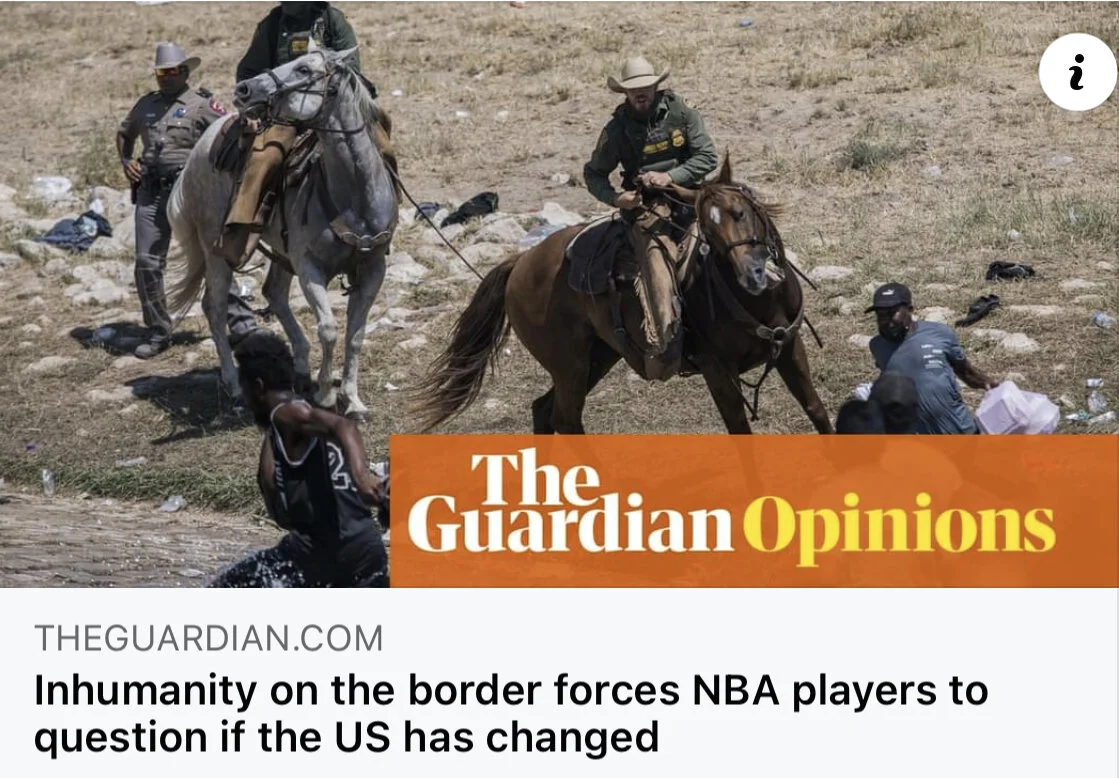
America’s welcome has included deporting thousands of the refugees to Haiti, a country some of them have never been to. But as well as the bureaucratic indifference to the plight of the refugees, there have been more visceral examples of the inhumanity shown by the United States. Images at the US-Mexico border captured by photojournalist Paul Ratje showed two Black men being pursued by a white security agent on horseback, who used his reins like a whip. Humans being treated like cattle is horrifying enough in any context, but the images were particularly repellant in a country founded on slavery.

‘They treated us like animals’: Haitians angry and in despair at being deported from US

There was relief when the regime of Donald Trump left the White House. But Ratje’s photos left many wondering if this is the change they voted for. Is trading someone who promotes, initiates, and supports evil (Trump) for someone who allows evil to continue (Biden) an improvement? 

And those who have doubts include athletes in the NBA, where 75% of players are Black – some of them with roots in Haiti. Olden Polynice, a human rights activist and 15-year NBA veteran, was born in Port-au-Prince, Haiti. During a recent appearance on my podcast, I asked him for his thoughts on the treatment of Haitians at the border.

“My first reaction was sadness. I’ve seen this movie before. In 1993 when I did my hunger strike [to protest US policies on Haitian refugees] we had the same situation. But it wasn’t the coronavirus back then, it was the Aids epidemic. And America was spreading the false notion that Haitians were bringing Aids into the country and they began putting them in Guantanamo Bay. So I have already seen this. It’s history repeating itself.”

The end of historic injustices are exactly what NBA players have fought for in recent years – highlighted most clearly in the months after the police murder of George Floyd. Former NBA All-Star Joakim Noah told me the scenes at the border were a reminder that the journey is not over.

“The images of border patrol agents on horseback whipping Haitian asylum seekers are appalling and unacceptable. These are human beings who have lost everything and are knowingly willing to face such injustices to their human rights because there aren’t any better options,” he said.

“Of course immigration is complex, but no human being should be treated like an animal in order to find a better life – it’s shameful and inhumane. We fought so hard over the past few years to shed light on police brutality in brown and Black communities and to hold accountable those who abuse their positions of power. We need to hold the Biden administration accountable to process immigrants and asylum seekers according to international law and to hold border patrol and vigilantes accountable for their abuse of power.”

It is not just Polynice and Noah who were saddened by America’s treatment of the refugees. After a few days of anger from the public, Biden condemned the inhumane treatment of the Haitians and said that anyone who has mistreated refugees at the Mexico border “will pay”. It’s important to note that details about actual policy change were absent from Biden’s remarks, as well as those of Vice President Kamala Harris. There is no suggestion that America will now abandon the mass deportations and give the Haitians the same dignity and opportunities they give to refugees of other nationalities. 

Biden’s comments far exceed anything Trump was willing to do – after all, he couldn’t even condemn white supremacists after the 2017 Charlottesville hate rally. But “better than Donald” is a low bar for Biden to set himself.

“We voted for these people, and politicians can be some of the biggest gangsters in the world. And whatever they say to get elected, isn’t always what they do after getting in office. They say bring us your tired and your huddled masses and come to a place of freedom, but the problem is, it’s not for everyone. It should be about human rights, but these people don’t see it that way,” says Polynice.

“The Haitians deserve the same that you gave to the Cubans that came over here, the same that you gave to the Afghans, the same that any other group of people receive from the United States. No more no less. Just give us the respect of valuing our human rights. That’s all we want.”

America voted for a changing of the guard, and in some cases NBA players actively assisted in that change. The expectation was for a massive change in policy. But rounding human beings up like cattle at the border seems like the same old America to many of us.

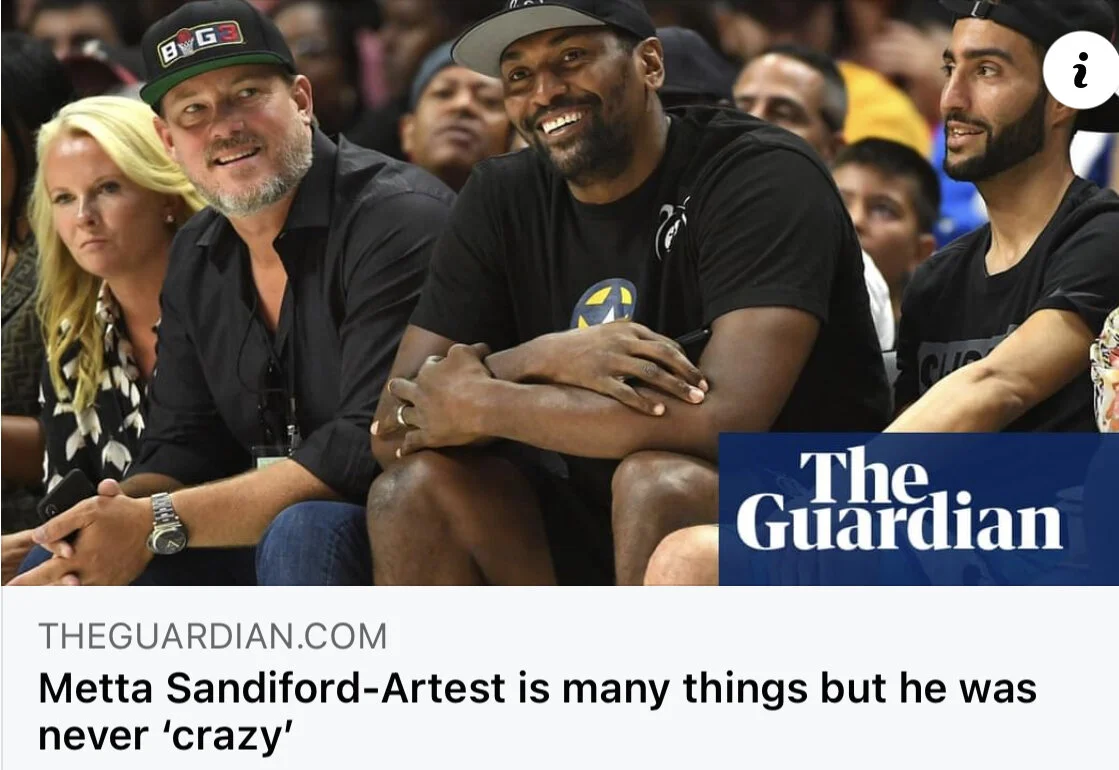
Metta Sandiford-ARTEST IS MANY THINGS BUT HE WAS NEVER CRAZY

In 2013 I was part of a trip put on by the NBA Players Association to Africa. Among my fellow players on the tour was none other than Metta Sandiford-Artest, then known as Metta World Peace. It was nearly a decade removed from The Malice At The Palace, when players and fans had fought at a game between the Detroit Pistons and Indiana Pacers. The NBA came down heavily on Metta, who was suspended for 86 games and fined $5m for his part in the incident.

On the trip, Metta and I talked a lot. We reminisced about our days in college, when my Syracuse team and his St John’s team battled on court. Metta was the same player in college as he was in the NBA: fiery and passionate. I asked him about an incident that stayed in my memory. When we beat St John’s in the dying seconds at Madison Square Garden, Metta approached one of the refs about a missed call. The ref shrugged him off and said something to the effect of: “The game is over, shut up and go home.” 

Metta promptly lost it. He knocked over a TV camera and had to be restrained by players and security. At the time he reminded me of the Incredible Hulk, unable to control his fury.

In Africa, as he recalled his outburst at The Garden, Metta said those types of incidents happened throughout his life and he was working on it. Then he added something I’ll never forget: “I’m not crazy”. I told him I didn’t think that was the case, instead he reminded me of a superhero who wants justice but sometimes picks the wrong way of fighting for it. “Nobody has ever said it like that before,” Metta replied.

I understood why he would be upset in many instances. Don’t get me wrong, I’m not attempting to minimize disproportionate responses in any way shape or form. Indeed without the proper boundaries, guidance and tools needed to deal with unjust situations, a disproportionate response can be dangerous, especially as a Black man in America.

But now, almost two decades after he was excoriated on national TV for his role in The Malice At The Palace, Metta has rebounded from issues with his temper and mental health, and has done the difficult work to not only save himself, but to help others.

I remember after he won the championship with the Los Angeles Lakers in 2010, one of the first things he did was thank his psychologist, Dr Santhi Periasamy.

To give context for that comment, back then, an athlete admitting any type of mental health issue was opening himself up for endless ridicule, from fans and the more unkind sections of the media. According to Johns Hopkins University, around 25% of American adults suffer from a diagnosable mental disorder in a given year. But the ridiculous theory runs that fame and money somehow insulate athletes from human suffering.

Indeed, athletes themselves were not always aware of how mental health could affect their own teammates. I recently interviewed Metta’s former teammate Jermaine O’Neal to discuss his documentary about The Malice At The Palace. O’Neal opened up about how much he regrets not being aware of the mental health issues Metta was struggling with at the time.

“I was young. I did not know anything about mental health. I wasn’t mature enough to understand what this man was going through. While we [were] worrying about wins and losses, [Metta] was worried about how he’s going to handle his life daily,” O’Neal told me on my podcast, The Rematch.

These days, teams take mental health much more seriously than when Metta and I played. The NBA and NFL both require teams to have mental health professionals on staff, a policy that was pretty much non-existent 20 years ago. Unfortunately, loudmouths such as Piers Morgan and Megyn Kelly never miss an opportunity to embrace their inner bully and attack playerssuffering from mental health issues. In fact, Kelly has gone as far as criticizing the US Open for providing “quiet rooms” for tennis players struggling mentally, proof – if any was needed – that her own inner mean girl is alive and well.

Nowadays, Metta has become a mental health advocate. He travels the country educating people on mental health. He encourages young people dealing with mental health challenges that they are not “crazy” but that with the proper coping techniques they can lead a very productive life. He even auctioned off his NBA championship ring and donated hundreds of thousands of dollars of the proceeds to charities across the US.

“I believe in … providing kids with someone to talk to because it’s so expensive. I pay for parenting counseling, marriage counseling and anger management, and it’s very expensive,” he told ESPN in 2010. “This will be for children of all demographics, rich or poor – preferably the rich can pay for their own psychologists – but it’ll be a great way to help kids who don’t know where they’re going in their life at this point.”

Metta’s former coach at St John’s, Mike Jarvis, said he has seen his former player’s growth.

“It makes me feel proud, and honored, and blessed to have had the opportunity to work with him and to learn from him,” Jenkins told me for my show, The Collision. “He is not crazy like people tried to label him, this is part of his mission. God has put him in a position where he can help other people. So I’m really happy for him and I am proud of what he is doing and I hope and pray that he will continue to let his light shine.”

I couldn’t agree more.

MARC LAMONT HILL: THE 76ers CODDLED BEN SIMMONS THEN TURNED ON HIM

Ben Simmons has demanded a trade from the Philadelphia 76ers, per Keith Pompey of The Philadelphia Inquirer. Simmons reportedly informed the 76ers that he wants to be traded and doesn’t plan on attending training camp if a deal isn’t done by that time.

On “The Collision: Where Sports and Politics Collide” with Dave Zirin, our guest was Marc Lamont Hill, a political columnist, commentator, host of BET News and Black News Tonight, and lifelong Philadelphia 76ers fan. He unpacked everything about the Simmons situation from who’s to blame, if a reconciliation is possible and potential trade scenarios involving the 25-year-old. 

Etan Thomas: “Let’s take it from the top: Where did the Sixers go wrong? And did they do anything wrong in their handling of Ben Simmons?”

Marc Lamont Hill: “They went wrong. I mean, the big picture thing is: Ben Simmons, to me, isn’t a point guard. And I've said this since he was drafted. He is a very talented basketball player with a wide-ranging skill set with, of course, one glaring omission, which is shooting. Ben Simmons is not an extraordinary playmaker. He's a great passer. He has great court vision. Lots of guys do who don't play point guard. And I think the fact that he has such deficiencies in the halfcourt [means he] really is not an effective facilitator in the NBA. I mean, you see guys take 15 steps back when he gets the ball at the top of the key, because he's not a threat. He's not a threat on pick-and-roll. I mean, we can go on down the list. This is why Ben Simmons is a problem in the halfcourt.

“So, the Sixers never forced him to develop a shot and they never played him in any position other than point guard. And I think some of that was due to playing to Ben's ego. Brett Brown had no control, and Etan, you know this. The coaches are trying to make the team too. When you're a coach like Brett Brown, a rookie coach, no one knows who you are, you got one shot at this and you do what the owners say, and they said, ‘We want Ben on that court. We want Ben playing. We want Ben as the point guard.’ Brett Brown couldn't sit Ben if he wouldn't shoot a jump shot. He couldn't sit Ben Simmons if he didn't follow instructions. And Ben had no commitment, in my estimation, to being a better shooter, not in a way that I think most NBA. But when you fast forward to the Doc Rivers era, that horse is out of the barn, and Ben wasn't a shooter. That's just not who Ben was. But where they went wrong was they failed to support him. Doc Rivers comes out and says, ‘Ben's a great point guard. He's a great player. Y'all don't know basketball if you think he's not or if you think he's a problem.’ And he was lying to us, y'all. I mean, come on.

“When a point guard goes 1-for-2, or any player goes 1-for-2 from the free-throw line in four-straight possessions in the fourth quarter of a playoff game, and Doc says, ‘Well, I will take one point per possession,’ that ain’t it. We all know you've got to make your free throws. You can't be a 50% free-throw shooter. So, Doc coddled him and played to his ego because he didn't want to mess with his head. He said, ‘I'm not taking him out in the last seconds of the game.’ But then by the end of the Washington series and the beginning of the Atlanta series, he had to take him out, because you can't have a guy that can't make free throws in the game.”

Etan Thomas: “You said he coddled him, but did he support him at the end? Just to be fair, and I love Doc. But I saw Doc in the post-game press conference after they lost and they asked him something like, ‘Can you be successful with Ben Simmons as your point guard?’ And Doc said, ‘I don't have the answer to that question.’ I was like, ‘Oh, that was a little chilly.’ So, what was your interpretation of that?”

Marc Lamont Hill: “My main interpretation was that Doc Rivers had finally become a Philadelphian, because that's what Philly does. We love you, we coddle you, and then we throw you away in a moment. We go from one extreme to the other.”

Etan Thomas: “That's cold.”

Marc Lamont Hill: “But you know it's true. What Doc Rivers did there was wrong, because first of all, you don't throw your player under the bus at the end of the game. He wasn't wrong. His analysis wasn't wrong. He wasn't wrong to say that, ‘I don't know if Ben can be the starting point guard on the championship team,’ because none of us know the answer to that question. I mean, I think that's obvious. The problem isn't that. The problem is you don't say that in the press conference. And Joel Embiid didn't do him any favors, either. He basically blamed the game on him. Was he wrong? Of course not. Do I want my point guard to give up a wide-open dunk because he's afraid of potentially getting fouled and having to make free throws? Of course not. But that's not what you do at the press conference.

“So, the Sixers mishandled him in terms of throwing him under the bus, but they put him in a position where he was extraordinarily sensitive leading up to that, and they played to his ego and coddled him. And so the combination of those two things was not good. Ben is thin-skinned and then they threw him under the bus in a way that even a thick-skinned player would be angry about. And I think that that combination is really bad. The Sixers never developed Ben Simmons, but Ben Simmons has to take responsibility for that too, because Ben Simmons never hired a shooting instructor– he let his brother be his shooting instructor. Many NBA players, coaches, etc. tried to develop Ben's shot and rebuild, reconstruct his shot the way Lonzo Ball did. He refused to do it. He doesn't want to listen to instruction. You can't get better if you're not willing to take instruction.”

TOP NEWS

5-star high school center Vince Iwuchukwu commits to USC

5H

Devontae Cacok to join Nets for training camp

8H

Eric Gordon open to, but has not requested, a trade from Houston

8H

Clippers announce 23-year naming rights deal for Intuit Dome

9H

Pau Gasol contemplating retirement: 'I have not made a decision 100%'

YESTERDAY

Josh Hall working out for multiple teams in search of new home

YESTERDAY

Dusan Ivkovic, decorated Serbian basketball coach, dies at 77

YESTERDAY

Jahlil Okafor signing non-guaranteed deal with Hawks

YESTERDAY

Isaiah Thomas to work out for Golden State Warriors

YESTERDAY

Bucks sign first female TV play-by-play announcer Lisa Byington

YESTERDAY

Dave Zirin: “That's true. One of my coaches said to me, "You can't learn how to jump 45 inches, but you can make yourself into a decent shooter." Everybody from Magic Johnson to, you said it, Lonzo Ball has been able to make themselves into an acceptable shooter or at least acceptable enough to stay on the court during close games. Marc, one of the things that makes you so dynamic – and I'm not just trying to gas you– is you've got this academic bonafide, but you also keep your ear close to the ground. So, where are the Philadelphia faithful right now? Are they on Team Sixers or Team Simmons in how they're feeling about this?”

Marc Lamont Hill: “There are people who are still Team Simmons, but look, I'm Team Sixers. I want him traded, not because I want to throw Ben under the bus, [but] because at this point, his mind's not here. He may develop into a great player, but he won't develop into a great player here. And I think most people here either think that or there's a sector of Philly fans that are saying, ‘We don't think he's great. We think he's a fraud. We think he has all these skills, but they don't matter if you can't be in the game. They don't matter if you have to sit the fourth quarter. They don't matter,’ etc. And then there's a slice of people that say, ‘Y'all just don't get how good Ben is. And y'all don't understand how he affects the basketball game. The eye test shows how good Ben is, and we should keep him. We're making a huge mistake.’ I think that percentage is 25%. The other 75% want him to leave for various reasons.

“I personally say, ‘Trade Ben, and I hope he goes to a place that will let him play small-ball 5, that will let him play the 4. And as Ben develops even a reasonable shot or is just willing to attack the basket, [he’ll be fine].’ Because let's be clear: It's not just that Ben can't shoot, it's that he won'tshoot. He doesn't even keep defenders honest. And so when you have those kinds of dynamics going on, you can't thrive. So I say trade Ben to a place where he can thrive and we get [some pieces back] that will allow the Sixers to be competitive.

“The other problem with the Sixers faithful is we've seen so many bad trades, man. We traded Allen Iverson for nothing. Remember when we traded Charles Barkley for, who was it, Andrew Lang and Jeff Hornacek? And then the next year, Charles was in the NBA Finals. Jeff Hornacek turned out to be a great player, but he didn't last long here; he played well in Utah afterward. Tim Perry was a great Temple player, but not a great NBA player. We've been on the wrong end of too many bad trades, and so we're just skeptical that we're going to get back a bag of magic beans for one of the most dynamic players of this generation.”

Etan Thomas: “Well, Marc, let me ask you this: I've seen some footage of Ben shooting in pick-up games and things like that in the summer, so it looks like he's been working on his shot. He was working out and shooting jumpers. And while everybody could look good in the summer, that at least shows that he is working on it. Would that be enough to warm up some of the 76ers fans, the fact that he is at least trying to work on it?”

Marc Lamont Hill: “Every summer, he says [this]. First of all, if you give me an hour in the gym and a camera phone, I can look like at least Seth Curry. You know what I'm saying? If I can edit the footage and you give me 30 [minutes]...”

Etan Thomas: “Hey, no offense to Seth Curry. He's a good shooter.”

Marc Lamont Hill: “I love Seth Curry! Seth Curry's one of the top 10 shooters [in the league] right now. Seth Curry is great, he's just not Steph Curry. But Ben Simmons ain't even Mark Curry!”

Etan Thomas: “Dang, that's tough. That's tough.”

Dave Zirin: “Shout out to 'Hanging with Mr Cooper.' (laughs)

Marc Lamont Hill: “Exactly. But the thing is, I mean, there are two problems. One, maybe he is killing it at LA Fitness, right? I don't know...

Etan Thomas: “(laughs) You gonna keep on with the jabs, huh Marc?” 

Marc Lamont Hill: “I'm having a rough day, man. This trade’s got my mind all messed up. But look, if Ben is able to shoot in competitive runs in the summer, [does it matter if he doesn’t shoot] when he gets the ball wide open in the corner? At this point in the NBA, that’s the red meat of the NBA offense, a corner three – who wouldn't take a corner three, right? If he came to the NBA game and [doesn’t shoot], it's not just a physical issue, it's a mental issue. And I think that's the part that we have not given Ben enough grace for. We can't be out here protecting Naomi Osaka, as we should, and we can't be over here protecting Sha’Carri Richardson, as we should, and then beat up on Ben when he talks about mental illness.

“And this is a mental problem, whether he says it or not – and he has alluded to it. When you're at the point when you're 6-foot-10 and athletic and won't dunk the basketball in an NBA playoff game because you are afraid of the consequences of having to go to the free throw line, then it's become at least a mental block that we have to take seriously. And instead of bullying him about that, we have to figure out how to develop him. Sports are tough, and I know all of that, but I do think there's more to this than just his lack of desire to get better. I don't think he doesn't practice basketball. I do think he's stubborn about reconstructing his shot. I mean, you don't have to be an NBA pro to look at his elbow and look at how he doesn't square up and look at his body language at the free throw line. He's just not a very good shooter. And you can have bad form and make it, but you can't have bad form and miss it. So I think it's both.”

Dave Zirin: “Let's talk a little bit about Joel Embiid's reaction to this. To me, [if] Joel Embiid doesn't get hurt, he's the MVP this year. So we're talking about one of the short-list, top-level players in the entire league and a team leader. And he tweeted:‘For clarity, I love the criticism. I love when I'm told I can't do something. It makes me work harder to prove everyone wrong, but not everyone is built like that.’ I've read that tweet over and over because I'm thinking, is he trying to show support or is he basically saying, ‘Yeah, we're done’?”

Marc Lamont Hill: “That was the worst show of support I have seen in a very long time. I don't want that kind of support. He basically said, ‘You know what? Be nicer, because some people can't take it.’ Right? ‘Some people are insert any hyper-masculine, inappropriate adjective here’ He's basically saying, ‘Yeah, Philly shouldn't be doing this.’  Right? He's saying, ‘Philly should not be treating players like this. Philly fans are problematic for how they respond to players, but it made me better. I'm not complaining, but everybody can't take it.’ And implicitly saying Ben can't take it. And he's not wrong. Ben is thin-skinned. Ben is not used to having to be criticized. He's been the star basketball player his whole life. He's the number one pick in the NBA draft. He's not used to that, but he's not wrong. But I think Ben is going to take that as another jab, even if it was intended as a show of support.”

Etan Thomas: “It's interesting, because Joel was doing good with the tweet right before that. He tweeted, ‘Stop using my name to push people's agendas. I love and hate drama, but I love playing with Ben. Stats don't lie. He's an amazing player. And we all didn't get the job done. It's on me personally. I hope everyone is back, because we know we're good enough to win.’ He had some other tweets saying the same thing. And then he had the one today. It's like three or four great tweets, and then one line that was just a little bit different.”

Marc Lamont Hill: “Yeah. That was the tell right there. And these guys, they've grown into a good relationship. They didn't always have a great relationship. They've grown into a great relationship. They like each other. They want to play together. But I think, again, it was also an assertion of power. If you really subject that to scrutiny, when he said, ‘It's on me,’ what he's really saying is, ‘It's really on me because it's my team,’ i.e. not Ben's team. So, I mean, there's all kinds of layers of authority being asserted, even in his so-called show of support. 

“But Joel Embiid is 100% right. It is his team. If everybody comes back, they are good enough to be competitive. They're not good enough to win unless Ben magically starts shooting the basketball. If Ben starts shooting the basketball, the team gets instantly better. I mean, the team getsinstantly better. But that's a lot of ifs in somebody's career. But the ultimate thing is Ben and Joel don't fit. They don't fit personality wise. They don't fit basketball wise. They take up the same space on the court. This marriage just doesn't work. And I think it's time for the Sixers to think about what kind of pieces, realistically, they can bring back. Not the Daryl Morey ‘give-me-half-your-team’ trade requests, but a real, sincere trade request to bring in some players that can fill out the Sixers' roster, give them some bench depth, give them a playmaker at point guard who can score, but also not be compromised [defensively]. Ben Simmons is probably, and y'all might disagree, the best on-the-ball defender, in my estimation, in the NBA right now.”

Roundtable: Which NBA team had the best offseason?

Dave Zirin: “Yeah. He's on the list, for sure. And if used right, that's an absolutely lethal weapon.”

Marc Lamont Hill: “Oh, it's a completely lethal weapon. There was some talk about him going to Golden State, which isn't going to happen just because it's a ridiculous request, but imagine him on Golden State with a healthy Klay Thompson, a healthy Steph Curry. I mean, suddenly you've got an amazing team with an extraordinary defensive dynamic that can get out on the open floor, etc. In a place like that, Ben would thrive. Ben would absolutely thrive there. And that's the type of environment Ben wants, but Ben [doesn’t have leverage]. Ben has four years left on his deal. He don't get to pick where he goes. The Sixers need to bring back some young players, some draft picks, and somebody who can score. But again, it's hard to do that when you've got a player who everybody in the world just saw not play so well in the playoffs.”

Etan Thomas: “Yeah. But as you mentioned earlier, you have to look at the 76ers' past and the way that they've traded away players. I mean, I still think Markelle Fultz is going to do great when he's healthy. I think he's going to blow up, and he was on pace to do that before he got hurt. But I think, who are they going to get back for Simmons? And I really do feel that Ben Simmons is going to blow up wherever he goes, but I'm looking at realistic destinations. I mean, you throw out different things. I heard Toronto and, like you said, Golden State. But what realistically are you going to get back that's going to equal Ben Simmons?”

Marc Lamont Hill: “Again, it's one of those things... You have two approaches, right? You wait for the superstar; you go superstar for superstar. That's plan A. That rarely happens in the NBA, because you rarely have two [stars available]. You rarely get the Danny Manning [for] Dominique Wilkins kind of deal, right? You rarely get the kind of star-for-star approach. You usually end up getting back pennies on the dollar, because usually if you're trading a superstar, it's because it's a so-called distressed asset. Right? So not to commodify the player, but just to think about the logic of it. So that would be where I began.

“So when you asked me what I would want to get back, Dame Lillard would be plan A. And if Dame Lillard says, ‘I want out,’ I think the Sixers are the primary destination, even though they're going to have to also give up Tyrese Maxey, which I think is a lot to give up because I really think he's a player. But you can find another Tyrese Maxey, no matter how good he is. Dame Lillard's in his prime right now. If you give me three good years of Dame Lillard with Joel Embiid, I think you'd have a puncher's chance at a championship every year, as long as you keep Tobias Harris and you have strong role players, like Seth Curry, etc.

“If that doesn't work, then you've got to go and talk about what package of players you can get. Minnesota seems to have the best haul of pieces. Sacramento would be interesting, but they said, ‘We're not giving up [Tyrese] Haliburton. We're not giving up De'Aaron Fox,’ so that's a non-starter for the Sixers. Buddy Hield is a guy that everybody's willing to trade for, but they're not willing to give up so much. The Lakers had that challenge. I don't want Buddy Hield here as my replacement for Ben Simmons. It doesn't make basketball sense. It doesn't make any sense. I personally think Minnesota is probably the best suitor right now, given what we see on the table. 

“The question is do you, as a Sixers team, want D'Angelo Russell as your primary return here? You'll get a shooter. You'll get a decent playmaker. You'll get somebody who's not afraid of the limelight. But you also get somebody who's been on multiple teams. Again, he's like a Tobias Harris. He's a great player, excellent player, but also a guy who sometimes gets traded because he's not the number one option. He might be the number two or the number three option on a great team. Give me D'Angelo Russell and some pieces. At this point, it might be the best thing on the table. If you get a lineup with D'Angelo Russell and Tobias Harris and Joel Embiid isn't terrible. But you're not defending like you did last year.

“The last thing I'll say is: we can't underestimate what Ben Simmons does on the basketball court. Ben Simmons as a defensive rebounder, as a help defender and as an on-ball defender… Ben Simmons is an all-world defender, and he makes up for a lot of the mistakes. And as Danny Green gets older, and Seth Curry... Seth Curry's just not a defender. When you have these shooters on the floor that don't defend well, all of these 3-and-D guys on the Sixers, losing an extraordinary perimeter defender like that is no small thing.”

Etan Thomas: “Is there any scenario where you can see it working if Ben Simmons comes back, if none of those trade scenarios work before training camp?”

Marc Lamont Hill: “I remember when Kobe Bryant was saying there ain't no way he was coming back to the Lakers and he wanted to be traded. It's happened before. I've seen guys [change their mind]. But the problem is this: Kobe wanted a better roster. This isn't a roster issue. This is an accountability issue. This is a support issue. This is an ego issue. This is a team [issue]. These issues are deep. And so, I don't know if this can be fixed. I'm not convinced that it can be fixed.

“Do I see a scenario where he comes back? Yes. Philly is not taking a bad deal, so I think the most likely scenario is [Morey] brings him back. He doesn't go to camp, but his agent, of course, Rich Paul, convinces him to actually play the games so that he doesn't look like a cancer. And then we see the James Harden situation, where five-to-10 games in, you have a trade. I think that is possible. But I'd love to be a fly on the wall in that locker room, man. I would love to see him and Doc talking. I'd love to see him and Joel talk. I mean, I'll be at the game just for that.”

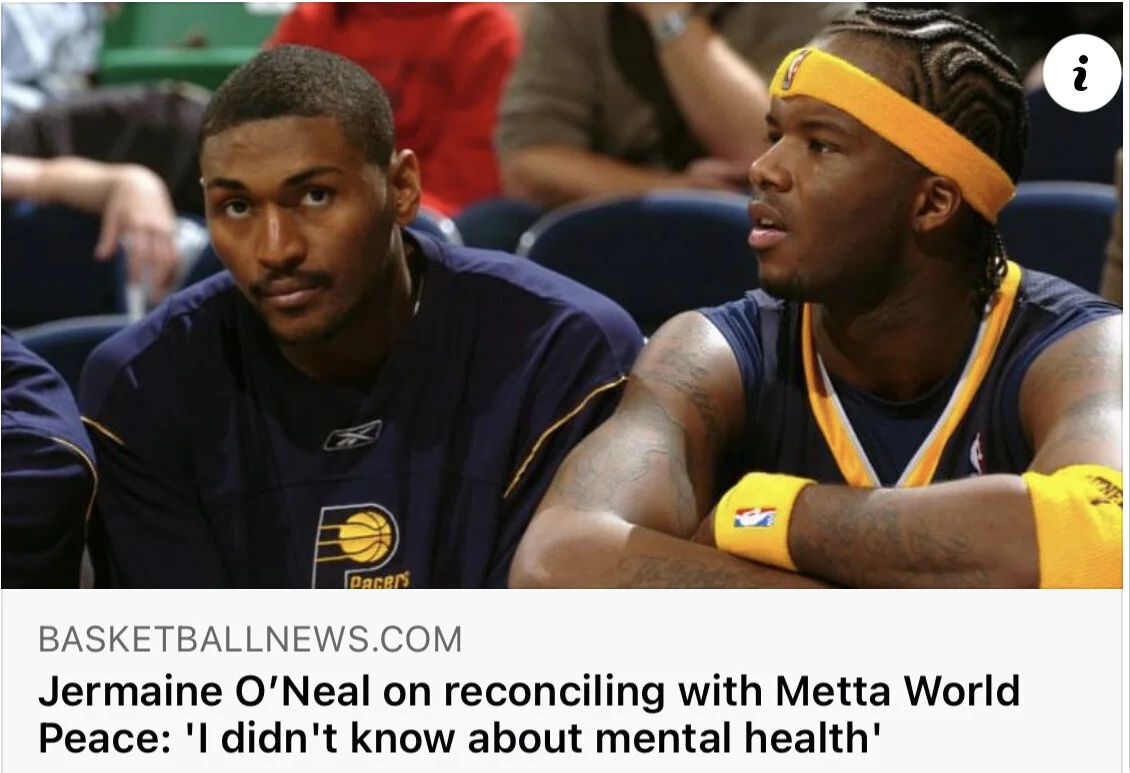
JERMAINE o’NEAL ON RECONCILING WITH METTA WORLD PEACE: I DIDN’T KNOW ABOUT MENTAL HEALTH

Watching the documentary “Untold: The Malice At The Palace” that premiered on Netflix on Aug. 10, it’s apparent that there was quite a bit of tension between Jermaine O’Neal and Metta World Peace (who went by Ron Artest at the time) following the Malice at the Palace.

The relationship between O’Neal and World Peace was already strained prior to the brawl, and it only got worse afterwards. Apparently, the friction intensified even more when Metta asked for a trade from the Indiana Pacers after the Malice at the Palace. O’Neal revealed that he wasn’t happy to see World Peace win a championship with the Los Angeles Lakers, and viewers left the documentary with many questions about their relationship.

Is there still a rift between O’Neal and World Peace today?

I interviewed O’Neal on my show, "The Rematch," and we broached this topic. He explained the tension and expressed a tremendous amount of regret – not for having his teammate’s back during the brawl, but for not fully understanding everything that World Peace had been dealing with for a long time. 

Etan Thomas: “I want to shift gears a little bit and ask you about Metta World Peace. I was watching ‘All The Smoke’ and you told Matt Barnes and Stephen Jackson that y'all have spoken recently. You sat down at the BIG3 and you had a chance to talk. I was so happy to hear that because I know that y'all weren't on good terms for a while and there was a lot of friction. But that’s great, that you sat down and spoke. Talk to me about that reconciliation process?”

Jermaine O'Neal: “Man, it was something that was much-needed. We all wish we knew back then what we know now – when we were at 23, 24 years old. I went through a process in Portland where it was like fight, fight, fight, fight, fight for everything, for every inch, [for] every minute. I wasn't playing, so I had to keep showing my worth. I went through that for four years. Through that process, I went to two Conference Finals, right? So I saw it, I understood what to do and what not to do. So, I felt like when I left there, it was only about one thing: Win, win, win, win. Right? That's it. Just show people who you are. Because I felt slighted for four-straight years by not getting a consistent opportunity. So, when I got [to Indiana], it was like, I wasn't really trying to hear nothing but, 'Hey, let's come in here and work.’ And I was young, I was 24 years old. I did not know anything about mental health. You know this like I know it, if you were speaking about mental health back then, it was devastating to you, because nobody was educated about it. If you heard someone needs help with mental health, you'd say, ‘Oh, he crazy.’”

Etan Thomas: “Right.”

Jermaine O'Neal: “You wouldn’t want to put ‘career’ and ‘crazy’ together in the same sentence because [you wouldn’t] have any longevity in that particular sport. I think the Pacers did a really good job on holding it together. I’d try over and over and over and over to reach out, ‘Hey, Ron, let's go to dinner.’ It was always, ‘Ron, let's do this.’ And then finally, he kept saying, ‘No.’ And then he kept wanting us to quit [asking]. And I was like, ‘Wait. Does he not like me? Or does he not like the team? Does he not want to be here?’ And it started to eat at me, like a virus. And bro, I just was so angry all the time with him, because he would call press conferences in the parking lot somewhere and we're getting the information when the media is getting the information – or even, in many cases, afterthe media. There was no conversation amongst the players with him saying, ‘Hey, I feel this way.’ And so I did not know how to handle that. 

“And as a brother, as a teammate, we're together all the time. You spend a lot of time with each other in the locker rooms and everywhere else, planes, bus rides. And I wish that I knew more [about mental health] because if I knew more, then my aggression towards him doesn't expedite his anxiety or his dislike – whether it was [about] me or being on the team or that basketball environment. He just was like, ‘I'm not messing with you.’ We just play, and then after that, boom: no conversation. And I think it's important for people to know that when we shot the doc, we shot it separately. The only conversation I had with him about the doc was the initial conversation of, ‘Hey, this is what I'm looking to do. It's a Netflix deal. All I need you guys to do is just be open and candid about how you viewed it.’ But we never saw each other at any point during the filming of that doc."

Etan Thomas: “Oh, okay. I didn't know that.”

Jermaine O'Neal: “Yeah, we shot it separately. So, when I saw him describe his process of that night – his counting to five, how he had to really take things in. Not only did it put a lot of perspective on that night– and how, when Ben Wallace pushed him, that started his process. So he then goes to lay down right away because he's trying to get himself together, right? Ben throws the headbands, wristbands at him. Now, it takes him up to level two. Now, the water is boiling at this point, and you see the bubbles are about to boil out of the pot. And he had jumped up and he told me, ‘You better get him!’ He kept saying, ‘You better get him!’ And he laid back down. Then, when the cup came, it was like number three, and that was the most heightened level. And I understood it. It made complete sense to me.

"But what it also did is put into perspective how he handled things as a teammate on a regular basis. When things got tight, in its most intense form – whether it's our level of communication to each other or in games – [this is how he would think]. Like, I remember we were in Memphis and we didn't have a good game and Coach was yelling or whatever; he went in and he knocked over the heating pads that they would put in the hot water. He knocked it over and it damn near got on everybody, and people are jumping out of the way because it's piping hot water! We've seen [his] reactions – breaking the camera in New York coming through the tunnel, right? And it all was like a flashback. And I’m like, ‘Damn, he's been trying to handle thisforever.’ And while we're worrying about wins and losses, he's worried about how he's going to handle his life daily.”

Etan Thomas: “Yeah.”

Jermaine O’Neal: “And so I felt a certain way when I saw that and I thought… We've talked multiple times before and especially after the doc about different things. But shoutout to Ron – I can't call him Metta –for being so open and honest and vulnerable. Because we know the media and public opinion can be cruel sometimes. So, I had to say that, man, because that meant everything to me. Actually, and I also didn't know what he said when he won the championship and he was on the court with Steve Smith and all of them.”

Etan Thomas: “Yeah, I remember seeing that live. In case anybody didn’t see it, the first thing that he did after winning the championship with the Lakers – before he answered any questions – was talk about you guys. He said he was supposed to win a championship with that Pacers team and that he had so many regrets about how it all went down and that he felt like a coward because he left Indiana. And he’s saying all of this on live TV right after they won the championship!"

Jermaine O'Neal: “I never saw that. Somebody told me, but I was so mad with him, I didn't want to see nothing, hear nothing, nuh uh! Like, when I did the doc, I said, ‘I wasn't happy that he won no championship! I was mad as hell!’ Like, ‘After what he did with us, why would he get to win it and I don't have one?’ Even at that point, I wasn't mature enough to understand what this man was going through.”

Etan Thomas: “Wow. When I saw him say that stuff after winning the championship, I realized, ‘Wow, he was really hurt by this.’ He acknowledged that he didn’t handle certain situations well, but he also said that he didn’t know how to handle those situations and it’s something that he was working through. And that’s the mental health part that was non-existent in the NBA until, really, just a few years ago.”

Jermaine O'Neal: “Yeah. And I gotta say this: People, when we hear ‘mental health,’ that is so wide-ranging. I mean, I'm watching myself over 17 years having mental-health issues. That doesn't mean I have the same mental-health issue as Ron or any person that deals with it at that level. But it's more of emotional distress or a level of sadness about something. We just watched Naomi Osaka go through that now– her process from the Olympics. I watched her yesterday on television doing an interview and she broke down crying."

Etan Thomas: “Right, because of what happened in Haiti.”

Jermaine O'Neal: “Yeah, it was about Haiti. And it's just people, we've got to understand what that is. We're all vulnerable to mental-health issues, just some people's severity is more significant than others.”

Etan Thomas: “Right. But I was really glad to see that y'all went back and started talking again. I’m really happy about that. I remember when he laid on the scorer’s table and was trying to calm himself down, a lot of the discussion was about that and so many people didn't understand what was happening. With mental health, people just didn't get it – and they're just now startingto understand or attempting to understand it. We're not robots; we have things we deal with like everyone else. We have different emotions that we have to figure out how to manage. That was the problem for so long: so many in society looked at us as robots or as video-game characters – like they just start the game and we just play and that was it, there were no feelings or anything like that. And that's just not reality.”

Jermaine O’Neal: “You’re absolutely right.”

David Aldridge: The Media Failed To Tell Full Malice At The Palace Story

David Aldridge was a guest on my weekly show, "The Collision: Sports and Politics," with my co-host, Dave Zirin, and we discussed the Malice At the Palace documentary that was just released on Netflix.

The documentary presented a thorough and complete examination of the infamous 2004 melee that turned the entire basketball world upside down. 

"Untold: Malice At The Palace" does something that the media as a whole failed to do back in 2004: Tell the whole story from everyone’s perspective who was involved, including the players and fans who played a part in the fateful night — Auburn Hills security, Auburn Hill police officers and the specific Oakland County prosecutor handling the case. This is the complete viewpoint everyone should have been privy to back in 2004, but instead, the vast majority of basketball fans were only presented a one-sided, skewed view of what actually took place. 

To discuss this in more detail, we had David Aldridge as our guest. Below is our conversation about the event itself, and its mishandling.

Dave Zirin: Welcome to The Collision! He's Etan Thomas, I'm Dave Zirin, here from your home of jazz and justice, 89.3 FM. WPFW also being broadcast on 99.5 WBAI in New York City. Etan Thomas?

Etan Thomas: Yes, sir.

Dave Zirin: So proud to introduce D.C.'s own, American University's own, the Hall-of-Famer, the dean of basketball broadcasting and sports journalist for The Athletic, the man himself, David Aldridge. David, how you doing, sir?

David Aldridge: Gentlemen, what's happening? How you doing?

Dave Zirin: Well, Etan and I have been talking all week about this Malice in the Palace documentary on Netflix. So we've been thinking about what we were talking [about] before, about what we were discussing 17 years ago, and how our perceptions have changed, who got it right [and] who got it wrong. So I just wanted to ask you if you could take us back then, for yourself, where were you and what was your first reaction when you saw the punches flying in Auburn Hills?

David Aldridge: Ah, man, my first reaction... I was sitting on my couch and my first reaction was, "Ah, man, I wish I was still at ESPN," because I knew exactly how this was going to go down. But they decided to go in another direction, as TV companies do. And it's okay, that's what happens to all of us eventually. But it was bad. Look, the visual was bad. The reaction was bad. We had Jermaine on our show, our podcast, a couple of weeks ago when it was premiering on Netflix. And I've talked to Jermaine about it over the years and I know it's obviously a very difficult subject for him because of all of the different things that were going on at the time. People don't realize this, that Jermaine had lost his stepfather the year before, who was in Indiana with him, was really kind of looking out for him, and had to deal with that on top of everything else, and then trying to compete for a championship at the same time.

I had always liked Jermaine. When I interviewed Jermaine the first time, he was 17 years old at the RTP in Orlando in 1996. And Jermaine was always one of the most thoughtful young cats that I talked to. He just always was a very deep thinker, even at a young age. And I'm just happy that he's gotten a chance to kind of get a more balanced view of what occurred that night out to the public, so that the public can kind of make up its own mind. I would say, [and] you asked Dave at the beginning who got it right and who got it wrong, look, when it comes to mental health, we all got it wrong. I'm at the top of the list. I did not know how to deal with people that had mental problems in 2004. I don't think many people did in the NBA.

And I think, if that had... If Ron Artest, Metta World Peace, Metta-Santiford Artest, as he likes to call himself now, if he was coming up now, it would be a completely different — there would be a support system in place for him that just wasn't there in 2004. And I think that would've... That may have changed everything in terms of how his career turned out. What happened that night, the perception of what happened that night, all of it would have been different if it had happened now.

Etan Thomas: D.A., thanks for coming on The Collision, always appreciate your commentary. Let me ask you, because watching the documentary and reminiscing about everything... I was in the league at that time, and I just remember the way that the media covered it — ESPN in particular -- and the way that it was shown and how they criminalized the athletes. It was all the athletes. The word "thug" was thrown around a lot, [as well as] menaces, savages, all these different descriptive terms, but then nothing was really said about the fans. And I remember talking to my peers about it. We had this big conversation in the locker room with the Wizards right after it happened, and I want to ask you this question: do you think that a lot of the media, after seeing this documentary and being shown different parts of it that they weren't privy to, do you think a lot of the media maybe owe the players an apology with the way that they described it, and described it so one-sided?

David Aldridge: Do they owe them an apology? Maybe. Would they give them one? I doubt it. So, I mean, I'm just being real with you, Etan. People, whether it's the media or just society in general, very few people have the kind of self-reflective gene in them to realize when they've made mistakes and to own up to those mistakes.

It is a failing of the journalism business in general that the resolution is never as prominently displayed as the charge. You know what I'm saying? The charge is on page one, the resolution is on page 18. And that's a failing of journalism but, again, it doesn't have anything to do with sports. That's journalism. We just fail at that as journalists. But there's no question that the media went overboard, just like they did with Latrell Sprewell, with PJ Carlesimo. And again, I'm not trying to make myself the center of this, but I think when I was at ESPN, when the Sprewell thing happened, I was able to go on TV and say, "No, the NBA does not have an epidemic of players choking their coaches."

Etan Thomas: Right, and that was important because that was becoming the narrative. 

David Aldridge: Right, so I was there to say no, this is not something that's going to happen... I remember, literally, one guy in particular with ABC News asked me that. "Is this going to happen a lot now? Is this just the way things happen now?" No, it's not. Look, the majority of reporters, media in the NBA... whether they're covering the NBA, or the NFL, or baseball, or whatever, are white males. And those are the people that, especially, certainly in 2004, were setting the agenda in terms of, this is how we're going to view this incident. Right? And in the documentary, you see Bob Costas, who usually is a pretty thoughtful guy on many subjects, just going right to "thug". You know what I'm saying?

Etan Thomas: Yeah, and a lot more media too.

David Aldridge: And it's not surprising in retrospect, because in 2004,  the league didn't know what to do with Allen Iverson — had no idea what to do with him. [The NBA] could not figure out the first thing about: how do we deal with Allen Iverson, the most popular player in the league?

So, how did they deal with him? Well, they airbrushed the tattoos off of his body when they put their hoop magazine out. I broke that story, by the way. Me and Rick Telander, at the Chicago Sun-Times, broke that story. So, they didn't know what to do with it. Allen has an incredible following, not just among fans, but among players. AI was the guy that a lot of guys looked up to coming up at that time. And so, the league didn't know what to do. And they had no idea how to handle it. They didn't know how to talk to these young men. They didn't know how to... They didn't relate to these young men at all. And so, they went to the default, which is, "Well, it's got to be the music that they listen to." And you see this today, with people in my business — some people in my business, I'll put it that way. Continually talking about rap culture and rap this, and rap that and rap the third.

And that's unfortunate, because it's a total mischaracterization, I think, of the circumstances under which a lot of the young men grew up and what they relate to and what they consider important. And the media failed. And what happens when you have an incident that goes beyond sports, is that a lot of people who don't know anything about sports wind up talking about sports.

So, you have people on network news, who've never been in an NBA locker room, who don't know anybody in the league, talking about the league as if they're experts, and that's problematic. But that's what happens when things like this happen that go beyond the sports page.

Dave Zirin: David, my mind is exploding with questions based on what you just said. But if I just have to choose one, I'll start with this. When you say that the league did not know how to relate to Iverson, the league did not know how to relate to hip-hop, the league did not know how to relate to this generation of players, are we really talking about [former NBA commissioner] David Stern, or was it broader than David Stern?

David Aldridge: Well, it was broader than David Stern, but David Stern had the hammer. Now, let's not get that twisted. David Stern was the guy, okay? He was the guy that set the tone. It's in the documentary. "Was this the unanimous decision?" he said, "Yes. One, nothing." There was no doubt that David Stern was making the decisions about how the league was going to react to this. Now, did he get advised by owners or other people that are in his circle of influence? I'm sure he took some calls and talked to people. But there is no question, and I don't think anybody, even in the league, would deny that this was Stern's call. He was wanting to set an example on somebody and it happened to be the Pacers, much more so than the Pistons. And he did. And it was David's league. He ran the league with an iron fist for 30 years. And he told the owners that: "It's my league."

And the fact of the matter... I mean, the real of it, guys: David Stern is hired by the owners, which means that he can be fired by the owners. If they don't like what he's doing, they can get rid of him. They didn't for three decades.

Okay? Because they liked what he was doing. They liked the kind of law-and-order mandate that he had, and the way he kind of kneaded out justice as he saw it over the years, along with other things. And he made them a lot of money too, don't get me wrong. I mean, that's part of it too, is that he made the owners a lot of money. [But] you didn't hear [Pacers owner] Herb Simon complain and say, "This is unfair to my team. Why did you do this to my team? You shouldn't have suspended Ron Artest for the rest of the season. That was wrong." You didn't see no interviews from Herb Simon. So they were all in line with what David wanted to do.

Etan Thomas: Let me ask you this. After you left ESPN — and I can say this, you don't have to say this, but I can say — if you were at ESPN, I think, at that time, there would have been at least a more balanced discussion as to, "No, this isn't all one-sided. Let's also take a look at what the entire NBA culture, including the fans, need to improve on as well." You know what I mean? And that just wasn't the discussion. There were panels, there were, "What's wrong with the NBA? Is the NBA full of thugs. Are they all criminals?" The rap music, like you said, the clothes, the hair, all of this stuff — was there anybody at ESPN to have that balance? Or after you left, was there just nobody else.

David Aldridge: I think there was a conscious decision made that they were going to go towards more debate. I'll put it that way. They wanted to have debate as their central thing. I was there for eight years, and when I got there, they had Peter Gammons and Ed Werder. Peter Gammons had been in The Boston Globe, Ed Werder had been in The Dallas Morning News, Chris Mortenson had been in The Atlanta Journal-Constitution, I've been with The Washington Post. They hired sportswriters. They hired people that knew the leagues that they were covering, knew the people in the league, knew everybody, knew the players, knew the owners, knew the GM's, knew the coaches, knew the agents. They started to get away from that because they felt like they had to do more than just cover the games.

And you can do that, but you then sometimes leave yourself kind of vulnerable on nights like the Malice at the Palace, when you need somebody who's covered the league for 15 years at the time who might be able to have some context. Then what was missing was context. Yes, this is bad, but the NBA has had way worse fights in the 50's and 60's. They used to go in the stands all the time in the 50's and 60's. Red Auerbach used to fight fans on the regular back in the day. So you need somebody who can say that, to point that out and say, "This is bad, but it's not the first time this has ever happened in the NBA's history." And they didn't have that.

Dave Zirin: Yeah. And I'll tell you, watching the documentary, and I was wondering if you had the sense of this at the time, David, because I did not have a sense of this at the time: the degree to which the players were besieged. Because that's what the documentary did so well, was that. Because ESPN, I remember at the time, it was all about Artest going into the stands. It was all about Stephen Jackson throwing punches. It was all about that slide across the floor with Jermaine O'Neal, but not about how, and they showed this in the documentary, them looking around and wondering where the security is and seeing the encroaching thousands. I mean, that must've been just absolutely terrifying.

David Aldridge: I will say, this is the one thing I learned from that documentary. Because if you're immersed in this stuff, as people cover the NBA, you knew most of it, right? But what you didn't know, where were the cops?

There were no cops. There are cops at every NBA game. There are hundreds of cops at every NBA game that I've been to. You see cops everywhere. They're in the voms. There are the voms, which are the little areas where the players go, between the court and the locker room. They call them vomitoriums, that little area underneath where you see them throwing everything at Ron Artest, beer and popcorn and everything, right? The cops are always there. You know what I mean? They're always ready to go wherever they need to go, to break whatever they need to break up.

And one of the police officers literally said there were three cops in the building. There were three cops on the floor, let's put it that way. And that, to me, is the most damning part of this documentary — that there was no law presence whatsoever. It was literally fans just coming on the court. When do you see a fan just walk on the court?

Etan Thomas: And not just popcorn and drinks. They were throwing chairs. Multiple times. They showed the one chair that almost hit Jermaine O'Neal, that hit the other fan, but there were multiple chairs. And I was just so curious as to why the media never told that part of it.

David Aldridge: I think part of it is, as the doc says, some of this was not available to the media, but some of it is just being lazy, I think. And again, the narrative kind of leaps ahead of the conclusion.

The narrative is, players go into the stands and fight fans. The conclusion is, fans get sentenced to prison, you know what I mean? For doing dumb stuff. The D.A., in this piece, I think, comes off as one of the heroes, who said, like, "No. We're going to prosecute these people. They need to be prosecuted for instigating." The guy said, if John Green doesn't throw the cup, none of this happens. You know what I mean? It's squashed. It's like Reggie said: it's what happens all the time in NBA. Guys come together, there's a little push, a little shoving. Ain't nobody really trying to fight in the NBA, you know what I'm saying?

So it would've been that. It would've been, like, maybe Ben gets suspended for a game and that's it. And it didn't happen that way. And again, I'm not excusing, but Ron shouldn't have gone to the stands. He shouldn't have done it.

Stephen Jackson shouldn't have gone to the stands. You can't do that. No matter how stupid people are acting, you just can't do that. Now, was it [warranting] a season-long suspension? I would argue it shouldn't have been a season. I would have argued 30 games for Ron, and maybe five games [or] ten games, for the rest of the guys. But again, David Stern's operating with a different set of priorities than maybe David Aldridge is, you know what I'm saying?

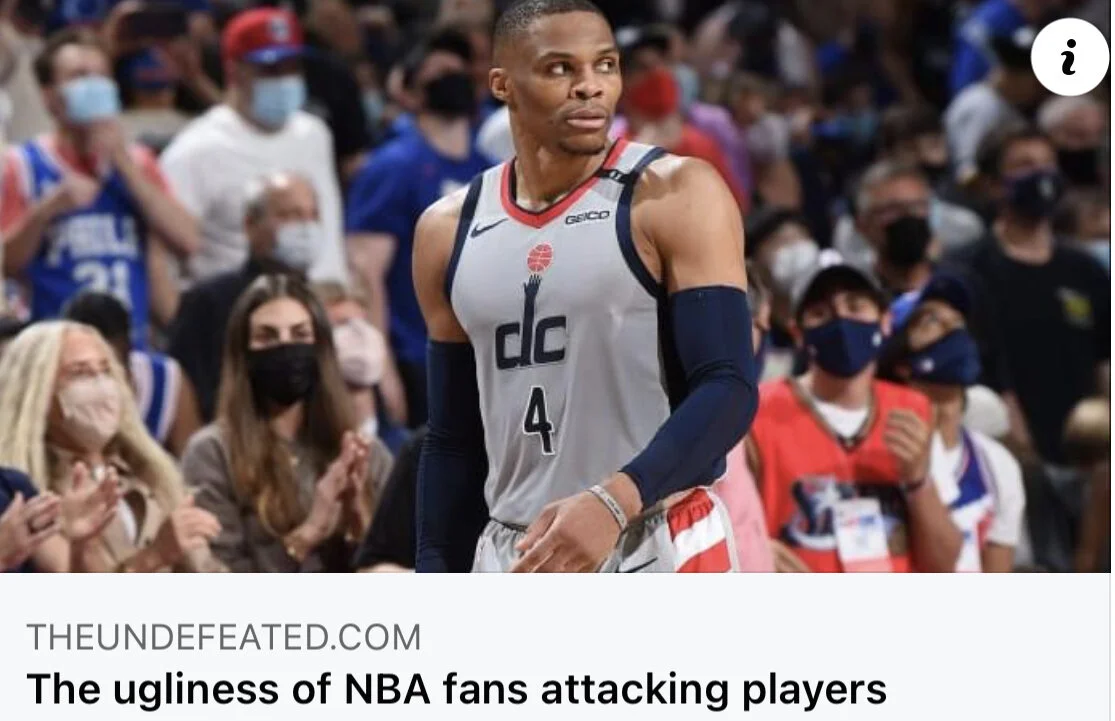
Etan Thomas: We're about to end, and it went so quick, but I want to ask you this related to today, because we still have issues with fans today. So as soon as fans were let back in from the COVID-19 pandemic, you saw the incidents. A fan spit on Trae Young, they threw the popcorn on Russell Westbrook, a fan ran onto the court right in front of Dwight Howard. So is the NBA doing enough now with fans, or what should be done moving forward?

David Aldridge: I think, Etan, it's very dangerous what's going on now. Because I think it is a combination of people coming back from COVID, wanting to get back in the stands, wanting to get back to their normal "lives" and be able to be fans and yell and scream and do all the things that, I think, most of us understand fans have perfectly within their rights to do. You can boo, you can cheer, you can hope the opposingguy misses, but when you start throwing the N-word around and throw popcorn and beer at people, now you've crossed the line.

You just can't do that. So, it's a combination of that, with people paying a lot of money for these tickets, and the NBA's got to think about this, and I don't think they think enough about this. People feel like, "I paid $4,000 for these two tickets. I can do whatever the hell I want, and I can say whatever the hell I want." And they have to think about that. I don't know what you do. You can't have seminars with fans. I don't know. But there's got to be some way to articulate to fans that... It doesn't matter if you're sitting courtside, you don't get to just say whatever the hell you want. You know you don't. That doesn't give you the right to do that. Maybe you do PSA's [or] you have some sort of public relations campaign, I don't know. But they have to do something, because I think this could be a real problem, as I suspect the league will be pretty close back to normal in most places by the start of next season, with regards to attendance.

I think most people are going to let fans in. And look, I think 95% of fans are great, and they're fine and they don't go over the line. And they're good people, and they want their home team to win, and I get that. And they handle themselves accordingly, it's just that lunatic 5%. And again, another good point they made in the documentary, and I think Reggie Miller made this, was the fact that the game was a blowout meant all the knowledgeable fans were like, "Well, this game is over. We're leaving."

So the arena was half-empty by the time the brawl started, because all the — I hate to say it this way — but I think all the more intelligent fans were like, "Well, this game's over. We'll come back. We'll get them next time." And then they left. And so that left all the drunks, basically, in the stands to kind of act ridiculous. And yes, you’re absolutely right. The media failed at not showing the full story back then. I can’t argue with that. 

The Sha’Carri Richardson discourse shows most fans don’t care about athletes as people

As I came to know in my own NBA career, the reality is most people don’t care what athletes are going through personally. Just do your job, entertain me and keep your issues to yourself

When it comes to athletes, nobody cares about your pain.

That much is apparent after listening to all of the discussions on sports radio and television and reading comments across social media in the week since Sha’Carri Richardson was dropped from the US Olympic team after testing positive for marijuana.

On Tuesday, Richardson’s last hope of competing at the Tokyo Games in the 4x100m relay, which is scheduled after her one-month suspension will be completed, was dashed when she was left off USA Track and Field’s 130-person roster for this month’s Summer Olympics.

One talking point that has been repeated time and again is that Richardson has accepted her punishment and everyone should just move on. But what was she supposed to do? Not accept the sanctions? Fight against the US Anti-Doping Agency, USATF or the US Olympic & Paralympic Committee?

All she could do after seeing her sensational results from the US Olympic trials disqualified was say she was sorry.

“I apologize,” Richardson said on NBC’s Today show. “As much as I’m disappointed, I know that when I step on the track I represent not only myself, I represent a community that has shown great support, great love. ... I apologize for the fact that I didn’t know how to control my emotions or deal with my emotions during that time.”

“We all have our different struggles, we all have our different things we deal with, but to put on a face and have to go out in front of the world and put on a face and hide my pain,” Richardson said. “Who are you? Who am I to tell you how to cope when you’re dealing with a pain or you’re dealing with a struggle that you’ve never experienced before or that you never thought you’d have to deal with. Who am I to tell you how to cope? Who am I to tell you you’re wrong for hurting?”

Richardson’s essential admission that she had self-medicated to cope with the death of her birth mother in the days before the US trials was met with a surprising callousness and lack of compassion from the talking heads across sports and general news media, many of whom have returned to the same points again and again:

 “What kind of example is she setting as a celebrity?”

 “Are we supposed to bend the rules because someone has a sob story?”

 “We have rules for the norm, not for the exception.”

 “It’s unfortunate that she initially tried to rationalize this. She had a good reason but it’s not enough to justify you violating restrictions.”

 “She knew the rules, she broke the rules, end of discussion.”

(It’s interesting that a lot of the critics who are now declaring that “rules are rules” tend to be the same people who loudly and proudly flouted the public health guidelines of wearing a mask or social distancing during a global pandemic. Or the same people who refuse to honor the results of a democratic voting process and are holding onto a false claim that the November election was stolen from Donald Trump despite zero credible evidence of voter fraud whatsoever. But I digress!)

This week I spoke with former NBA player Al Harrington for my show The Rematch. Harrington, whose company Viola Exracts is one of the nation’s leading producers and licensed wholesalers of premium quality cannabis products, made the case that marijuana was not in fact a performance enhancer and therefore shouldn’t be on the banned list in any sport. He highlighted the contradiction of addictive opiates being passed out like candy in professional sports but an organic pain-management alternative like marijuana being illegal. He recalled how he was given an anti-inflammatory called Celebrex and instructed to take two in the morning and one at night for most of his career; only years later did the FDA require Pfizer, the drug’s manufacturer, to pull Celebrex from US pharmacies because its risks of heart, stomach and skin problems clearly outweighed the benefits.

Harrington also discussed the irony that Richardson won the trials in a state where marijuana is legal for both medical and recreational use. He advocated for Usada and the USOPC to re-evaluate what he called a very “outdated” rule, especially as many countries around the world are now accepting cannabis in some form within their countries. He discussed the benefits from a medicinal standpoint of the plant, not only for athletes but everyday people dealing with anxiety, depression, as well as joint pain.

But what stood out to Harrington most was the lack of compassion toward Richardson he saw in the general tenor of the media coverage.

“You have to think, she had to be really low,” he said. “She knew she had to run in four or five days, she knew there was a possibility that she could test dirty, she had to be really low at that moment to say, you know what, I’m either going to do this or I’m going to do that, and her that was probably way more detrimental to her health. That has to let you know that she was in a bad spot.

“I lost my dad when I was eight, and I remember what that did to me. I can imagine what she is going through. And having to then go out and compete?”

Advertisement

“Yes, rules are rules, and I will always acknowledge that. But it’s time for us to change this old, outdated rule. Sha’Carri Richardson smoking weed four or five days dealing with her mother’s passing did not make her run that 100 meters in 10.65 seconds.”

As I came to know in my own NBA career, the reality is most people don’t care what athletes are going through personally. They just want them to perform at an optimal level and that’s all they care about. Entertain me and keep your problems and issues to yourself. If you’re required to talk to the media, who cares about your depression or anxiety? Just do your job, Naomi Osaka. If your mother just passed away, who cares how you’re feeling, Sha’Carri Richardson. These are the rules and you better not break them.

Let me be clear: I’m not advocating for anyone to break anti-doping regulations, which in place there for a reason. But certain situations like Richardson’s need to evoke a sense of compassion and nuance that at best cause a reevaluation of the rule itself, but at least serve as a reminder to fans that athletes are in fact human beings.


I played alongside Jordan. I’ve seen the pressure on athletes like Naomi Osaka

When I saw the news of Naomi Osaka’s withdrawal from the French Open I thought of two people: my former teammate Michael Jordan and my 13-year-old daughter, Imani.

With all due respect to the greatest basketball player of all time, family comes first so I’ll deal with him later. So on to Imani. As much she has enjoyed me sticking up for my former teammate Kwame Brown’s struggles with the media, she thought it was just as important to defend Osaka.

Imani is a huge fan of Osaka and it’s easy to see why. Not only is she a brilliant player, she is also an advocate for social justice. I remember the pride Imani felt last summer when Osaka wore masks at last year’s US Open displaying the victims of police brutality, and encouraged people in Japan to join a march in support of Black Lives Matter.

Now, I could dive into the hypocrisy of the French Federation Tennis president Gilles Moretton fining Osaka for not taking questions from the media … then having the audacity to refuse to take questions from the media about why he fined her. I could discuss the irony of people wanting athletes to shut up and dribble, but then complaining when they do.

But it was Imani who saw the humanity in Osaka, who has spoken of her battles with depression and anxiety. Imani explained to me that Osaka uses techniques to deal with her anxiety such as wearing headphones before matches and listening to her pulse to calm herself down. She played me a videowhere Osaka, through a forced smile, told the media at a press conference that she was “so sad right now” and followed her words with a deep breath.

As Imani asked me: “Who in their right mind can’t tell that she is struggling with depression? Is it just that they don’t care?”

I told Imani that the hard truth: many times the media – and, indeed, the wider public – don’t care about what a player is going through, they just want the story. I still remember when I first realized this. I played alongside Jordan for two years with the Washington Wizards. As an NBA player, I was used to a certain level of game but the scrutiny Jordan was under was on a completely different level.

I remember when he was going through his divorce. One day, I came in early to get some treatment and saw MJ turned toward his locker, just sitting there, looking at nothing. He didn’t even hear me walk into the locker room. After practice, one reporter asked if a divorce was inevitable, and he cut them right off, telling them it was none of their business. I turned to our teammate Christian Laettner and said: “Why would they ask him that?” Laettner looked at me and said: “Because they don’t look at us as humans.”

It was tough enough for Jordan to deal with those questions at the time but he was in his late 30s, had been one of the most famous people on the planet for more than a decade and was not, as far as I am aware, dealing with any mental health issues. When we played, answering questions at press conferences was a dull, occasionally annoying, part of the job. But imagine dealing with those questions when, like Osaka, you’re 23, prone to depression and, as Japan’s most famous athlete, the face of the Tokyo Olympics. No wonder she wanted to step away.

If there is one positive from this situation it is that there is more awareness of mental health issues among athletes than when I played. A torn knee ligament or broken hand was understood. But depression or anxiety? No way.

It’s absurd for a person who has never dealt with any mental health issues to even comment on how someone like Osaka should conduct themselves. So I asked Chamique Holdsclaw, who played in the WNBA for 11 years and is now a mental health advocate and the subject of the documentary Mind/Game: The Unquiet Journey of Chamique Holdsclaw.

“I am so proud of Naomi for prioritizing her mental health on the world’s stage,” she told me. “As a mental health advocate who found the courage to speak out against the stigma and shame of mental illness after I retired, I admire her fortitude being one of the most notable athletes today, to advocate for self care and knowing that her mental and physical health are both incredibly important. No matter how the media portrays this situation or whether or not people agree with these outdated rules and regulations, she has made a powerful statement that will positively impact the next generation of athletes and young people about mental health.”

Hopefully what comes from this is a shift toward viewing athletes as humans and not robots or video game characters. It is great to see the outpouring of support Naomi Osaka is receiving from athletes such as Steph Curry, Kyrie Irving, Serena Williams, Martina Navratilova, Billie Jean King and Laurie Hernandez.

But I’ll leave the final words to someone I know well: Imani Thomas of 13U Metro Volleyball East. She wrote: “Naomi Osaka is a very strong woman. By leaving the French Open, she taught women of all ages, all around the world that taking care of yourself is more important than anything.”


53 years later John Carlos still sees the IOC as a money-chasing dictatorship

I recently had the honor of sitting down with Dr John Carlos for my podcast, The Rematch. I wanted to get the thoughts of the man who made history by protesting in support of human rights on the podium alongside Tommie Smith at the 1968 Olympics. His views are particularly timely given the International Olympic Committee’s intention to enforce its infamous Rule 50 in Tokyo this summer. Under Rule 50, athletes are banned from protesting on the podium, field of play or at ceremonies (they can still express political views on social media or in interviews). It may as well be called the John Carlos and Tommie Smith rule.

It is unclear what punishment athletes will face if they ignore Rule 50 and protest, but in 1968 the US Olympic Committee, under pressure from the IOC, expelled Carlos and Smith from the Games. Carlos told me he is concerned athletes will face similar punishments this year in Tokyo.

“The IOC is standing firm on their position from ‘68,” he said. “They don’t want any type of demonstration whatsoever. They don’t want a social demonstration, moral demonstration or political demonstration. Now, my concern is that the United States Olympic committee initially endorsed the kids and allowed them to stand on their moral character. But my concern is … if any young individuals decide to make a statement, whether the United States Olympic committee will be there to support them, back them, or throw them under the bus”.

Any hope that the IOC has softened over time is dampened by the fact that Carlos has never received an apology for the events of 1968, despite the fact that he and Smith faced death threats and widespread exclusion on their return to the United States.

“I confronted the IOC about an apology and they told me: ‘We didn’t do anything to you. The United States Olympic committee did that to you.’ Which technically is true, but it was under the direction of the International Olympic Committee. The IOC put a mandate on the US Olympic Committee and said: ‘If you don’t kick these guys off the team, we’re going to suspend the whole United States Olympic team.’”

As well as its refusal to apologize to Smith and Carlos, the IOC’s defense of Rule 50 is odd to say the least.

“The mission of the Olympics is to unite and not to divide. We are the only event in the world that gets the entire world together in a peaceful competition,” IOC president Thomas Bach said last year.

“I ask them [politicians and athletes] to respect this mission of the Olympic Gamesand in order to accomplish this mission we must be politically neutral. Otherwise we would end up in this divisive and boycott situation. I ask them to respect this political neutrality by not using [the Olympics] as a stage for their political purposes.”

I find this insulting. Wearing a shirt that says, “Bernie Sanders should have been president” is a political statement. “Black Lives Matter”, on the other hand, is not a political statement, but a human rights statement.

Besides, Carlos told me the idea that the Olympics isn’t inherently political is a fiction to begin with.

“I would tell the International Olympic Committee, first of all, you need to come out the stone age,” he said. “You need to realize that times have changed. People’s visions and people’s views have changed. The people who represent you, you should have a concern about their pain. These are things you have a responsibility to instead of putting up a fictitious statement like this is an a political institution – it’s been political since it’s been there. If it wasn’t political, you would have one Olympic flag and everyone would have the same Olympic jersey on. But you have flags all over the Olympics. What you’re doing is running a dictatorship”

Smith also addressed the issue of athletes from different countries showing solidarity with each other, just as Australia’s Peter Norman did with Carlos and Smith in 1968. Carlos said Norman demonstrated the crucial role white allies can play when they stand in solidarity with Black people, as well as the importance of unity and the moral courage to stand up for human rights. They seem like ideals the Olympics should want to embrace.

Imagine, for example, the message it would send for athletes from around the world to stand together and protest against the violations of human rights happening right now to Palestinians.

Carlos has had 53 years to think about politics, the Olympics and protests. But he does not believe protests and human rights are the main motivations for the IOC. Instead he sees its driving force as something far more basic – and a good deal less lofty.

“We had one of the most dire times in world history with this virus that has been going around,” he said. “And they will force the Games through [despite] the virus. We’re gonna bring athletes from all over the world to host these Games, for [the IOC’s] bottom line … No matter who is at the helm of the International Olympic Committee, they are protecting their interest: money.”

The ugliness of NBA fans attacking players

I had the honor of attending The ESPYS two years ago when Bill Russell was honored. During the presentation, they showed a video montage of all that he had to endure while winning championships and the racial epithets that were hurled at him night in and night out. Especially after he started speaking out about racism and segregation. And this was from the home fans. 

The next day, I interviewed Kareem Abdul-Jabbar and we discussed what he had to endure from fans who, for some reason, always wondered why he wasn’t the warmest person when it came to fans. 

“When you are playing in front of people who are calling you names that are just revolting and vile, and letting you know that they despise you, while you do understand how ignorant they are, that is a very dangerous setting that can get to a point where the situation is on the edge of violence,” Abdul-Jabbar said.

How warm and inviting would you be if day in and day out you looked into the crowd and saw what often resembled an angry white mob in the stands with hate in their eyes and racial epithets being hurled from their mouths? 

NBA players have always been held to high standards of professionalism, but there’s always been a double standard when it comes to spectator abuse. Remember the Malice at the Palace, the infamous 2004 brawl during an Indiana Pacers-Detroit Pistons game that ended with the suspension of nine players for a total of 146 games? Plenty of blame was immediately placed on Indiana’s Ron Artest, far less so on the fan who threw a beer at him or the two others who jumped the rail and squared up toe-to-toe with him.

Nine years before that, Steve and Nick George were two “fans” who harassed Houston Rockets guard Vernon Maxwell during a game against the Portland Trail Blazers. They cursed at him and allegedly hurled racial epithets at him the entire game. Then one of them allegedly brought up Maxwell’s wife’s miscarriage. That led to Maxwell slowly walking up into the stands and punching him in the face. In the aftermath, the man sued Maxwell and the NBA handed him one of the strictest punishments for a player at that time. The NBA suspended Maxwell for 10 games and fined him $20,000. Nothing much was said at the time about what should happen to those fans.

My former teammate with the Washington Wizards, Antonio Daniels, who is now a New Orleans Pelicans analyst, knows full well fans are not afraid to stoop to the lowest levels. 

“As a player that played in the league for 13 years, I have had some fans say some egregious things to me,” Daniels told me. “People have heckled me about the passing of my brother where, if there wasn’t a barrier between me and that fan, we would have had issues.”

Unfortunately, these types of incidents aren’t behind us.

In this week alone, we had a fan spit on Trae Young in New York, another fan dump popcorn on Russell Westbrook in Philly, and a group of fans in Utah verbally assault Ja Morant’s family with racial epithets. This all happened on the same night. 

The NBA took swift measures against the fans. The Philadelphia 76ers, New York Knicks and Utah Jazz announced they had identified the particular fans and banned them from their arenas indefinitely – which was the right move. You have to set the tone and the standard, or else fans would feel free to do whatever they want once they enter an arena, as they have historically been left without repercussions. (Sounds similar to the issue with police, doesn’t it? But I digress.) 

Every athlete has a story like this. 

Every away building is a hostile environment with passionate fans rooting for the home team, and sometimes fans cross the line. For me, the place that always stood out was Salt Lake City. I can recall countless road trips in Salt Lake City and being shocked by the faces of hate glaring back at me from the crowd. There were clear racial undertones to the heckling that seemed to hover in the arena. 

Marcus Smart of the Celtics also confirmed that he’s witnessed racism in Boston aimed at opposing players.

“I’ve heard a couple of them,” Smart said, according to Jay King of The Athletic. “It’s kind of sad and sickening because even though it’s an opposing team, we have guys on your home team that you’re saying these racial slurs and you’re expecting us to go out there and play for you.”

So again, Celtics general manager Danny Aingeand all of the people who are acting shocked that former Celtic Kyrie Irving would suggest that there is racism in Boston, it’s true

But the real question is, how do fans really view athletes? I think back to the movie Gladiator, where the crowd was cheering for more blood and more gore as the gladiators fought to the death. I thought about the scene where the blood was splattered on a woman and she gave a sick smile as she wiped it off with her finger. Do fans even look at athletes as human beings? For a fan to actually spit on a player quickly answers my question.

Have we progressed from the times of Russell and Abdul-Jabbar being called the N-word and every other racial epithet you can think of? 

Morant’s family definitely wouldn’t say so. 

Basketball is supposed to be an arena where people can be unified as everyone cheers for their team to win. It’s supposed to be a time where all political, social and religious differences can be put to the side. Instead, many times it exists as the exact opposite. A time where the country’s ugliest, nastiest, most vile, deplorable behavior is on full display for the world to see.

‘He was just different’: Kobe Bryant stood out among the high school Class of ’96

I was playing NBA 2K21 with my son Malcolm, and I was the all-time Los Angeles Lakers. My lineup was ridiculous. Shaquille O’Neal and Kareem Abdul-Jabbar down low, LeBron James at the 3. Kobe Bryant at the 2. And Magic Johnson at the point. Malcolm was running with the Milwaukee Bucks and abusing me with Giannis Antetokounmpo. But during the game, he said, “They make Kobe too good. I know he was nice, but dang.”

Then he asked, “He was your high school class, right? Class of ’96, so you played against him. Was he just nice like that his whole life?”

I told him Kobe was nice for a few reasons: He worked out harder than anyone I had ever seen in my life; his concentration and focus was on a whole different level even at a young age, he was a student of the game and he studied tape, and he wanted to play like Michael Jordan, so he copied and perfected all of his moves. He just had that Mamba mentality way before it became his mantra. 

Even back in high school when we were coming up. I never played against him in high school, but others from our class did.

Tim Thomas was in our class. In high school, Thomas was actually ranked ahead of Kobe. He was bigger, stronger and could play every position on the floor. But Thomas soon found out Kobe was different.

“What sealed the deal for me was the McDonald’s All American game in ’96,” Thomas said. “His approach was completely different. In an all-star game, you’re gonna go hard, but you’re not gonna go as hard. So the practice is gonna be where you just wanna get the sets, and kind of go through it. They didn’t really want guys to get hurt. Just get in, get out. But Kobe was on 1,000. He wanted to show everyone that he was the best player in the class. We were going through the drills and everyone else is walking through it and he’s going full throttle, dunking the ball, boom, boom, boom. So we all kind of knew at that moment: This guy is different.”

He set the tone for the rest of the class that day.

“When the game started, everyone knew not to come out and treat it like another all-star game,” continued Thomas, who went on to play 13 seasons in the NBA. “If you don’t bring it, you may be embarrassed because at least one guy is definitely bringing it.”

Mike Bibby remembers that game, too. Bibby was one of the top guards in our high school class. 


“You could tell his work ethic was second to none at that age,” Bibby recalled. “You could tell he was loaded with confidence. Going out there and knowing he was the best player on the court every time he stepped out there.

“You would’ve thought he was a pro back then.”

Bibby says watching Kobe back then was like watching a young MJ. 

Bibby would go on to play 14 years in the NBA and had many memorable battles with Kobe’s Lakers. He said Kobe was the hardest worker he’s ever seen.

“To be on top of the game like he was and still work like he did, it’s something you don’t see even back then, even nowadays,” Bibby said. “You get a lot of guys who are at the top of their game and they kind of start coasting, taking it easy. I did it. I felt sometimes I could take the day off, but he never did that. … People were going out, he’s in the gym.

“His will to win was tough to match.”

Mateen Cleaves, also a member of the ’96 class who played in the aforementioned McDonald’s game, remembers that same mentality during an NBA preseason game.

“To understand the Mamba mentality, let me tell you this story,” said Cleaves, who won a national championship with Michigan State and played six seasons in the NBA. “I’m playing against Kobe in the league, and I was playing with another superstar player – I won’t say his name – that made a comment about Kobe being selfish. So we’re playing the Lakers in preseason. And you know, top players in preseason, it’s just to get a little sweat. Get up and down a little, find your rhythm. Kobe told this guy before the game, ‘I’m coming at you.’ And it’s preseason. So I’m sitting there like, ‘Uh-oh, this about to be good.’

“And I’m telling you, the first 10 plays, Kobe went at this guy so hard Phil Jackson had to take Kobe out, because he was going playoff speed, in preseason, just because a guy made a comment about him before the game. He was just different.”

When I entered the league in 2000, I finally witnessed firsthand what the Mamba mentality was all about. 

Kobe and I had the same agent, Arn Tellem, at the time (this was before he made the switch to Rob Pelinka, but Rob was still one of the agents under Arn). I was sitting in Arn’s office in LA talking about plans to work out for the summer. Kobe had just finished signing about 100 basketballs, walked by and heard us talking.

He had been in the league for four years by then, and I wasn’t even officially a rookie yet. He told us about pickup games at UCLA and the sand dunes we should definitely do. Then he told us about his regimen in the offseason. He would go to sleep around 10 or 10:30, sleep for a few hours, get up and work out, go back to sleep around 4 a.m. for a few hours, get up around 7 a.m. and work out again. That way he could get extra workouts in throughout the day and didn’t have to waste time sleeping through the entire night. Honestly, at first I thought he was joking, but he was all the way serious.

When I told my son this story, he looked at me like it was the most ridiculous thing he had ever heard. I have to admit, if I wasn’t there to hear it myself, I would’ve thought it was pretty far-fetched too, but that’s what Kobe said. And Pelinka backed his story and told me, “Yup, that’s his regimen in the offseason.”

I didn’t pick up his offseason program – I did not have the Mamba mentality to work out at 1 a.m. – but the message was received.

Kobe became what he became because of that mentality. That’s what pushed him to never be satisfied no matter how many awards and accolades he received. To always feel the need to prove himself. To outwork everyone no matter what the situation. To step up to every challenge no matter how big or small.

We had a supertalented high school class, which also included Jermaine O’Neal, Shaheen Holloway, Richard Hamilton, Stephen Jackson, Jason Hart, Ed Cota, Kenyon Martin, I could keep going. But there’s only one Black Mamba, and it was an honor to have come out of the same high school class that produced Kobe Bryant.

Rest in peace, Kobe aka the Black Mamba.

Former NBA GM confirms false narratives hurt Kwame Brown, others

Pete Babcock is a former NBA executive, who served as the general manager of the San Diego Clippers, Denver Nuggets and Atlanta Hawks. He also worked in a variety of capacities -- from scouting to coaching to player personnel -- with the New Orleans Jazz, Los Angeles Lakers, Milwaukee Bucks, Toronto Raptors and Cleveland Cavaliers over a 42-year period. In his final two seasons, with the Denver Nuggets, he also served as president and minority stakeholder.

After my most-recent article (“After 20 years of public degradation, Kwame Brown is fed up”), Babcock replied on Twitter: “Great perspective Etan. It is sad how these false narratives gain a life of their own around the league. And even sadder that we all (mostly) bought into them.”

In the article, I wrote: “The public degradation and the false narratives perpetuated by the media actually hurt Kwame financially, as NBA teams listened to those narratives regardless of whether they were factual or unsubstantiated… They began broadcasting a false narrative that was detrimental to Kwame when it came time for teams to sign him. It lowered his market value. They remembered what was said. It didn't matter that there were no facts or proof; the rumors that were created by the media impacted these decision-makers.”

The response to the article has been great. However, some members of the media and other naysayers pushed back on how the false narratives perpetuated by Stephen A. Smith, Skip Bayless and others could have possibly affected Kwame financially. 

In response, I followed up with Pete Babcock so that he could go into a little more detail about his comment and how the media influences NBA front offices. He spoke from personal experience about how false narratives hurt two other prominent players, and the regret he feels for allowing these narratives to affect him. This was a very honest and open discussion. 

Etan Thomas: Mr. Pete Babcock. How are you doing, sir?

Pete Babcock: Fine. How are you?

Etan Thomas: I'm doing good. You are a former NBA GM and you worked around the league over a 42-year period. That's an impressive resume. You've been in the game for a long time.

Pete Babcock: I've “been around a long time,” just means you're old. It doesn’t mean anything special (laughs). But I was very fortunate and got a chance to do a lot of different things in the league and work with a lot of great people over the years.

Etan Thomas: Great, great. You made a comment under my article on Kwame Brown, saying, "Great perspective, Etan. It is sad how these false narratives gain a life of their own around the league and even sadder that we all (mostly) bought into them." Tell me a little bit about what you meant. Go into a little bit more detail because I thought it was very interesting.

Pete Babcock: Well, my experience was that there were certain players that maybe got labeled one way or another. I'll tell you the two that jump out, that I feel the worst about in the sense that I listened to the rhetoric that was out there... Craig Hodges and Mahmoud [Abdul-Rauf], both of them. The rhetoric out there... the message from their teams basically was they were washed up, that [they] lost a step and they couldn't play any longer. And I bought into that rhetoric, which I think most teams must have because nobody was signing those guys. Both of those guys could shoot the ball. Even if they'd lost a step, everybody's looking for shooters, especially coming off the bench. And I should've known better because we drafted Craig Hodges with the old San Diego Clippers. I had a relationship with Craig. I knew Craig. We got him in, I think, the third round. It's back when we had 10 rounds of the draft. And Craig was a really good player for us. Then, he goes on and obviously has the success he had in Chicago.

If I had to do it over again, knowing what I know today, I think I would've signed both of those guys. Partially because we needed shooters, but probably I would've also done it just because I think it was the right thing to do because nobody was signing them and they deserved an opportunity to continue playing. But my point is whether they lost a step or not -- and I don't know the answer because we never brought them in -- but from my perspective, I can't speak for other GMs, but I wish I would've given them an opportunity to come in and play for us and see if they could help us win games.

Etan Thomas: It's interesting. We had this situation pop up recently, and I mentioned it in the article, with Carmelo Anthony. The word around the NBA was that he couldn't play anymore, that he was a troublesome player, that he caused trouble -- all of the different things that were put out there by different sources. And it was just amazing to me how everybody believed it, and he was out of the league for a year!

Pete Babcock: Yeah. And sadly, that's why I commented. I think it happens too often, where management buys into what they hear and it scares them off a little bit or they just… It's not like an official “blacklist.” It's not that you're blackballed from the NBA. There's nothing sent out saying, "Don't sign this player." But people buy into the rhetoric that's out there. And they assume that it's accurate or they don't want to take a chance.

And, like I said, if I could go back and do it over again, both Craig and Mahmoud, I would've signed them both. Not just one of them; I would've signed them both. And I was wrong in not doing that. And then I could find out for myself. And, as I said, it's extra sad for me because I knew Craig really well because we had drafted him. I knew what kind of person he was; I wasn't concerned about that at all. I was just concerned that the word out of Chicago was he couldn't play anymore.

Etan Thomas: You said that there's not an official blacklist put out and nobody tells you, “Don't sign this player.” But do you think it's possible that baseless things are intentionally put out by whoever because they know this will have an affect on teams and they don’t want this player signed? It seems too calculated for all of these different cases to just happen by accident.

Pete Babcock: No, that's a fair point. I don't know if I have a good answer to it, but [when] something happens, whether it's a political statement like Kaepernick or if it's [something else] that develops a life of its own, then people are afraid. They're going, "Well, gee, what do we do? If we bring this guy in, our fans are upset with us; a certain segment of the fan base is upset." I don't know if there's a good answer to it, but these things take on a life of their own.

And I never knew Kwame Brown, but I heard stories about his work ethic being questioned, his motivation to improve, [that] he just didn't have the burning desire to maximize his potential that he had as an NBA athlete. And I listened to those things and I figured, "Well, it's probably accurate," because you figure that the word coming out of Washington was the reality.

Etan Thomas: Yeah. And that's why right now, you see Kwame taking issue with certain people who repeated those things. There’s video of Stephen A. Smith repeating those things over and over and over again. He was going to college campuses and repeating this stuff. He was repeating it over and over on ESPN. Every opportunity he had, he would say these things. But I was teammates with Kwame and I saw how hard he worked and his motivation. It was just the opposite of everything that you just said. After reading my article, a lot of people were shocked that the media can have that amount of influence and affect a player’s contract talks. But what you're saying right now is that they definitely do have an effect, right?

Pete Babcock: It does have an effect. And whether it's professional sports, whether it's the political arena, it doesn't matter. Stuff gets perpetuated and repeated over and over again. On the plus side with the media, they can work hard and do their research, but it depends on who they talk to. So, they talk to people who believe whatever the false narrative is. So, if you're in the media, it's like, "Well, I talked to so-and-so. And they told me they worked with this player firsthand and this is what their experience was. So, I know for a fact that the player doesn't work hard or the player doesn't [do this or that] because I heard it from this person who actually worked with him." So, it's not always where the media is intentionally trying to spread false information. But, again, as I said, these things develop a life of their own and it just builds and builds and builds. And unfortunately, that's [only worse] with social media today. It's worse today than it has been in past years because of the propensity of social media. It didn't used to exist.

When I started in the league, there was no talk radio even. They didn't have sports talk shows. When I was in Denver is when they first started. And in the beginning, I'd get calls from talk radio shows. Irv Brown started a talk show, and Irv was a long-time referee and had coached. And they started this talk show. But they would call me in the morning and say, "Hey, we're going to propose on our show today a crazy trade that we know you would never make, like you should trade Fat Lever for this, this and this. And we know it's crazy, but it'll generate a lot of calls. People will phone in. So, don't think that we really believe that you should trade Fat Lever, but we're going to throw it out there. We're just letting you know ahead of time." So, I'd say, "Fine. It's your talk show. Talk about whatever you want to talk about." But eventually, the stuff became a little more sensationalized, a little more attacking. Not their show, but just the medium itself... It was viewed by people who were in the business, on the franchise side of things -- whether it's coaches or GMs -- almost feeling like the talk-radio medium and then social media as almost a negative, like all they do is attack all the time. So, I don't know what the answer is to it, but it's part of reality now.

Etan Thomas: You brought up so many interesting points. And those are two of Kwame's points right now. One is that these talk-show personalities, like Skip Bayless and Stephen A. Smith, become the source even though they're reporting things that aren't factual or they're baseless or they're not verified. And, like you said, it takes on a life of its own. That’s how rumors spread, and then people accept them as true. And you said that some GMs do their research and some don't. Some listen to these reports, whether factual or baseless, and then others don't. How often does that happen? I mean, you said "most." Of course, you never want to say "all." But is it something that is the norm, where people -- GMs, presidents, teams -- listen to those rumors?

Pete Babcock: Yeah. Again, I can't speak for everyone. It's all an individual thing. But I think, in general, too often in management, you're swayed somewhat by the public perception that's out there. And so, [with] the draft, when you're making a decision on who to draft and there are rumors out there, "Well, this guy has a questionable character," or, "He's got this red flag about whatever." If you really do your research carefully, you can find out whether it's true or not. Sometimes that public perception sways management, and they'll go like, "I'm not going to take a chance. I don't know if the story's true, but our fans think it's true, or there's enough out there that people might think it's true, or we don't want to be associated with it, so we're not going to draft that player," whoever it may be. So, yeah. Again, it's one of these gray areas. You can't really divide it into the right or wrong, or yes or no. It's a gray area. And I think it depends on the individual. And one GMs going to be different from another.

And, as I said, I think it was a big mistake for me not to sign Craig and Mahmoud when I had an opportunity to. I don't know if other GMs would feel the same way. But I had no problem personally with Mahmoud, his religious beliefs and his [point] that he was making. That didn't bother me a bit because I felt he had a right to do that. Now, maybe had we brought him into our franchise, I'm sure there'd be fans who would've been upset with me about it, but I wish I would have gone [through with it]... If I could go back in time, I would've addressed it, definitely.

Etan Thomas: In my article, another connection I made is that a lot of these things were specifically done toward Kwame Brown since he came into the league straight out of high school. I was part of the Players’ Union, and I sat across from David Stern. I heard him repeat those same things that Stephen A. Smith and Skip Bayless said about Kwame and attach it to why high school players should not be allowed to come straight to the NBA, why there should be an age limit. But from what you heard about Kwame Brown, in particular, just speaking for you, did that make you kind of think twice about drafting a high-school player?

Pete Babcock: Yeah. It would factor into my thought process because my thought process, when I was working as a GM and we were allowed to draft high school players, was, in general, stereotyping most 18-year-olds [as] not mature enough yet to handle the business of professional sports. [It wasn’t that] physically they aren’t capable of playing, but I would look back at myself when I was 18. I was way too immature. If you had thrown me into any kind of a business at that point, I wasn't ready to handle it. But that's a generalization. There are always exceptions to the rule. I'd go out and watch LeBron play. I'd watch Kevin Garnett play. I'd watch Kobe play. And it's like, these guys are exceptions because their talent level was so above board of what was normal for that time. I coached Kobe's dad with the old San Diego Clippers. And so, I knew the family. I remember going to see Kobe play a home game at his high school and met with Joe and Pam, his parents, at the game and talked to them for a while. And I knew that he was most likely going to come out. They hadn't made a decision yet, but he most likely was going to come out. With those guys, those three in particular were so talented that, yeah, even though maybe conceptually I thought that there should be an age limit of players coming in, I would've drafted any of those three players.

Etan Thomas: But when you heard all of those things about Kwame Brown, did that change how you viewed high school players because of what you heard specifically about Kwame?

Pete Babcock: For me, personally, I would still want to research the player carefully. I'd want to study them, do all the background on them, spend time with them personally, get to know them as an individual. And then, for me, I would make the decision based on how successful I thought that player could be and [whether he could] help our franchise be successful. So, I would hope that I wouldn't let the Kwame Brown situation, whether accurate or inaccurate, factor into my decision-making going forward. But I would take it all in. I would try to study it all. And so, again, I don't know if it's that gray area. I don't know if there's a good answer to it.

Etan Thomas: So, it could be a factor, but not the factor?

Pete Babcock: Right, right. You'd look back and you say, "Okay, what's past history tell us about high school players?" Then, you go through all the high school players who have come into the league and succeeded, those that didn't succeed. And why did they not succeed? Was it a lack of talent? In judging the player's physical ability? Something that happened, just immaturity or lack of preparedness for getting involved with this hard-nosed business of professional sports? So, you try to factor all that in.

Etan Thomas: And the problem is that with Kwame, what you're factoring in is a false narrative.

Pete Babcock: Exactly.

Etan Thomas: Regardless of where you fall on the political spectrum, at the beginning of last year, there was a narrative that COVID was a hoax. Regardless of who started it or what station promoted it or whatever, it was out there. And then some people behaved accordingly, although all of the data showed that it was very real and people were dying. That just shows you how strong narratives are. So, going back to Kwame Brown and why he wants to hold the media accountable for how they portray athletes, he's using himself as an example to show how they can negatively impact a player’s career. This is bigger than just Kwame Brown. It’s about the media having a responsibility to present the facts. Would you agree?

Pete Babcock: Right. Absolutely. Without question.

Etan Thomas: Thank you. That's what I needed. I appreciate you being honest about this. A lot of people just never made that connection. They never thought of it like that. Before, people were like, "Oh, athletes just need to get tougher skin. Everybody gets criticized." Everything like that. We're like, "No, let me break down how it all works!" And especially when it's a false narrative, it’s unfair. The story could have been "Kwame Brown, even at the young age of 17 and 18, was able to persevere through an impossible situation with Doug Collins and Michael Jordan on his back, and he never broke, although they tried to break him.” But that's not the story that was told. If GMs constantly heard that story, that would've had a different effect, right?

Pete Babcock: Well, Etan, let me tell you a story that went around the NBA. And you would know, since you were there. And I'm just going to tell you what was heard around the NBA. It was a story around the NBA, and it could be totally false, I have no idea. But [the story goes] that when Michael Jordan came back to play, one of the reasons he came back to play was to try to motivate Kwame. And that he started his Breakfast Club that he had in Chicago -- where they'd have early-morning workouts and Michael would bring guys along to work out early before practice and then take them to breakfast, and then they'd go to practice. And that when he came back to play, he tried to get Kwame to come to his early practices and Kwame said, "No, I'm not getting up that early to work out." Now, that's a story that went around the NBA.

Etan Thomas: That's completely false. I was there. That is completely false.

Pete Babcock: I'm asking you because you were there. You lived it. But that's what was heard around the NBA.

Etan Thomas: Wow.

Pete Babcock: I don’t know who started that; I have no idea. I never heard it from Michael. He never said it. But somebody started that and it developed a life of its own.

Etan Thomas: Wow. And that’s the interesting thing: They don't ask the people who were right there! They don’t ask any players or Michael or Kwame. Those should be the main sources that you ask for something like that, right?

Pete Babcock: Exactly. But that's the kind of thing that you would hear. So, talking to teams, they'd go like, "Oh wow. This guy... Michael Jordan asked you to work out with him, and you turned him down?! I mean..." 

Etan Thomas: Wow. Yeah, no.

Pete Babcock: If you hear that story, you're going, "Who wouldn’t want to work out with Michael Jordan?" If he ever asked you to come work out with him, you go work out with him!

Etan Thomas: Earlier, you said the radio host told you that they were going to put something out there and they knew it wasn't true. They knew that trade wasn’t going to happen, right?

Pete Babcock: Right.

Etan Thomas: But they knew it was going to gain attention and stuff like that. I saw with my own eyes the media making things up about Kwame that would get attention. So, all of a sudden, stories like, "Oh, he didn't know how to order food from a restaurant. He didn't know what a dry cleaner was.” All of this crazy stuff. And those stories got all of this attention in Washington. And I'm sitting there like, "Wait a minute. We go out to eat on the road all the time. He knows how to order food just fine. What are they talking about?" And that's the problem with the media wanting sensationalist things that get clicks and attention. That's where the media has to be held accountable. It can't be like the National Enquirer or the tabloids where they just put out rumors or anything like that. If you're an outlet like ESPN or The Washington Post, you need to have some factual basis to what you report and what you allow your media personalities to say. 

After 20 Years of Public Degradation, Kwame Brown Is Fed Up

“The media’s the most powerful entity on earth. They have the power to make the innocent guilty and to make the guilty innocent, and that’s power. Because they control the minds of the masses. The press is so powerful in its image-making role." - Malcolm X

I didn’t want to touch on any of this. I even tweeted that I was going to mind my business on this.

However, since Kwame Brown posted that first video on his IG account (plus additional videos on IG Live and his YouTube page "Bust Life"), there have been multiple media outlets that have reached out to me to inquire if I would come on their show. They wanted me to get in the middle of what was going on with Kwame and Stephen Jackson and Matt Barnes, and my answer has consistently been an adamant, "No." I told them that they were not going to use me to fan the flames of this beef. When I first caught wind of it, I immediately tweeted that I hated seeing good Brothas beef to this level over something that could’ve (and should’ve) been fixed with a phone call, and I still stand by that.

I also have a lot of respect for all of them. I am still amazed at all of the work that Stephen Jackson has done around the world after George Floyd was murdered. I’ve interviewed both Stak and Matt for my show, "The Rematch," and for my new book on white supremacy and police brutality that I’m currently putting the finishing touches on (shout out to Haymarket Books). Kwame and I have been friends since we were teammates with the Washington Wizards for four seasons, so I have always been in his corner. I immediately ordered some shirts from his clothing line for me and my son. (We got "Momma’s Cooking" and "My Momma’s Son" shirts).

I support all of these Brothas. I do believe they will eventually reach peace in their own time and show all of the world how Brothas can resolve differences peacefully, and then, maybe even work together and achieve something that Pac and Biggie never got the chance to do. Again, I fully believe that will happen in time. And when they do squash the beef and make peace, I want to hear all of the media who have been fanning these flames to be just as loud as they are now... but I doubt we will hear a peep out of the media about that. They love to promote drama and infighting, especially with Black people. It gets ratings and that’s why I emphatically told them all, "No." I’m not coming on any of your shows to join you in fanning these flames. 

In addition to the media, a lot of NBA executives and former Wizards executives started reaching out to me, saying, "Hey, we know you and Kwame were always friends. You should talk to him." My answer to all of them was, "And say what, exactly? Kwame is a grown man, and y’all are just worried that he’s coming for y’all next. So, no, I am not interested in speaking to Kwame on your behalf."

Kwame has a long list of people in the media who have consistently degraded his image, his family and his reputation. They have attacked him as a man for two decades and he has finally had enough. 

It’s like the movie "Kill Bill" when Uma Thurman had the list of all the people who tried to kill her and was crossing them off one-by-one. Well, that’s what Kwame is doing right now. So Stephen A. Smith, Skip Bayless and all those other media people who have assassinated his character for literally 20 years are now feeling the wrath of Kwame Brown. 

Many people have asked why I keep bringing up the media and why I'm so anti-media. They say it’s the media’s job to report, and Kwame, Stak and Matt are doing all of this themselves on their own platforms. People say to me, "What about sticks and stones?" and, "Kwame is being too sensitive," and, "The media criticizes all athletes," etc.

Yes, the media’s job is to critique athletes' play. So for instance, if they report that a player isn’t rebounding the ball the way they should or that their defense is lacking or their shot is off or they aren’t playing up to their potential, that’s all fair game.

But when the media attacks someone personally and creates a false narrative about a person’s character and manhood, that’s an entirely different subject. It is done far too often now that media personalities are treated like celebrities and paid salaries comparable to professional athletes. It seems the louder they are and the more negative they are, the more they are rewarded.

With Kwame, it was so much deeper than the media simply “talking bad" about him. The public degradation and the false narratives perpetuated by the media actually hurt Kwame financially, as NBA teams listened to those narratives regardless of whether they were factual or unsubstantiated.

In fact, false narratives kept Carmelo Anthony out of the league for more than a year. NBA teams were scared to touch him. So, yes, Kwame has a valid reason to be upset with the media because they took money out of his pocket with the way those false narratives destroyed his character. 

The media could’ve told the story of how he persevered through an impossible situation in DC with Michael Jordan and Doug Collins, and how he fought through unbelievable adversity at 18 years old. They could’ve covered how he never broke despite Collins and Jordan's attempts to break him. Instead, they began broadcasting a false narrative that was detrimental to Kwame when it came time for teams to sign him. It lowered his market value. They remembered what was said. It didn't matter that there were no facts or proof; the rumors that were created by the media impacted these decision-makers. 

In one of Kwame’s videos, he briefly mentioned how he was treated in DC and how the situation was set up for him to fail. He also said, "Ask Etan Thomas, he’ll verify everything I’m saying." This led to my phone being flooded with even more calls, so I decided to reach out to a few other former Wizards so we could all verify Kwame's remarks. I brought Jahidi White, Tyrone Nesby and Chris Whitney on my show, "The Rematch," to discuss what we collectively saw. And just for the record: Kwame didn’t exaggerate one bit about how he was treated in DC. In fact, we also recalled a few horror stories that Kwame left out. 

But the media didn't tell those factual stories. All they had to do was ask someone who was actually there. I was there and Istill asked others for their account. Do some actual investigative work!

But that’s not what they did. And one of the biggest culprits was Stephen A. Smith. There are countless videos -- and I will include a compilation so nobody thinks I’m exaggerating -- of Stephen A. Smith bashing Kwame. He said, “He’s a scrub, he can’t play the game of basketball, he has small hands, he can’t catch the ball, he's got bad feet, he can't really move... he doesn’t really know what he’s doing, he doesn’t have a post move that he can commit to memory, he has no game whatsoever, he plays no defense, he doesn’t have the heart, the passion, or anything that comes with it." He called him a "bust" and constantly called out Kwame's work ethic; for example, he said, "He didn’t work hard in 10 years," and, "[He] never worked and put forth his due diligence." Stephen A. refused to pronounce Kwame's name correctly. He called Kwame “nothing” and actively campaigned for the Knicks not to sign him.

At the end of this compilation, you'll see that there's actual footage of Stephen A. Smith going on a speaking tour to colleges, high schools, and middle schools to continue his public degradation of Kwame. He exploited every opportunity to further these false narratives. He shouted fabrications that were simply baseless. The footage shows him telling college students that Kwame was immature and not ready mentally, emotionally or psychologically. 

Now, I’m no lawyer, but I would think that Kwame Brown has a slander case that he could bring against Stephen A. Smith (and a lot of media members) considering how he was defamed, as long as there's no statute of limitations. He would likely win because the proof is readily available. 

Roundtable: Who's the best college player that never became a star in the NBA?

I remember seeing articles about Kwame not knowing how to order food in a restaurant, which I knew was a lie because me and Kwame went out to eat on the road and he ordered food just fine. There were stories about how he didn’t know how to use dry cleaners. People wrote that he was depressed. Not to mention the pieces about how he was garbage and a bust and shouldn’t be in the NBA. They used words like "worthless" and a "waste." None of that was true or accurate, but that’s the narrative that was constantly repeated over and over and over again until everyone just believed it. 

When you repeat something a million times, there will be people who believe it and act accordingly. It shifts their opinion. It’s like brainwashing. And that’s exactly what the media did with Kwame. Stephen A. Smith and Skip Bayless, in particular, did this and there are many others who joined in (and I’m sure Kwame has them on his list). That’s why I told any media member who reached out to me that I had zero interest in talking to Kwame on their behalf.

That narrative the media created was used in more ways than a lot of people know. For a large part of my NBA career, I was on the executive board for the Players' Union. I was also part of the negotiating team. I was one of the people whom Billy Hunter consistently included when we sat across from David Stern and the NBA Board of Governors to negotiate the collective bargaining agreement. I remember Stern using Kwame Brown and that same narrative that was broadcasted by Stephen A. Smith and Skip Bayless and others as a justification as to why we needed to create an age-limit rule. They said that teenagers aren’t mature enough and that Kwame didn’t even know how to order from a restaurant and how much of a “disaster” it was to have young high-school players thrown into the throes of the NBA. He actually quoted the same narrative Stephen A. and others were constantly repeating, and I heard that with my own ears. 

Of course, Stern didn’t use the examples of Kobe Bryant, Jermaine O'Neal, Kevin Garnett or LeBron James to show that high-school athletes can successfully make the jump to the NBA. And yes, this position was loaded with hypocrisy. To have no issue with sending an 18-year-old overseas to war but adamantly objecting to them playing in the NBA because they don't have the mental, physical and emotional capacity to handle it is almost laughable. Also, there was no objection for European players turning pro at 13 years old over in Europe (and I never once heard David Stern or anyone else use Darko Milicic’s failures to justify why there should be an age limit for Europeans). They welcomed them with open arms. Stern wanted to expand the NBA worldwide so he wouldn’t say anything against that expansion, but he had no problem using Kwame Brown as the poster child for the age limit. 

People always ask me: If you have such an issue with the media, why did you become a member of the media? The reason is because I want to do things differently. One of the main reasons I created "The Rematch" was to give athletes a platform to retell their story. I wanted to give each individual an opportunity to reclaim their image from these false narratives created and spread by the media. My hope is that this makes the media as a whole rethink they way they cover athletes in general moving forward. 

To all the media who joined in with Stephen A. Smith, Skip Bayless and others to assassinate the character of Kwame Brown over the last 20 years: Before you say something about him now, you really should think it through -- or the next video he makes might be about you.

Real Life Stories similar to Netflix movie "I Care A Lot"

By JoHanna Thompson

Ms. Thelma Webb-Crawford is a 93 year old resident of Miami-Dade County at her home address in Miami, Florida.

As of June 3, 2021, Ms. Crawford is currently re-hospitalized at St. Joseph’s Hospital after sustaining a broken hip from a fall at an adult rehabilitation center that she was signed into by someone she has never claimed or recognized as her granddaughter and who assumed power of attorney over her.  

Ms. Crawford was removed/taken from her residence on Monday, May 17, 2021 and initially hospitalized out of state, against her wishes or unknown to her, at St. Joseph’s Hospital in Savannah, GA. She was subsequently transferred to Tara at Thunderbolt Nursing & Rehabilitation Center 3223 Falligant Ave., Savannah, GA on Friday, May 21, 2021 and restricted from visiting family members who were there to meet and console her. 

Ms. Crawford was signed into care under power of attorney held by Tammie Jones also known as Tamara C Jones at Tara at Thunderbolt Nursing & Rehabilitation Center against her expressed wishes which she made known as recently as June 3 and June 4 to many family members and previously on Tuesday, May 25, 2021 on an audio recorded call where Ms. Crawford could clearly be heard saying she wanted to return home, “you know what you did” (believing she was talking to the person(s) who took her), and clearly communicating who she trusts and would like to talk to and receive a visit from.

Other next of kin, blood relatives, family and friends have not been allowed to communicate with Ms. Crawford directly to validate her expressed wishes to remain in her home in Miami, Florida - until her death - because the person holding the power of attorney is restricting communication or visitation with Ms. Crawford without the approval or presence of Tammie Jones. 

The facility, Tara at Thunderbolt, complies with Ms. Jones’ restrictions based on the alleged disability of Ms. Thelma Crawford who, according to the facility administrator, was diagnosed in Savannah, GA by an evaluation. This diagnosis was made without the knowledge of or consultation with Ms. Crawford’s primary care provider and during a period of time when Ms. Crawford may have been responding and reacting under the severe trauma of an adverse experience, transfer trauma, being removed from her home without her consent, not trusting any of the people around her, possibly being medicated, and not clear about where, how or why she was not in her home. An attorney attempted to contact the facility and communicate the misuse of power of attorney however the facility was unresponsive. The facility also would not provide Ms. Crawford with flowers that were brought for her nor were they willing to listen to a concerned friend of Ms. Crawford regarding the patient’s expressed wishes that were audio recorded proof of the patient’s wishes for specific visitors. The patient was being held like a prisoner and restricted from anyone. She verbally expressed that she was trying to get out.

Family and friends have alerted all appropriate authorities in Miami-Dade County and the local police in Thunderbolt, Savannah, GA about their concerns for the best interest of Ms. Crawford since being removed from her home. Currently. Ms. Crawford has a broken hip which she was not at risk of in her own home, confirming the concerns of harm to her person. 

Law enforcement authorities, hospital and adult rehabilitation staff, patient advocates, the clinical care coordinator, Department of Children’s and Families Adult Investigators, the Miami-Dade Police Department Vulnerable Persons Crime Unit, the State Attorney’s Office, Georgia Advocacy Office and the State of Florida Elder Affairs have been notified of this incident.

Ms. Crawford remains in Savannah, GA pleading with anyone who she is able to communicate with, to be returned to her home in Miami, FL. 

Ms Thelma Crawford was last seen by a close friend and care-giver in her home in Miami, FL on Saturday, May 15, 2021 with Tamara C Jones aka “Tammie” and a granddaughter from Ms. Crawford’s deceased son, her granddaughter’s husband and two children. They were waiting for the arrival of another granddaughter from Ms. Crawford’s deceased daughter and her partner who arrived around 5:30pm

The caregiver-friend visited Ms. Crawford on the afternoon of May 15, 2021 after returning from a trip to California from May 4, 2021 through that morning on May 15, 2021. Ms. Crawford was in good spirits, communicative, laughing, walking on her own, and said she had eaten and was feeling fine. The caregiver-friend cared for her feet (grooming her toes) while everyone spoke about the incident involving her grandson, a 43 yr old man who had been living with Ms. Crawford. The grandson, granddaughter, and allegedly Tammie Jones are siblings from Ms Crawford’s son. The other granddaughter is their cousin who happens to also be a notary. 

The incident between Ms. Crawford and her grandson happened on or around May 7, 2021, resulting in Ms. Crawford sustaining a cut on her forehead and a black eye. Tammie supported Ms. Crawford by taking her to file a restraining order against the grandson since the caregiver-friend was away in California. A local Miami-Dade Police Officer completed the police report of the incident involving physical violence and is familiar with Ms. Crawford because a report was filed a month prior regarding her bank account being wiped out. A Florida Department of Children & Families, Adult Protective Investigator was assigned to the case since it involved physical elder abuse. 

The granddaughter of Ms. Crawford’s deceased daughter and her partner remained in the home on Saturday and Sunday with plans to leave on Monday. The verbal agreement was that the caregiver-friend would be there to spend the evening with Ms. Crawford on Monday night, then support Ms. Crawford with working out all of her needs the next day, Tuesday. On Sunday, the caregiver-friend called to speak to Ms. Crawford and was intercepted by the granddaughter who said she was asleep. Arrangements for Monday were reaffirmed; the granddaughter would be there Sunday but had to leave on Monday to go back to work. The caregiver-friend told her she would be able to be there Monday evening

Another friend of Ms. Crawford, who happens to also be law enforcement, stopped by to visit Ms. Crawford on Sunday and was surprised to see the granddaughter since she had completely not communicated with her grandmother since June 2020. The granddaughter said, “they plotting to get her house” to which the friend asked “who” and the granddaughter shifted her eyes toward the house then remembered she was revealing information to an officer. The friend went inside to check on Ms. Crawford who appeared to be sleeping which she thought was unusual when there were so many people in Ms. Crawford’s home. 

On Monday, May 17, 2021, the caregiver-friend called around 10:30am to find out when Ms. Crawford's grandchildren would be leaving and confirm an appointment at Ms. Crawford’s home for an estimate on tenting the property from 12-2pm that day. The caregiver-friend asked to speak with Ms. Crawford directly and was informed that VITAS nursing service was there and that they would see the caregiver-friend later. 

The caregiver-friend called after reaching home from work, again around five in the evening, and headed to Ms. Crawford’s after no response to calls and messages. Once arriving at Ms. Crawford’s residence that evening, banging on all the windows and doors for an hour and trying to reach the granddaughter, her partner and Tammie with no response, the caregiver-friend returned home and proceeded to reach out to the three people with no response. The next morning, Tammie did answer her phone, and told the caregiver-friend that Ms. Crawford was “okay” and that she was with family, however the caregiver-friend could not speak to Ms. Crawford and would not be able to until she returned to her home. This response concerned and disturbed the caregiver-friend greatly because she was certain that Ms. Crawford did not want to be removed from her home in addition to not being allowed to talk directly with Ms Crawford. The caregiver-friend called everyone she knew related or connected to Ms. Crawford to determine her whereabouts and safety as instructed by Ms. Crawford should anything happen to her.  

There was a lot of mis-communication from Tammie initially sending a text to the caregiver-friend on May 18, 2021 at 1:32pm "stop telling people Granny is in a nursing home. She's not, she'll be back in two weeks." It was later found out that Ms. Crawford was actually at St. Joseph's Hospital. Tammie told other family members she was returning Ms. Crawford to Miami on that Thursday, so those family members drove all the way from Atlanta to receive Ms. Crawford at her home. They arrived at an empty house. Ms. Crawford was located in Savannah at St. Joseph's Hospital. Tammie and the other granddaughter from Ms. Crawford’s son told family members the house was condemned, unlivable, however the caregiver-friend requested police come to the home on May 21, 2021 to document it was not condemned. They also stated to family members they had concern that their step-brother would return to the home, however two restraining order service notifications were placed at Ms. Crawford’s residence and local police officers are watching the house on patrol. Various family members were in communication with the grandson, his mother and brother. 

The caregiver-friend attempted to reach the adult investigator on numerous occasions by phone, text, and email with no response for days. When the investigator finally returned a response, the first question asked was “how did you get my email?” not how is the victim and what additional information do you have to provide? The investigator, then, proceeded to communicate that she only wanted to receive information from one source and that if Ms. Crawford was in a facility, she was considered safe. Ms. Crawford was removed out of state during an active investigation. The investigator confirmed that Ms. Crawford was in a facility, regardless of being out of state, she was considered to be safe. The investigator did not actually check on Ms. Crawford’s welfare as her job dictates before making those statements to the caregiver-friend.

Ms Crawford's eldest living nephew, took charge of reaching out to people to get information on Ms Crawford.  He was able to locate her on Thursday, May 20, 2021 at St. Joseph’s Hospital in Savannah, GA where she had been admitted two days earlier on or about  May 18, 2021. The caregiver-friend was able to speak to Ms. Crawford at 6:09am EDT on Friday, May 21, 2021. She was a bit disoriented but knew who she was talking to and communicated “they did something to me, secure my home, and please come get me.” The caregiver-friend immediately hung up the phone and called the nurses station to tell them that Ms. Crawford was not her usual self, she was not a crazy person and she had clearly undergone some trauma, pleading not to mis-diagnose or medicate her. She was a resident of Miami, FL and family is on the way. The hospital responded with urgency, communicating they were happy someone called because they did not know what was going on with the patient. The caregiver-friend was connected with the clinical case coordinator whom she relayed detailed information about Ms. Crawford. The clinical case coordinator assured the caregiver-friend she would look into it. At some point, the granddaughter must have informed the hospital they were not authorized to speak about Ms. Crawford, only Tammie Jones. Contact with family and friends was restricted through Tammie Jones. That afternoon, Ms. Crawford was transferred to Tara at Thunderbolt Adult Rehabilitation Center in Savannah, GA. The family members who had driven from Atlanta to Miami then back up to Savannah were turned away at St. Joseph's Hospital and then again at Tara at Thunderbolt until Tammie Jones could be present during a visitation. Frustrated and tired, those family members returned home to Atlanta.

After days of no contact, on May 23, 2021, the caregiver-friend and law enforcement friend drove for the first time to Savannah attempting to visit with Ms. Crawford. They were initially turned away and resorted to alerting the Thunderbolt police department to conduct a Wellness check of Ms. Crawford. An Advanced Police Officer followed by a Sergeant responded to the call. The Director of Nursing was called to the facility and the friends asked what authority Tammie Jones had to restrict visitation and on what grounds. The facility had not verified Tammie Jones’ authority. Tammie Jones was asked to produce some authority and she produced what was determined to be a verified Durable Power of Attorney erected in the State of Florida since 2018 signed by a notary. The friends left without incident.

None of the family or friends were aware of the existence of the power of attorney document. Ms. Crawford was not reminded of its existence nor made aware that Tammie Jones was making decisions on her behalf. Tammie Jones had not been around Ms. Crawford for anyone to really know her, she was never claimed or referred to as a granddaughter of Ms. Crawford by Ms. Crawford or other family members, and she was not acting in the duties of agent for the past two years. The caregiver-friend was supporting Ms. Crawford with caregiving since May 16, 2019 when initially meeting her at her home in response to a request to help Ms. Crawford learn how to use a cell phone. From that moment, they developed a strong friendship bond. 

On the drive home, the caregiver-friend was advised to check Ms. Crawford’s medical record to determine if an advanced directive was signed which would have a more recent date and provide authority to visit with Ms. Crawford. The caregiver-friend also proceeded to research legal alternatives to advocate for Ms. Crawford and ran into every possible barrier realizing the limited resources to support elderly members of the community. 

On May 25, 2021, the caregiver-friend was able to get through to Ms. Crawford on a three way call with another family member. A portion of the call was recorded where Ms. Crawford communicated that she knew what they were trying to do to her, they had locked her up and for what, and they would not get anything of hers. She expressed wanting to see the caregiver-friend and her daughter. The caregiver-friend and her daughter made another 6.5 hour trip to Savannah in an attempt to honor Ms. Crawford’s wishes for visitation. The facility was notified that they acquired legal documentation from Ms. Crawford’s medical record naming the caregiver-friend as health care advocate in Ms. Crawford’s advanced directives. The facility administrator relayed the message that she would handle it when they arrived the next day. On May 26, they entered the facility and were brought into the administrator’s office. The administrator was frustrated from receiving calls from a Miami Dade police detective and local police who had been called to the facility before they arrived. They were instructed not to speak until there were witnesses present. The Director of Nursing and another staff member were called into the office at which point Tammie Jones was called on speaker phone. The administrator mis-spoke saying that Ms. Crawford’s granddaughter was here to visit. Jones responded angrily that they were not family and the administrator was not allowed to discuss Ms. Crawford at all; the administrator ended the phone call. The administrator was asked if she was willing to look at the legal documentation to which she replied, “I am not allowed to talk about anything regarding Ms. Crawford.” The administrator was asked if she would at least put the flower bouquet brought for Ms. Crawford in her room. The administrator shook her head and provided the exact same response. They left the facility without incident and within minutes received a threatening phone call from a granddaughter and texts from the other granddaughter and Tammie making false claims which the caregiver-friend did not respond. She did call the Department of Children and Families, Adult Division, as required by law, to report the emotional abuse of Ms. Crawford. Within minutes, she received a call from a supervisor that four other reports were filed and why were so many reports being filed? The caregiver-friend was unaware of the other reports however she asked the supervisor if that was not an indication that there might be a problem to investigate.

The caregiver-friend relentlessly continued to find some advocacy support and legal representation. She needed a lawyer to be able to file certain petitions with the court and could not find one until she was able to file a petition for an emergency hearing on behalf of Ms. Crawford. She was also connected with the Georgia Advocacy Office who confirmed the misuse of the power of attorney and began to look into the case.

On June 3, Ms. Crawford was admitted back into St. Joseph’s hospital after falling at the adult rehabilitation facility. The caregiver-friend was able to communicate with Ms. Crawford again and she fervently expressed her wishes to be returned home. The caregiver-friend once again drove to Savannah hoping that the hospital staff would respond positively to the advanced directive. Leaving her home at 3am to arrive by the opening of visiting hours, by the time she arrived, she was stopped at security and told she was not allowed to visit. The caregiver-friend asked to speak with the hospital administrator and was connected with the patient advocate who did look at her paperwork and returned minutes later saying she was honoring the hospital policy recognizing the power of attorney and there would be no visitation. This decision was made even though the patient was clearly able to state that she wanted to see her friend on a second audio recording an hour prior to arrival at the hospital. This time, the caregiver-friend had the support of the Georgia Advocacy Office who she believed called the hospital informing them they needed to consider the advanced directive because it was dated more recently than the power of attorney and provided equal advocacy for the best interest of the patient. The patient advocate and clinical case coordinator reached out to the caregiver-friend, who was already on the 6.5 hour drive back to Miami, to request a copy of the paperwork to recognize her interest in regards to the patient, Ms Crawford. The legal document from the patient’s medical record was not accepted at the hospital because, according to St. Joseph’s policy determined by their lawyer, it needed to have two witnessed signatures from staff at the doctors office. It was a testament to all of the legalities that put human lives at risk within systems. 

Ms. Crawford should not have been removed from her home at 93yrs old and taken on a long journey which ultimately ended up with her hospitalization; she rarely goes to the doctors, was not on any medication, and has not been hospitalized. These events are especially concerning during risk of COVID exposure which she has no prior exposure. She was unnecessarily endangered, kept from communicating with other family members, caregiver, friends and removed from her home which she always clearly communicates is against her wishes. 

The entire incident, which remains without resolve, calls into question at what point do we as a society stop honoring our elders when they are making their wishes known. At what point do we pay attention to who they are surrounded and who is considering their best interest? How often do we hear stories of family committing the most egregious acts against the elders of their bloodlines. We are a society that has many practices that need to be reconciled, we must also consider how we care for our most vulnerable as a commitment to them and a demonstration of the character of our culture. 

Let us return Ms. Crawford to her home safely and let us make sure we are listening to and returning all of our elders to their places of safety and peace. 

Google Docs: Create and edit documents online.
Google LLC, 1600 Amphitheatre Parkway, Mountain View, CA 94043, USA
You have received this email because pricelessblack@gmail.comshared a document with you from Google Docs.

The announcer who blamed his racism on diabetes? That's the Oklahoma I grew up in

Back in 1996, my Booker T Washington High School team beat Norman High in the Oklahoma state tournament final to seal back-to-back state championships. 

What I remember most about it years later was an incident with some of the Norman fans after the game as I was leaving the arena on the campus of Oral Roberts University, where the tournament was held. These guys weren’t mad about losing the championship. They were mad that I had done the Black Power salute during the national anthem before it started.

See, while in high school, I discovered the third verse of the Star-Spangled Banner that had later been omitted from the song we sing today. It read:

No refuge could save the hireling and slave

From the terror of flight or the gloom of the grave,

And the star-spangled banner in triumph doth wave

O’er the land of the free and the home of the brave.

Since learning that, I always felt offended whenever I would hear the anthem played. All I could hear was that third verse. I wondered why they used a song that has something so evil in it? Why couldn’t they just create a whole new song?

By then I had also learned about John Carlos and Tommie Smith, who had the courage to stand on the podium at the 1968 Olympics and perform the Black Power salute in front of the entire world. So from that moment on, whenever the anthem was played before our games, I would use the Black Power salute to make a statement against that third verse in particular, which didn’t go over too well in Oklahoma. Those fans from Norman didn’t appreciate it either.

I will never forget the anger, hatred and evil in their faces. I remember their venom as they shouted: “Who the hell did you think you are to disrespect our country?”

I can also remember the university’s security guards coming over to break up the situation, only to ask me “Is everything OK here?” and looking at me as if I was the one starting trouble.

That incident was the first thing I thought about when I saw the now-viral video of Matt Rowan, the announcer who made headlines on Friday after a hot mic caught him using the N-word toward the Norman girls’ basketball team as they knelt before the national anthem. (It should be noted that his broadcast partner Scott Sapulpa, the head football coach at Hulbert High School in northeast Oklahoma, could not be heard objecting to Rowan’s language.)

Did it surprise me? Not at all. It was, however, shocking to hear Rowan blame his comments on his “spiking sugar levels” in his official statement. I wasn’t aware that racism was a side effect of diabetes.

But from my own experiences growing up in Tulsa and playing in all those towns outside the city where there were hardly any Black people, I have heard much worse from crowds. There were times it felt like a scene from the movie Glory Road, only this wasn’t the 1960s: we won our consecutive state titles in 1995 and 1996. What people don’t understand is the emotional toll that volume of hatred being hurled at you can take.

On my show The Rematch. I interviewed Mahmoud Abdul-Rauf, who was in essence Kaepernick before Kaepernick. He was infamously white-balled from the NBA after he caused a stir with his public stance on the national anthem. One of the topics we discussed was the evil and hatred that he experienced when he chose to silently pray during the anthem rather than stand.

“I ended up having to go to the hospital twice because I’m trying to process it and I’m listening to all of these diatribes and epithets being used against me every game and through hate mail,” he said. “I’m processing everything and in the process I had to be admitted to the hospital twice, because I had ulcers and they had to put IVs in me and everything. The anger and hate that was constantly being thrown at me took a toll on me both mentally and physically.”

Advertisement

No one should be subjected to that type of torment as a result of a peaceful demonstration, regardless of what the opposition feels about it.

The bright spot in all of this was the solidarity exhibited by the other teams in the Oklahoma state tournament. Most notably, Norman’s next opponent, Union High School, whose players all took a knee alongside Norman before Friday’s semi-final. That included all of Union’s white players.

That for me shows hope. The ugly racial past and present of Tulsa can never be forgotten: from the Tulsa Race Massacre and torching of Black Wall Street, to police officer Betty Shelby killing Terence Crutcher and getting away with it, to the vitriolic images of Trump supporters outside his rallies during the 2016 campaign (at the Mabee Center where I was harassed), to Trump’s super-spreader Juneteenth rally last summer at the Bok Center downtown, to Friday’s video broadcasting a moment of hate to the entire world. But to see Black and white high school girls taking a knee together in defiance of hate is enough to make me believe in a better tomorrow.

IMG_0661.jpeg

Syracuse center Jesse Edwards answers critics with his play

Jesse Edwards, Syracuse University's sophomore center, has been relegated to the end of Coach Jim Boeheim’s bench for the majority of the season. Many, including myself, have been screaming from the mountaintops: "FREE JESSE!!!!"

Our main center is injured and we're playing Marek Dolezaj out of position. He's a great player and incredibly important to this team, but is giving up size, strength and height to opposing centers on a nightly basis. For that reason, many Syracuse fans have been puzzled as to why a 6-foot-11 sophomore center like Edwards hasn’t been utilized more. Thus, the chants and hashtags of #FreeJesse.

Despite the pleas from the fan base, every time Coach Boeheim has been asked by reporters why Jesse Edwards isn’t getting a chance, he responds with a litany of excuses: “He’s not strong enough," "He’s too thin," "He doesn’t rebound well enough," "I play the guys who play the best at practice," and his most consistent response, “He’s not ready.”

On many occasions over the past two years, I’ve personally messaged Jesse to offer some encouragement, telling him almost exactly what Syracuse legends Rosevelt Bouie, Coach Louis Orr, and the late Conrad McRae told me my freshman year. I wasn’t playing and Coach Boeheim was similarly telling everyone I wasn’t ready. I told Jesse that his time was going to come to make Coach Boeheim eat his words, to prove to everyone in the country that you have been ready all season and that he should continue to be mature, conduct himself professionally, have a good attitude, and be the ultimate team player.

I also told Jesse to not sulk on the bench and to keep working hard in practice and be ready when his time comes. The worst thing that could happen is for Coach Boeheim to throw him in a game and he doesn't play well -- that would allow him to say to the media "See? That’s why I can’t play him. He’s not ready."

Those were the advices I got from the OGs my freshman year, and now, I've been able to give it right back to Jesse Edwards. It’s an honor to be able to do that.

Then, on Saturday, it happened. Jesse finally got his chance against Georgia Tech.

When Marek Dolajaj got into early foul trouble, Jesse's number was finally called, and he was ready.

He was active, challenged shots, finished inside with dunks, got steals, altered shots and was a difference maker from the time he entered the game. I actually jumped out my seat and dunked right along with Jesse when Kadary Richmond set him up for the finish after a nice drive to the basket. It was kind of like in Rocky V when Rocky was watching Tommy Gun on TV and mirroring the moves of his protoge while punching the punching bag in his living room (I know I’m dating myself with that reference).

But man, I was so happy for Jesse. Did he play perfect? No. Did he make some mistakes? Of course. But did he show the entire basketball world that he was ready and able to contribute? Definitely.

Despite the strong performance, after the game, Coach Boeheim was a little stingywith the praise for Jesse.

“I thought Jesse gave us some good minutes in there," he said. "He rebounded, but he still bobbles a lot of balls, but he got to play... He did a good job in the middle, but obviously there’s balls he has to get to, so those are still some issues out there.”

It wasn't exactly a ringing endorsement from the coach, but, hey, it was kind of a compliment, I guess. You just had to listen really closely, but it was in there... Kind of.

Nonetheless, Jesse Edwards had shown everyone that he was at least ready to contribute. The real test, though, would be Monday’s game against North Carolina, the team with one of the best, if not the best front courts in the ACC with 6-foot-10, 240-pound Armondo Bacot, 6-foot-10, 240-pound Garrison Brooks and 6-foot-11, 265-pound Day’Ron Sharpe.

Lo and behold, Coach Boeheim went to Jesse early, and this was show-and-prove time for the sophomore. This was the moment of truth. It was here where Coach Boeheim would be able to say "I told you so!" if Jesse performed poorly or where Jesse would show the world that the game against Georgia Tech was no fluke.

He didn’t disappoint, more than holding his own about North Carolina's talented bigs. Upon entering the game, he again had an immediate impact -- he fought for rebounds, challenged and altered shots and proved to be exactly what the famous 2-3 zone had been missing: an inside presence.

Although he fouled out in just 24 minutes, Jesse's presence was felt the entire game. He finished with six points and eight rebounds, helping Syracuse to a 72-70 victory. The performance left fans and media wondering what would’ve happened if he'd been playing the entire season. Would Syracuse still be on the bubble? Most experts predicted the team's tournament hopes were flushed down the toilet after the last loss to Georgia Tech. Maybe Jesse could've helped the team prior to that point.

The Post Standard's Donna Diota recognized his contributions to the win after the game, as well:

“Jesse Edwards. The sophomore big man was crucial for Syracuse on Monday against all that UNC size and length. He played 11 first-half minutes before exiting with three fouls. He’s so long in there, he at least has a chance to contest those gigantic UNC guys. And in those 11 minutes, he grabbed five rebounds.

"He was even better in the second half, walling up inside and rebounding the ball -- even going out of his area to track down misses. His play enabled Marek Dolezaj to move to the forward spot and helped the Orange with its backline defensive issues. And he produced some points, too.”

Despite the strong performance, as tweeted by The Athletic's Matthew Guiterrez, Coach Boeheim still doesn't believe Jesse is "ready."

It kind of makes you wonder what Jesse has to do to actually be "ready."

Does he have to be a mixture of Bill Russell, Wilt Chamberlain, and Kareem Abdul Jabbar all rolled into one?

While I will readily admit my Big Man bias, that's not why I believe in Jesse. Syracuse fans and media have all been singing his praises after his performances the last two games. He’s finally been allowed to play and showed what he is capable of.

Kudos to Jesse Edwards for staying professional and staying ready. He's proved to the entire college basketball world that he is ready to contribute.

#FreeJesse

IMG_0667.jpeg

Juwan Howard silences critics after winning Big Ten Coach Of The Year

After his former teammate Juwan Howard was named the Big Ten Coach of the Year, Chris Webber texted me when I asked him for a quote for an article about him.

"I’m happy for Juwan. He earned it! He is a great leader! He doesn’t even have to address all the critics that doubted his success because I will.... Haaaaa told you soooo. Lol. I’m so damn proud."

By leading his Michigan Wolverines to a 19-3 record as the No. 4 team in the nation, Howard has stuck it to the critics that Chris was referring to. Let's go back to May 2019, when his alma mater introduced him as the university's next men's basketball head coach.

It was a beautiful moment seeing the Fab Five member and 19-year NBA super-vet sitting there with his entire family by his side and overcome with emotion, and watching him fighting back the tears as he held up his same No. 25 jersey and hugged Michigan athletic director Warde Manuel.

It was enough to plug at the heart strings of Howard and Michigan fans, but anybody with eyes could see how much this meant to him. This wasn’t simply someone being excited and elated to take the reins of a team as the head coach, this was special to Howard. It was so special that, as he took the podium, he needed almost a full minute to compose himself before he uttered words.

“I said I wasn’t going to cry...I guess that happens when you’re excited about something so special to you," said an emotional Howard.

As amazing and as memorable of a moment that it was, however, not everyone shared in that excitement. It didn't take long for the media and pundits to foolishly come after Howard's credibility as a head coach.

“In essence, U-M is replacing a great coach who was never an assistant coach with someone who has never been a head coach, which raises all kinds of concerns and question marks,” wrote Jeff Seidel of the Detroit Free Press. “...Howard has never been a head coach -- Coaching the Heat's Summer League team doesn’t count. And he has no college coaching experience.

“...We don’t know if Howard will be able to push the right buttons or draw up the right plays or manage the clock or make the right adjustments in a game. And we don’t know know if he will be able to be an effective recruiter.”

MLive's Andrew Kahn questioned the move. There were articles saying at the time that Howard's hire “raises all kinds of concerns and question marks," and considered the decision “a huge risk.” Mike Valenti, a radio host on 97.1 The Ticket, went further with his disrespect: “Hiring Juwan Howard is nothing more than a PR stunt and an admission you couldn’t get a quality candidate," Valenti said.

This is still happening now, too. It is well known that Doug Gottileb of FOX Sports thrives to criticize. It’s kind of his schtick. Just look at this tweet from last month.

The disrespect was evident of not only misspelling Juwan’s name in his tweet, but the backhanded compliment in suggesting that Howard doesn’t know what he’s doing or isn’t qualified to be a head coach so he needs people around him that do. 

Well, Howard proved each and every one of them wrong. Not only did Howard win Big Ten Coach of the Year in 2021, but he also was named Sporting News' COY.

On Sunday afternoon, SN's Mike Decoursy went into detail on former-players-turned-coaches and tied it into the initial reaction of Howard's hire two years ago.

“There was cause to be skeptical of whether Howard was the ideal choice," Decoursy wrote. "The immediate period before he was hired saw a series of NBA alum cycle through the college game with moderate to no success. Avery Johnson lasted four seasons at Alabama and finished just 13 games over .500, with one NCAA Tournament appearance. Chris Mullin spent just as long at St. John’s and was 14 games short of breaking even. From 2016 through 2019, Mike Dunleavy Sr. compiled a .258 winning percentage at Tulane. With his fourth season at Georgetown soon to end, Patrick Ewing is exactly a .500 coach.

"All of these men made serious contributions to the greatest basketball competition on the planet, but each found conquering the college game elusive. Working in the college game is a different deal; one is as much a general manager, a salesperson, a fundraiser and a mentor as a coach. The NBA has others to fill those roles, leaving the people in charge of coaching to do only that. Handling that wide variety of duties appears to be one reason those who attempt to make the jump from the pros so often fail. But Howard immediately demonstrated he was different.”

Asked about the critics during a press conference in Feb. 17, Howard admitted that he's heard the doubters from day one.

"I’m not gonna sit here like I don’t hear the noise before I got hired. And also, still to this day, I hear the backhanded compliments," Howard said. Am I competitive? Of course I am! But I’m also about improving and having the growth mindset of how I can get better to be the best version of myself to help prepare this team, and more importantly to represent this fine institution the best way possible. That’s my No. 1 goal. That’s what drives me. That’s what really excites me.”

“And also -- yeah, I wake up in the middle of the night thinking about plays, thinking about defensive situations, thinking about how I can get better, how I can help prepare the team.  That’s how I’m wired. I wouldn’t have been able to last 19 years in the NBA if I didn’t have a certain edge about me. To get back into coaching, for six years as an assistant coach, the Miami Heat staff and also I took upon myself to prepare myself to become a head coach someday. I worked at this. And I’m gonna continue to keep working. I love it.”

As a result of that love and dedication, Howard’s feisty Wolverines are in contention for a national championship as we enter the NCAA tourney next week. He’s out-recruiting Kentucky's John Calipari and Duke's Mike Krzyzewski, two of the top coaches in college hoops. Michigan's freshman center, Hunter Dickinson, exceeded expectations and won Big Ten Freshman Of The Year,

The Wolverines are a conference champion, a presumptive No. 1 seed for the NCAA Tournament and a highly-favored Final Four lock. As Chris Webber told me, “He doesn’t have to address all of the critics that doubted his success."

And with that success, Juwan Howard shut all of the critics up.

IMG_0666.jpeg

Zlatan's attack on LeBron James echoes the hypocrisy of the American right

At the end of Black History Month, the Sweden striker Zlatan Ibrahimovic, a larger-than-life figure who has resuscitated an entire city during a remarkable season with Milan, felt the need to take time out of his schedule to criticize LeBron James for using his global platform to turn a spotlight on social injustices in the United States. LeBron has been one of the NBA’s leading voices in the ongoing fight against police brutality, racism, inequality and social change, using his voice in a way that will have him permanently listed with the great athlete-activists of the past such as Bill Russell, Muhammad Ali, Kareem Abdul-Jabbar, John Carlos, Tommie Smith, Mahmoud Abdul-Rauf, Craig Hodges and Colin Kaepernick.

Apparently, Ibrahmovic believes that’s not his place.

In an interview with Discovery+ in Sweden, Ibrahimovic felt compelled to criticize the Los Angeles Lakers star and any sportsperson who dares to use their position and platform to speak out on issues beyond the narrow focus of the sport they play.

“I like (James) a lot,” Ibrahimovic said. “He’s phenomenal, what he’s doing, but I don’t like when people with a status speak about politics. Do what you’re good at doing.

“I play football because I’m the best at playing football. I’m no politician. If I’d been a politician, I would be doing politics.

“This is the first mistake famous people do when they become famous: for me it is better to avoid certain topics and do what you’re good doing, otherwise you risk doing something wrongly.”

On Friday, after the Lakers’ win over the Portland Trail Blazers, LeBron responded to the criticism from Zlatan by vowing never to stay silent about social causes. As he put it to reporters: “I will never shut up about things that are wrong. I preach about my people and I preach about equality, social justice, racism, voter suppression – things that go on in our community.

“Because I was a part of my community at one point and saw the things that were going on, and I know what’s still going on because I have a group of 300-plus kids at my schoolthat are going through the same thing and they need a voice.

“I’m their voice and I use my platform to continue to shed light on everything that might be going on, not only in my community but in this country and around the world.”

LeBron didn’t stop there. He went on to reference a Canal Plus interview with Ibrahimovic from three years ago where he blamed “undercover racism” for what he’s considered unfair treatment by the Swedish media.

“He’s the guy who said in Sweden, he was talking about the same things, because his last name wasn’t a [traditional Swedish] last name, he felt like there was some racism going on,” James said. “I speak from a very educated mind. I’m kind of the wrong guy to go at, because I do my homework.”

Maybe Ibrahimovic watched a little too much Fox News while he was living in the US during his two-year spell with the LA Galaxy, because his criticism sounded very familiar to Laura Ingraham, the conservative opinionator who infamously demanded that LeBron “shut up and dribble” in a segment many perceived as racist. It’s a line of argument that exposed Ingraham and the entire American right wing: It’s perfectly OK for athletes to use their platform when they are promoting a narrative that you agree with or that is personal to you. That double standard was on full display last year when the GOP invited NFL and college football legend Herschel Walker to be a speaker at the Republican national convention.

However, if the narrative is in opposition to their personal beliefs, then the athlete needs to stay in his lane, or stick to sports, or shut up and dribble – or as Ibrahimovic put it – do what you’re good at doing. And again, as LeBron pointed out, Ibrahimovic had zero problem speaking out about the racism and discrimination he felt that he was a victim of. That’s the definition of hypocrisy.

And finally, for the record, LeBron’s decision to stand with the athletes and activists across America in calling for an end to the police killings of unarmed Black and Brown people isn’t “politics”, but a demand for basic human rights. And that’s something that anyone – no matter what color, race, nationality, place of origin, background, religion, occupation or status – should have the moral courage to support. Like Dr Martin Luther King said, there comes a point when silence is betrayal.

IMG_0665.jpeg

Craig Hodges and Mahmoud Abdul-Rauf were Kaepernick before Kaepernick

I recently interviewed former NBA player Matt Barnes for my show The Rematch, where he discussed meeting with Joe Biden before November’s presidential election. Barnes and a coalition of prominent Black influencers including billionaire businessman Robert F Smith, CNN’s Van Jones, Charlamagne tha God and film director Deon Taylor pushed Biden on subjects such as the 1994 Crime Bill, making sure he and Kamala Harris would be held accountable for their policies around race and social justice moving forward.

During the interview – and as we examine race in America during Black History Month – I kept thinking about how times have changed since Craig Hodges was whiteballed by the NBA less than 30 years ago for wanting to do the same thing as Barnes today.

Hodges played in the NBAfor 10 seasons and led the league in three-point shooting three times. He won two NBA championships with the Chicago Bulls, and along with Larry Bird, is one of only two players to win three consecutive three-point shooting contests at NBA All-Star weekend.

But when he visited the White House in 1992 for the ceremonial championship team visit, he wore a dashiki and delivered a handwritten letter to the staff of then president George HW Bush. The letter challenged the administration’s treatment of poor communities and sought a partnership to hold them accountable. Sounds very similar to what Barnes did with Biden, right? But that was a different time, and as a result, Hodges was subjected to a firestorm of public scrutiny, resentment, ridicule and condemnation that led to his exile from the league. His career was effectively over at 32, even though he was still in his prime and in a league where shooters such as Hodges often thrive into their late 30s.

I interviewed Hodges for my book We Matter: Athletes And Activism and asked him how he dealt with the criticism and his exile from the NBA.

“Black people are my first love, and then basketball,” he said. “And even though basketball gave me opportunities and opened doors for me my entire life, I wasn’t going to have one without the other. That wasn’t even a question.”

Hodges is not the only courageous player I remember during Black History Month. This past summer, we witnessed entire NBA teams – as well as coaches and referees – take a knee during the national anthem to bring attention to racial injustice in the US. And I couldn’t help but also remember how Mahmoud Abdul-Rauf, like Hodges, was whiteballed from the NBA for his beliefs. Abdul-Rauf was Kaepernick before Kaepernick, protesting during the national anthem in 1996. Like Hodges and Kaepernick, his career wasn’t cut short because his skills were diminishing or because of injuries. It was the result of the controversy he sparked for calling the flag of the United States a symbol of oppression and racism and explaining that standing for the anthem would conflict with his Muslim faith.

“You can’t be for God and for oppression. It’s clear in the Qur’an, Islam is the only way,” he said at the time. “I don’t criticize those who stand, so don’t criticize me for sitting.”

He eventually came to a compromise with the NBA after being suspended. It was agreed he could stand and pray with his head bowed during the national anthem. But even that was met with hostility, death threats and public condemnation. The NBA, along with mainstream America, turned on Abdul-Rauf and he was inevitably depicted as an ungrateful Black athlete who didn’t appreciate the riches and fame basketball provided for him.

Despite recording career-best figures that season, he was traded away by the Denver Nuggets and by 1998, at the age of 29, he couldn’t get so much as a tryout with an NBA team and left to play in Turkey.

As with Hodges, I asked Abdul-Rauf if he would do it all again when I interviewed him for my book.

“When I make a decision, especially when I have thought it out, I stick to that decision,” he said. “In looking back at all of the decisions that I’ve made and looking at my life now, I see the growth, I see the development, and I wouldn’t trade that for anything.”

Have things changed since? I also spoked with NBA commissioner Adam Silver andasked him if he would ever punish a player for speaking out on something that Silver personally disagrees with. Because that’s always the caveat: Anybody can applaud someone when they agree with them.

“What is special about this league and something I worked very hard at is making sure that players feel safe having a voice on important social matters, because I have heard from employees in other industries, other companies, athletes in other situations, where they have told me they have a strong point of view but they’re concerned that it will have a direct impact on their employment,” Silver said. “We’ve made it a point to encourage players to be active participants in our system. To have a voice. They have a point of view about what’s happening around them”

If only Silver had been the commissioner while Hodges and Abdul-Rauf were playing. I remember reading about both of those in high school. I was amazed at their courage, to have the conviction to take a stand for what they believed in like the great athlete activists of the past such as Bill Russell, Kareem Abdul-Jabbar, Curt Flood, John Carlos, Tommie Smith and, of course, the great Muhammad Ali.

Now that NBA stars like Draymond Green enjoy the freedom to say whatever they want, whenever they want, it’s important to remember athletes such as Hodges and Abdul-Rauf. They made the sacrifice and paid the price so players today can speak their minds and take whatever stance they choose, without fear of being exiled from the NBA as a result.

IMG_0664.jpeg

Lebron’s spat with courtside karen was not unique

When it comes to the case of Courtside Karen, LeBron James is obviously taking on Michele Obama’s philosophy: when they go low, we go high.

But first a quick recap. The Lakers star was confronted by a fan, Juliana Carlos, during his team’s victory over the Hawks in Atlanta on Monday night (some NBA teams are allowing spectators back into arenas in a limited capacity). Her husband had been heckling James and that ended with Carlos pulling down her facemask – during a pandemic, mind you – and verbally abusing James before being escorted out by security, along with three others in her party. She then took to social media to tell James that: “I will [expletive] you up”. There were many more words in the video, mainly beginning with F. She also appeared to think she was entitled to abuse James because she had “courtside seats that I … paid for”.

Twitter was on the side of James anyway (who himself tweeted that “Courtside Karenwas MAD MAD!!” along with several laughing emojis). People joked that Carlos wouldn’t have had all that mouth if LeBron’s wife, Savannah, had been in the stands – and they’re probably right. But Mrs James shouldn’t be put in the position to have to defend her husband from fans making verbal threats. This is supposed to be a family environment, not Road House with Patrick Swayze (I know I’m dating myself with that reference).

Carlos has since apologized, James said that he did not think her party should have been ejected and the Hawks have decided not to ban her from the arena. But does that send the right message of what is tolerated in the NBA?

Certainly, it sometimes seems that teams are more concerned about appeasing fans than their own players.

Few players would argue with some good-natured heckling from the crowd – interaction with fans can be a fun part of the game. But it can also turn ugly and racist, particularly in a majority Black sport played in front of majority white crowds.

I remember when I was playing for the Washington Wizards in Utah, and the crowd was heckling my teammate Kwame Brown as we were walking out. They were saying vile things (as the Utah crowd often does) and I looked right in the face of an older white man, who called Kwame a “Black mothereffer” (although he used something else than “effer”). Michael Jordan was my Wizards teammate at the time, and I told his security guy, George, what had been said. George told me that I would be surprised if I knew some of the things people had said to Jordan over the years. That stuck with me because if people hurl racist epithets at someone as venerated as MJ, they will do it to anyone. And it shouldn’t be acceptable.

I asked two time NBA champion James Posey if he had experienced fans who crossed the line, and the consequences they faced.

“While I was coaching in Cleveland, it had to be 2015 or 2016-17, there was a guy who sat behind our bench who was a season ticket holder and we still had LeBron James, and his whole purpose was to berate the coaches and players, as his wife would sit next to him and just laugh and she would be so proud. They talk about us being professional, but fans feel that they can say whatever they want to because they have that right because they bought their ticket.

“One day, as an assistant coach, I couldn’t take it anymore. He was cussing out [then Cavaliers head coach] Tyronn Lue, cussing out LeBron, other players and I turned around and went off in front of everybody. So, the game ends, he complains to our front office, I was reprimanded for my reaction and they rewarded him by giving him a tour of our facility to make amends with him as a season ticket holder, and I thought to myself, what kind of message does this send?”

There are far more examples. There was the Malice at the Palace, the infamous 2004 brawl during a Pacers-Pistons game which ended with the suspension of nine players for a total of 146 games. Fans jumped the rail and threw beer at players, while squaring up to them. But the majority of blame was placed on Indiana’s Metta Sandiford-Artest (then known as Ron Artest).

The NBA has a responsibility to create a safe work environment for their employees, who earn the league billions of dollars every year. And the league has shown it can act effectively. In 2019, the Utah Jazz banned a fan for life for racially abusing Russell Westbrook, an action that sent out a strong message that such behavior will not be tolerated.

It’s not just players who would benefit either. All it takes is for the Juliana Carloses of the world to abuse the wrong person, someone who is more Metta Sandiford-Artest than Michelle Obama. Then the NBA will only have themselves to blame for failing to set the standard for what is acceptable.

IMG_0663.jpeg

NBA players weren't surprised by DC. We live with white supremacy every day

The silence has been deafening on the right. From the right-wing evangelicals who had prayed for Donald Trump to be reelected, to the All Lives Matter and Blue Lives Matter crowds, to the Kaepernick haters and those who labelled Black Lives Matter as violent thugs. In the wake of a mob of Trump supporters invading the US Capitol in an attempted coup on Wednesday, the same people who rushed to condemn peaceful protests against racism are either silent or ludicrously blaming Antifa.

The events in Washington DC really should have come as no surprise to anyone. Trump had been promoting the “Stop the Steal” rally which led to the Capitol invasion non-stop on Twitter as if it were an upcoming pay-per-view fight, promising his supporters: “I will be there. Historic day!” He marketed it. He encouraged it.

And yet the reaction of large parts of Mainstream America was shock that white supremacists could invade the heart of U.S. democracy largely undisturbed, strolling through the Capitol like it was their own private kingdom.

But none of this came as a surprise to NBA players, 80% of whom are Black and see the effects of white supremacy every day. Not the violence at the Capitol, not the election of Trump in the first place, or his describing large parts of Africa with an obscenity, or the police killings of George Floyd or Breonna Taylor or the acquittal of the officers who shot Jacob Blake. In fact, one of the few white people who wasn’t shocked was Golden State Warriors coach Steve Kerr, who has spent most of his career around Black people. “A legitimate election is suddenly questioned by millions of people, including many of the people who are leading our country in government, because we’ve decided to – over the last few years – allow lies to be told,” he said on Wednesday night. “So, this is who we are. You reap what you sow.”

Later, Boston Celtics guard Jaylen Brown explained – as if it still needs explaining – how Black people live with white supremacy every day.

“It reminds me of what Dr Martin Luther King has said, that there’s two split different Americas. In one America, you get killed by sleeping in your car, selling cigarettes or playing in your backyard,” he said. “And then in another America, you get to storm the Capitol and no tear gas, no massive arrests, none of that. So, I think it’s obvious: It’s 2021 – I don’t think anything has changed. We want to still acknowledge that. We want to still push for the change that we’re looking for. But as of yet, we have not seen it. We want to continue to keep conversations alive and do our part.”

Jaylen is absolutely right. We have watched over and over Mainstream America justify police shooting after police shooting. Terence Crutcher in Oklahoma; 12-year-old Tamir Rice in ClevelandEric Garner in New York; Philando Castile and George Floyd in Minnesota; Breonna Taylor in Kentucky; Jacob Blake in Wisconsin. The long, heartbreaking list goes on and on.

As we discussed on my show, The Collision “Where Sports And Politics Collide” with Dave Zirin, police choose to use restraint and deescalation techniques with white people – as we saw at the Capitol on Wednesday – as opposed to the shoot first ask questions later approach when dealing with Black men, women or children. We all watched as they allowed the white domestic terrorists who had just stormed the Capitol to simply walk out like they were on a school field trip. There was an image of a white lady literally being helped down the stairs by a police officer. They were handled with such care, unlike the teargas and rubber bullets that greeted Black Lives Matter protesters this summer

As Deadspin journalist Chuck Modiano, who was on the ground at the Capitol told us on the show,

“I was like OK, when’s the tear gas coming because I’ve been covering protests in DC for seven months pretty religiously, and the amount of provocation to get tear gas is as little as a water bottle. This is what I am accustomed to, this is what Black People in DC have been dealing with. My mind was so blown at the inaction by the police because this was so easily preventable” 

Anyone who is still having trouble recognizing white privilege after what we saw this week is simply in denial. Black NBA players know this, they have witnessed it their entire lives. And they are using their fame to get the message into homes across America and the world, hoping something will change. That’s why Milwaukee Bucks and Detroit Pistons players knelt before their game on Wednesday night. It’s why Colin Kaepernick knelt in the first place.

After Golden State’s game on Wednesday, Draymond Green addressed the media.

“Stop describing [the Capitol invaders] the same way you describe someone who just stands there and makes a chant saying ‘we want justice, we want peace’”, he said. “Stop using that same word, it’s disrespectful and it’s shameful to keep calling them protestors … they’re terrorists”

Draymond is absolutely right. Nobody is demanding that the police shoot white Trump supporters like they shoot us. We’re demanding that the police not shoot us like they don’t shoot them.

IMG_8014.jpeg