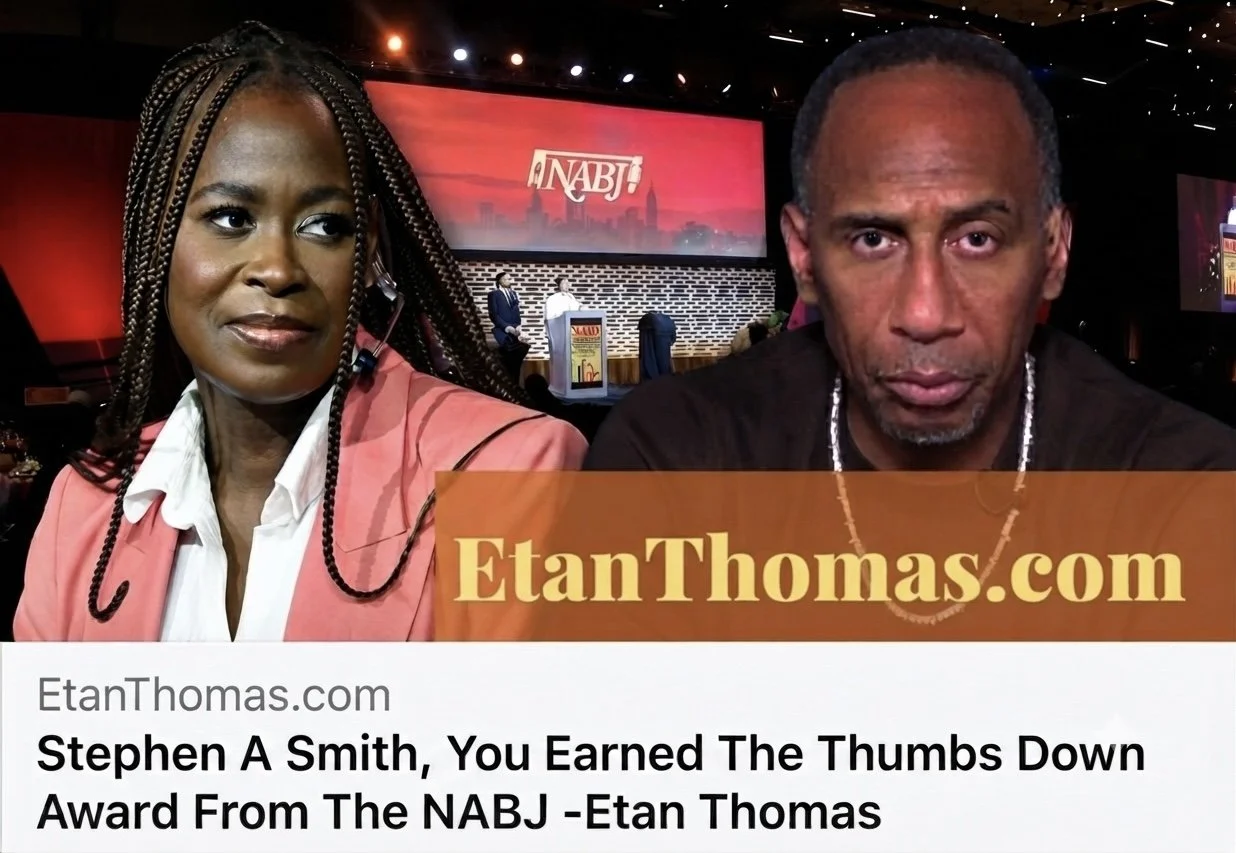
Dear Stephen A. Smith,
After receiving the National Association of Black Journalists’ Thumbs Down Award, you responded by defending your record.
You tweeted:
> “The work speaks for itself. I will continue opening doors, creating opportunities, and making space for Black journalists and beyond.”
You also laid out your history with NABJ and talked about the work you have done throughout your career. You spoke about your sisters and your mother and the tremendous love, respect and admiration you have for them.
And Stephen A., all of that is well and good.
But none of it actually addresses why you received the award.
NABJ describes its Thumbs Down Award as recognition given for “especially insensitive, racist or stereotypical reporting [or] commentary” about the Black community, or conduct contrary to the organization’s goals. The criticism surrounding your award specifically centered on what NABJ described as a recurring pattern of disparaging commentary toward prominent Black Women in politics, sports and media.
So listing the Black People you’ve helped doesn’t answer the criticism.
Listing your history with NABJ doesn’t answer it.
Talking about how much you love your mother and sisters doesn’t answer it.
Because nobody said you don’t love Black Women.
Nobody said you’ve never helped Black journalists.
Nobody said you haven’t opened doors.
Those again are straw man’s arguments. This has become a pattern with you I see as you utilized this same tactic when you responded to my article back in May where I explained why Many Black People didn’t like you. Which I addressed on my podcast The Rematch
The topic at hand is what you have repeatedly done with the enormous platform you possess.
The Bible repeatedly teaches that correction should not automatically be treated as an attack. Proverbs warns that rejecting discipline and correction leads toward foolishness, shame and destruction, while listening to correction leads toward wisdom and understanding.
And Stephen A., you are falling into that category right before everyone’s eyes.
Because rather than seriously examining whether there could be something to what so many Black journalists, athletes, commentators and viewers are telling you, your instinct is to take offense and defend your resume instead of examining the actual critique.
And then you went to Sean Hannity.
That part was especially telling.
Why, after receiving criticism from the National Association of Black Journalists, would validation from Hannity’s audience be the place you turn? You have publicly described Hannity as a longtime friend, and your relationship with him goes back many years. But friendship doesn’t erase the larger question: why seek affirmation in a media environment that has so often been hostile toward the very Black Voices raising concerns about you?
Bishop Talbert Swan put together an extensive list of receipts and the cumulative pattern deserves an answer rather than a dismissal.
https://www.instagram.com/p/DcL4O7dOjTN/?igsi=MWVmdjlxeG8zZXZndw==
The examples raised include your public scolding of CongressWoman Jasmine Crockett. Stephen A, Donald Trump is the most disrespectful President this country has ever seen. The most disrespectful politician this country has ever seen. In a society that has always disrespected Black Women, for you to have the audacity to tell a disrespected Black Woman (who is a U.S. Congresswoman) that she needs to adopt a more professional approach, focus on negotiating to get results for her constituents, tone down her aggressive rhetoric and be more respectful in the face of the most disrespectful person on earth, would've sufficed as the sole example of you winning this award, but there are so many more.
They include your clashes with Monica McNutt over WNBA coverage, your attacks on Sheryl Swoopes while vigorously defending Caitlin Clark, your criticism of Angel Reese, and your public disputes with Black Women across sports, politics and media.
Then there are the broader criticisms: your defense of Jerry Jones after the resurfacing of the 1957 Little Rock integration photo; your arguments that racism isn’t as prevalent as some claim; your repeated suggestion that Black voters should seriously consider Republicans; your criticism of Kamala Harris; and your repeated appearances alongside Hannity.
Some of those are political disagreements. You have every right to them.
But you can’t simply wave away the entire criticism as politics.
Your disparagement of Black Athketes isn’t political.
Threatening or talking down to athletes because they challenged something you said isn’t political.
The radically different energy you often display depending upon who is sitting on the receiving end of your criticism isn’t merely political.
That’s racial.
That’s cultural.
That’s about power.
And that’s precisely why people are talking about a pattern rather than one isolated opinion.
You have publicly attacked, not critiqued which is your actual job, but publicly disparaged and demeaned Kwame Brown, Terrell Owens, Stephon Marbury, Kevin Durant, Kyrie Irving and Jaylen Brown, among others, with a level of aggression that has become part of your television persona.
But when Donald Trump publicly disrespected you, something interesting happened.
Trump called you:
● “an arrogant fool”
● “a low IQ individual”
● “dumb as a rock”
● “totally unqualified” to run for political office
● “a loudmouth huckster”
Those aren’t paraphrases. Trump actually used those words publicly.
And suddenly the temperature seemed different.
You told CNN you weren’t offended and explained that attacking the intelligence of people who challenge him is Trump’s “default position.” You later said publicly that Trump had every right to fire back at you.
And that’s where people notice the contrast.
Where was the Stephen A. who has consistently eviscerated Black Athletes on national television?
Where was that same venom?
That same indignation?
That same theatrical fury?
That same willingness to question somebody’s character, intelligence, professionalism or worth?
Because we’ve certainly seen that Stephen A. before.
Jemele Hill has made a broader version of this point about the noticeable difference in how you discuss Black women such as Jasmine Crockett, Kamala Harris and Michelle Obama compared with the grace you sometimes extend elsewhere.
https://youtu.be/sY8eU3A2M-Y?is=Vt3BSEC-vdQKZO9Y
And when you speak about certain Black women, there are moments when — whether you realize it or not — you begin sounding remarkably similar to the people whose shows you repeatedly visit at Fox.
And yes, Stephen A., I know you aren’t going to like this analogy.
But remember Samuel L. Jackson’s character Stephen in Django Unchained?
Remember the difference between the way he addressed the enslaved Black People on that plantation versus the way he addressed the white people who held power?
Remember the image of Stephen hugging and crying when Leonado Di Caprio’s character was dying ? Not insert your face for Stephen and Trump’s face for Di Caprio.
That’s the uncomfortable analogy people are seeing every time you speak about Black Athletes with so much venom but have a much softer and respectful tone with athletes of a lighter hue. That’s the nauseating image that comes to mind every time you passionately and emotionally defend Trump.
Let me be clear; I’m not saying you’re that character. I’m talking about the difference in posture — aggression toward people who look like you, followed by a noticeably different posture around people who don’t look like you.
That’s what many people see.
And you can’t answer that by telling us how many HBCUs you’ve helped.
It isn’t about that.
You can financially support HBCUs and still deserve criticism.
You can mentor young Black Journalists and still deserve criticism.
You can create jobs for Black People and still deserve criticism.
You can adore your mother and sisters and daughter (who is a star by the way) and still deserve criticism for the way you publicly discuss other Black Women.
Two things can be true simultaneously.
Nobody has to erase the good you’ve done to examine the harm people believe you’ve caused.
In fact, the more powerful your platform becomes, the more important that examination becomes.
You have spent decades telling athletes that accountability comes with the territory. You’ve told coaches that. You’ve told executives that. You’ve told politicians that.
Well, Stephen A., it comes with your territory too.
When Monica McNutt challenged your WNBA coverage, that was an opportunity for reflection.
When Sheryl Swoopes pushed back against narratives surrounding Caitlin Clark, disagreement didn’t require public ridicule.
When Black Journalists criticized your treatment of CongressWoman Jasmine Crockett, that didn’t automatically make them political operatives.
When Black Viewers notice that the volume seems to go up when you’re chastising Black People — particularly Black Women — but somehow gets adjusted depending upon who’s sitting across from you, dismissing everybody as haters doesn’t make the observation disappear.
And when the National Association of Black Journalists gives one of the most successful Black broadcasters in American history its Thumbs Down Award, maybe the first response shouldn’t be:
Look at everything I’ve accomplished.
Maybe it should be:
Why are they saying this about me?
Because you’re absolutely right about one thing, Stephen A.
The work does speak for itself.
But so do the receipts.
So does the criticism.
So does the pattern.
And so do the people you’ve publicly attacked.
And let’s be honest Stephen A, there are a lot of reasons the NABJ could’ve named you as one of their recipients of the Thumbs Down Award.
They could’ve cited the numerous times you vehemently defended Donald Trump who has proven himself time and time again to be exactly what Jemele Hill called him in 2017 on then twitter which is a white supremacist.
They could’ve cited the way you defended Charlie Kirk and praised the Yankees for honoring him. The same Charlie Kirk who in 2023 said that Michelle Obama, Joy Reid, Rep. Sheila Jackson Lee, and Justice Ketanji Brown Jackson, “You do not have the brain processing power to otherwise be taken really seriously” and that they had to, “steal a white person’s slot” to be taken seriously. If we listed all of the times Charlie Kirk made hateful, racist remarks about Black People, we would be here all day.
They could’ve pointed to your decision to give your massive platform to people pushing inflammatory narratives about Nolan Wells and his family—including allowing the accusation that Nolan’s own parents ‘don’t care about him drowning’ to be said on your show. Think about the weight of that statement, Stephen A. These are parents who buried their 18-year-old son and have publicly fought for answers about what happened to him. You yourself previously said your heart went out to Nolan’s family and that ‘we need to find out what happened to that young man.’ Yet you then provided a national platform where Nolan’s grieving parents could have their motives and their love for their own son questioned in such an ugly and personal way. There is a difference between allowing opposing viewpoints and allowing grieving parents to be personally disparaged while they are still searching for answers about their child.”
They could’ve pointed to your willingness to share your platform with people like Steve Bannon in 2025. The same Steve Bannon who formerly ran Breitbart, which he famously described as a “platform for the alt-right.” Even Ben Shapiro, who worked at Breitbart, acknowledged that the alt-right included actual white supremacists and white nationalists and criticized Breitbart’s later promotion of that movement.
Or you platforming known white supremacist Ben Shapiro for a lengthy face-to-face interview in March 2025, including a debate about George Floyd and Derek Chauvin. Shapiro has a long history of white supremacist commentary but here he is on your show, not challenged as if he is on the hot seat, but welcomed as if you are an ally to them.
They could’ve pointed to your repeated criticism and dismissal of Black Lives Matter, or the stunning irony of you—someone who has built an enormously successful career by speaking loudly and unapologetically about issues far beyond the boundaries of sports—telling Black sports journalists who criticized Donald Trump that “we are stepping out of our lane.” Stephen A., how exactly do you tell other Black journalists to stay in their lane when you have made an entire second career out of leaving yours? You discuss presidential politics, race, crime, immigration, culture and virtually every major political issue in America.
They could’ve also revisited your criticism of Black Men wearing hoodies and the troubling respectability-politics message behind suggesting that what Black Men wear somehow contributes to how society perceives or treats us. Any one of these controversies could have warranted serious criticism from an organization whose mission includes advocating for Black journalists and challenging the very stereotypes and double standards that Black People continue to confront in American media.
But Stephen A., none of that was listed as reasons why you received the award, although it could’ve and actually should’ve been. But the NABJ, focused solely on
your treatment of and public commentary about Black Women in particular, and yet that is the criticism you seem least willing to actually confront. Instead of addressing what was said, examining why so many Black Women found it harmful, or even considering whether there might be something worth reflecting on, you responded by presenting your résumé. You pointed to the doors you’ve opened, the opportunities you’ve created, your history with the NABJ, your love for your mother and sisters, and your record of supporting Black Journalists.
And Stephen A., all of those things can be true. You can love and respect the Black women in your life. You can have helped Black Journalists advance their careers. You can have opened doors that were previously closed. But none of that automatically absolves you from criticism about how you have publicly spoken about other Black Women. Your accomplishments are not a rebuttal to the criticism; your résumé is not an answer to accountability. The question isn’t what you’ve done throughout your entire career. The question is whether you are willing to honestly confront the specific behavior that earned you the Thumbs Down Award in the first place.
I was at the NABJ conference in Atlanta last weekend sitting on a panel that examined the strained relationship between athletes and the media. It was a powerful discussion.
And of course your name came up as exhibit A, and the word accountability kept coming up. The media needs to be held accountable for their words. The power of the pen. The reckless nature some members of the media, not all, but far too many utilize in covering athletes because it receives clicks and attention. The fact that members of the media who utilize those tactics can’t be shocked and surprised when athletes have a negative feeling toward them.
Stephen A, Self-examination doesn’t erase your accomplishments. It doesn’t diminish the doors you’ve opened or the young journalists you’ve helped. If anything, having the humility to examine criticism would strengthen that legacy.
Because if one person tells you something, perhaps they’re wrong.
If two people tell you, maybe they’re biased.
But when journalists, athletes, commentators, social media, Black Women, Black Men and finally an organization dedicated to Black Journalists are all pointing toward variations of the same pattern, at some point you have to stop asking why everybody is attacking you and start asking whether there is anything they’re seeing that you refuse to see.
You’ve built a career demanding accountability from everybody else.
Now accountability has knocked on your door.
The question isn’t whether you’ll yell louder than the people knocking.
The question is whether you’ll finally open the door of accountability.