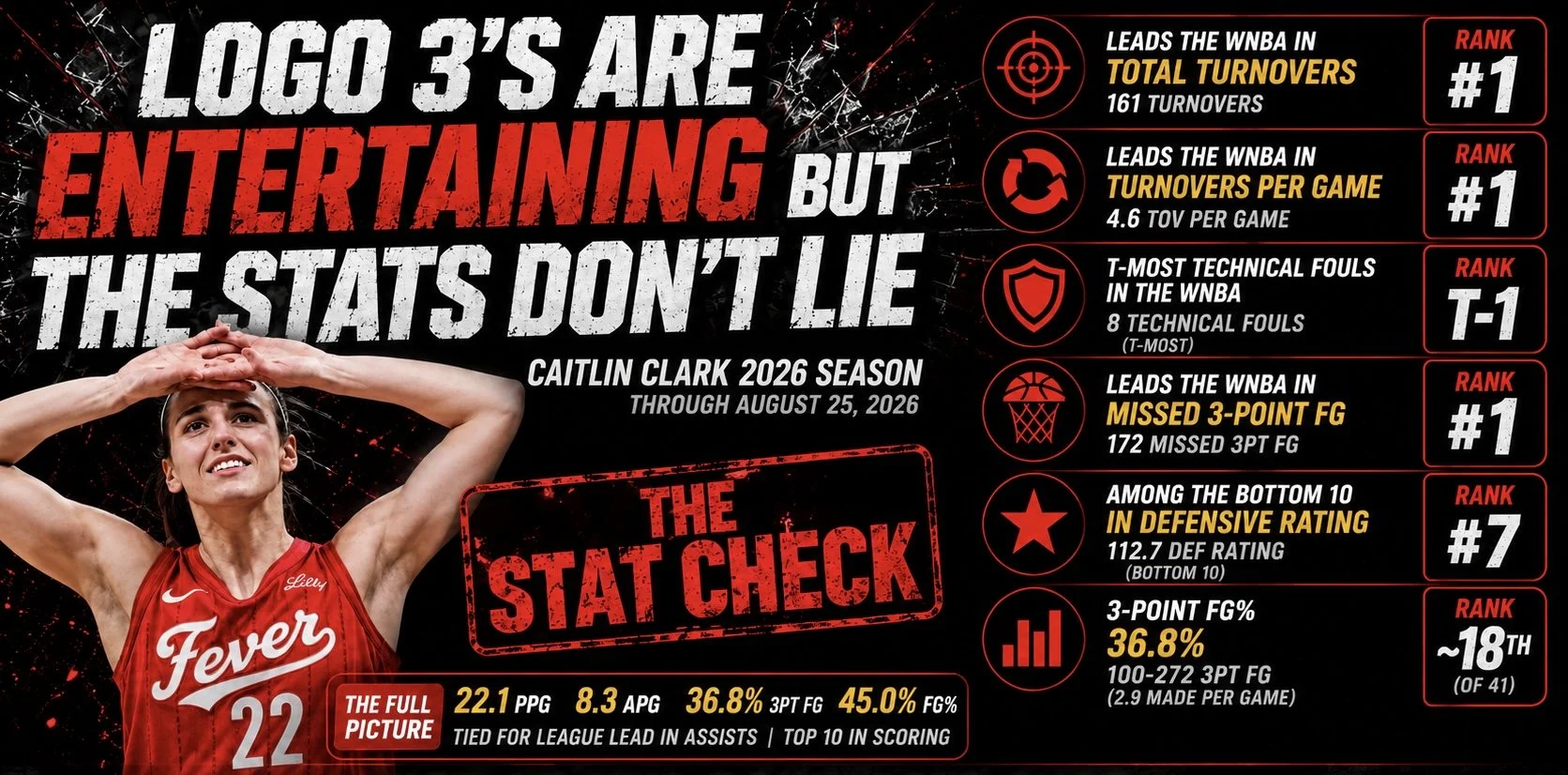
There is no denying that Caitlin Clark is one of the most entertaining players in basketball. The logo threes are spectacular. Her passing can be breathtaking. She can take over a game offensively, and when she gets hot from 30 feet, there aren’t many players in the world who create that kind of electricity.
She deserves credit for all of that.
But MVP isn’t the Most Entertaining Player award.
And once we move beyond highlights, logo threes, social-media clips and television ratings and examine the entire body of work, I don’t believe Clark has a stronger MVP case than A’ja Wilson, Olivia Miles, Kelsey Mitchell or Paige Bueckers.
First, let’s correct one talking point. Clark does not have the most 30-point games in the WNBA this season. A’ja Wilson does. Wilson already had 11 such games as of August 21, while Clark has added another explosive 37-point performance since then.
What Clark does have is an extraordinary collection of scoring-and-passing accomplishments. Her latest 37-point, 10-assist performance gave her a WNBA-record fifth career game with at least 30 points and 10 assists. That’s incredible and should be celebrated.
But again: look at the full picture.
Clark is averaging 22.1 points and a league-leading 8.3 assists, which are absolutely elite numbers. She’s third in the league in scoring average. But she also leads the entire WNBA with 161 turnovers. The next-highest player has 126. That’s a 35-turnover gap between Clark and second place.
Then compare her overall impact with the other candidates.
A’ja Wilson is in another universe statistically. She’s leading the WNBA at 26.0 points per game, while ranking among the league’s best rebounders and shot blockers. She also leads the league in Win Shares. CBS noted that Wilson was averaging roughly 26 points, 9.5 rebounds and two blocks while shooting better than 50% from the field and 40% from three. That’s MVP production on both ends of the floor, not simply offensive fireworks.
Kelsey Mitchell has a fascinating argument because she’s doing it on Clark’s own team. Mitchell is averaging 24.8 points, compared with Clark’s 22.1, and leads the entire WNBA with 967 total points. She’s also second in the league in Win Shares, while Clark ranks 19th. Mitchell recently extended her remarkable streak to 23 consecutive 20-point games.
Then there’s Olivia Miles, who is doing something remarkable as a rookie. She’s averaging approximately 20 points and 6.2 assists, shooting over 40% from three, and playing a major role for a Minnesota team with the league’s best record. Her efficiency and team success have put her squarely into the MVP conversation.
And Paige Bueckers is averaging 20.6 points per game while sitting sixth in the league in total scoring. Her team’s record hurts her MVP argument considerably, but if we’re discussing the league’s elite individual performers, her name belongs in the conversation.
That’s why my argument isn’t that Caitlin Clark isn’t great.
She is.
It isn’t that the logo threes aren’t entertaining.
They absolutely are.
It isn’t even that Clark doesn’t have an MVP-caliber offensive skill set.
She clearly does.
My argument is that an MVP evaluation has to account for efficiency, turnovers, defense, consistency, winning and overall impact — not simply the moments that generate the loudest reaction on social media.
Ironically, the current MVP odds actually have Clark third, behind Wilson and Miles and ahead of Mitchell and Bueckers. So people can reasonably disagree with my ranking.
But if I’m casting an MVP ballot based on the full picture, I’m putting A’ja Wilson, Olivia Miles, Kelsey Mitchell and Paige Bueckers ahead of Caitlin Clark.
Because logo threes may win the highlight reel.
But the stats don’t lie.